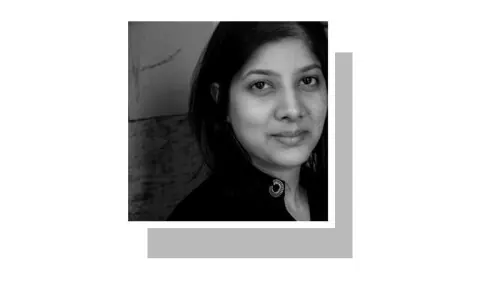
Sundus, on fighting for Fatima’s chance to hear

A week after Fatima Raza’s first birthday, her parents discovered she was deaf.
Before that day, they did not have the slightest inkling that she had what doctors say is ‘profound deafness’.
“She was doing baby talk and engaging with toys that have musical sounds like regular kids,” says her mother Sundus Munir.
What they didn’t realise at the time, however, was that Fatima was responding to the visual element of toys – a bright light or eye-catching image – and had no reception of sound at all.
Sundus had her tested.
“The hearing evaluation [brainstem-evoked response audiometry] – revealed that Fatima could not hear anything. So if she stood next to a jet engine, maybe she would hear something very faint,” says Sundus.
The revelation shattered the family. Plunged deep in denial, they went for a second test that confirmed their fears: Fatima was born deaf.
Sundus describes the harrowing course of coming-to-terms with the predicament. “I was unable to speak from shock,” she says.
“I could not even say the word ‘deaf’ when I spoke about Fatima till last year. But one must accept it. You have to use the word and come to terms with it. If I can’t accept that she is deaf, how can she be okay with it?”
Her mind was clouded with dreary thoughts of her daughter’s future: was she ever going to attend a regular school? Would she enjoy going to birthday parties? Would she make friends? What if she got bullied?
“I could not even say the word ‘deaf’ when I spoke about Fatima till last year,” she says. “But one must accept it. You have to use the word and come to terms with it. If I can’t accept that she is deaf, how can she be okay with it?”
In the face of a tremendous test of strength, Sundus made a silent vow to fight back.

The lack of accessible support groups or guidance did not deter her; she rejected a doctor’s theory that Fatima would never be able to speak and immediately launched into researching options.
“We could have spent £40,000 to figure out why this happened to us, but we opted to invest in the path ahead,” she says.
Sundus and her husband decided to get Fatima a cochlear implant, a device that does the work of the damaged part of the ear by providing sound signals to the brain.
“We could have had the surgery in the US or India, but we didn’t want to run back and forth between countries in case something happened. We opted to have it done here [Pakistan] by Dr Sohail Awan who has a 98% success rate with 600 of these surgeries,” Sundus explains.
She describes the moment Fatima heard sound for the first time. “It was very emotional for all of us. The doctor turned on the implant and knocked on the table… Fatima reacted. She started to cry. We were all crying.”
From relying solely on sign language and being unable to talk, three years after her procedure Fatima is able to speak and hear mechanical sound. She has overcome the initial unwillingness to wear the device for very long and now takes it off only to charge it while she sleeps at night.
“She is hearing just fine,” Sundus beams. “My deaf daughter can now sing nursery rhymes. She can say full sentences.”
“She is a very stubborn child. It works for her because she is a fighter. Whatever situation you put her in, she accepts it slowly but eventually she gets there."
Although her speech isn’t very clear, Sundus says it is work in progress. Fatima is a fantastic lip reader, and her mother jokes that she may have a promising career as an FBI agent.
“We all ask, ‘why us?’ But things like this teach us to be compassionate and strong. Why not us?”
As the mother of a daughter who was born with a disability, Sundus understands that parents go through a negative phase. “You cry in your own time. But then you need to stop feeling sorry for yourself. You need to help your child.”
Sundus’ current battle is to fight for educational inclusion for Fatima, as several schools are reluctant to take on hearing-impaired students.
But even with her sight set on that daunting challenge, Sundus works hard with Fatima’s speech and confidence to give her the best shot at competing with other children her age.