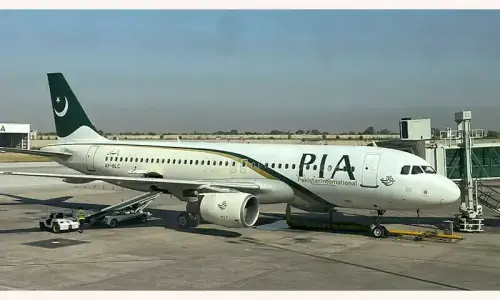
VARIOUS suggestions are being made to make PIA operations viable including even banning other airlines from operating out of Pakistan with no consideration of its consequences.
This calls for going through PIA’s annual financial statements and to compare the same with a few competitors. The financial statements 2014 were picked up as only one player out of the peer group had published its 2015 performance report/balance sheet.
The good news is that PIA reduced its losses to Rs30.7bn as compared to Rs45bn last year, which can be largely attributed to lower fuel costs and foreign exchange rate gain. The idea is to understand PIA’s numbers in comparison to its peers as the following table tries to do.
-------------------------Table-------------------------
These numbers show that PIA is not the only airline that is losing money in this group as the airline industry is an exceptionally competitive business. However, it is quite clear that PIA has the highest employee per aircraft and is overstaffed and has been a victim of political hiring.
PIA has an inefficient fleet of aircraft or it has a faulty process to procure fuel. This is a major issue and no business can remain sustainable if it has major operational inefficiencies
In a similar vein, PIA has higher employee costs as a percentage of its revenue as compared to Emirates and Turkish airlines. This becomes more worrisome as all the airlines concerned belong to countries that have higher per capita income than Pakistan.
PIA requires more employees to run each aircraft and spends more on employees to earn each unit of revenue even though it should have a competitive advantage in terms of labour costs.

Similarly, PIA has a higher fuel cost as a percentage of its revenue as compared to the peer group. It may be argued that the airline from the Middle East might have a competitive advantage over PIA in terms of fuel costs. This clearly shows that PIA either has inefficient aircraft or it has a faulty process to procure fuel. This is a major issue and no business can remain sustainable if it has major operational inefficiencies.
It takes 13pc more out of its revenues to run its aircraft than Turkish airlines, which clearly makes it uncompetitive. Bringing these costs down can really turn around the direction of the organisation. This problem was more acute in 2013 when fuel costs accounted for 58pc of the revenue and this might again happen if the oil prices bounce back.
Comparing the financial charges of these airlines, PIA is clearly at a disadvantage because of its financial history and its current state of affairs. It not only spends far more on financial charges as compared to its revenues but digging deeper one realises that the spread that PIA is paying on its debt is also substantially higher than its peers. This raises the issue that PIA needs a large scale financial restructuring so that its debt can be brought down to a sustainable level.
Looking at these numbers, there is no doubt that PIA requires a major overhaul as no country can afford to give handouts amounting to $450m, especially one which needs heavy external and domestic borrowings to manage its fiscal and balance of payments deficits.
We can only hope that the government will try to make PIA a self-sustaining service organisation by taking the right measures.
Published in Dawn, Business & Finance weekly, February 15th, 2016