ISLAMABAD: Participants of a consultative meeting on Friday, chaired by Prime Minister Nawaz Sharif at his office, decided to form a steering committee headed by the prime minister to oversee implementation of the China-Pakistan Economic Corridor (CPEC) project.
The meeting, which was attended by representatives from all political parties and provinces, was held to allay concerns and reservations over the construction of the economic corridor.
Editorial: CPEC transparency
PM Nawaz also directed fast track implementation of the western route of the corridor, as all political parties agreed to support the project, said a statement from the PM Office.
All four chief ministers will be included in the committee, which would meet every three months to review progress on the project’s implementation.
The statement added that the prime minister will personally supervise implementation of the western route of the CPEC to ensure that reservations of all political parties are addressed with consultation.
Read: CPEC-triggered investment
The meeting discussed the details of the project, its route and the setting up of economic zones at strategic locations.
In the meeting it was agreed that the location and setting up of the economic zones along the CPEC would be done in consultation with the provinces.
Talking to reporters after the meeting, Planning and Development Minister Ahsan Iqbal said the corridor will benefit all provinces.
“The premier will head a committee comprising all four chief ministers, federal ministers and chief secretaries to oversee implementation,” he said, adding that PM Nawaz has assured the political leadership their reservations will be addressed.
Also read: What’s ‘P’ in CPEC?
Iqbal said work on the western route will be initiated after consultation with the political leadership.
Senator Mushahid Hussain Syed mirrored Iqbal’s comments, and added that the entire political spectrum had expressed support for the government in completing the mega project.
JUI-F chief Maulana Fazlur Rehman said the “western route will be given top priority.”
“It will comprise four lanes and may be extended to six.”
Khyber Pakhtunkhwa Chief Minister Pervez Khattak said PM Nawaz has assured to address “our reservations.”
He said details of the project will be shared with all stakeholders, adding that the provincial government will “extend full support to CPEC.”
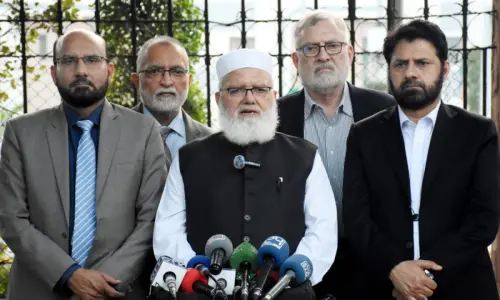
Jamaat-i-Islami chief Sirajul Haq termed the meeting as “fruitful.” He said his party had forwarded their “proposals for CPEC.”
Concerns on CPEC
The $46 billion project spearheaded by China, which is expected to transform Pakistan’s economy and benefit the entire region, created divisions among political ranks in Pakistan after it was alleged that the “original route” of the corridor had been changed.
Earlier this month, QWP chairman Aftab Ahmad Khan Sherpao said the federal government would face strong resistance if the original route of CPEC was changed.
“We appreciate and support this mega project and we want to make it a success as soon as possible. But the federal government seems to be less interested in the western route.”
KP Chief Minister Pervez Khattak had also recently warned his government won’t allow the CPEC to pass through the province if the centre denied the due share in its route to the latter.
Read: CPEC won’t pass through KP if due share denied: Khattak.
Khattak lambasted Punjab for ‘trampling on the rights of smaller provinces’ and said everything was being manipulated to benefit the country’s largest province.
These apprehensions of political parties in Balochistan and KP rose from fears that the federal government will focus only on the eastern route, rather than the western route that mostly passes through KP and Balochistan.
But the federal government has time and again assured all parties that both routes will be developed as planned and all stakeholders will be made part of the decision making.
CPEC: background
The CPEC is a 3,000-kilometer network of roads, railways and pipelines to transport oil and gas from Gwadar Port to Kashgar city, northwestern China's Xinjiang Uygur autonomous region, China Daily reports.
Know more: China’s new silk road: What’s in it for Pakistan?
Proposed by Chinese Premier Li Keqiang during his visit to Pakistan in May 2013, the CPEC will act as a bridge for the new Maritime Silk Route that envisages linking three billion people in Asia, Africa and Europe.
An official agreement on the corridor was signed between the two countries in May this year during President Xi Jinping's historic visit to Pakistan.
A flagship project of the Belt and Road initiative as well, the CPEC intends to revive the ancient Silk Road with a focus on infrastructure, and constitutes the strategic framework of bilateral cooperation.
The project links China's strategy to develop its western region with Pakistan's focus on boosting its economy, including the infrastructure construction of Gwadar Port, together with some energy cooperation and investment programs.
It also involves road and railway construction including an upgrade of the 1,300-km Karakoram Highway, the highest paved international road in the world which connects China and Pakistan across the Karakoram mountains.
The CPEC will reduce China's routes of oil and gas imports from Africa and the Middle East by thousands of kilometers, making Gwadar a potentially vital link in China's supply chain.