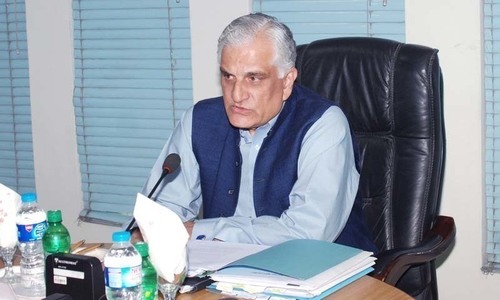
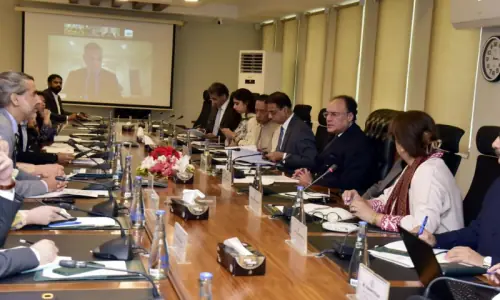
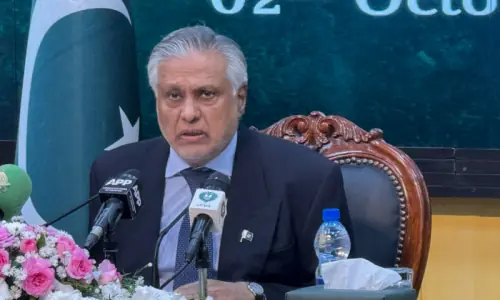
ISLAMABAD: The Federal Minister for Climate Change, Zahid Hamid, who calls himself a “longstanding environmentalist”, addressed a group of journalists at a media workshop on Tuesday in Islamabad organised by the Heinrich Boll Foundation on the outcomes of COP21 which recently took place in Paris.
He pointed out that “Prime Minister Nawaz Sharif was the only head of government who was there at the Earth Summit (in 1992) when the original convention was finalised and he was fortunate enough to be there for the actual implementation of the new agreement that was being finalised in Paris”.
According to the minister, “Pakistan sent a good delegation to Paris with officials from the ministry of climate change, ministry of foreign affairs, representatives from the KPK government and representatives of NGOs. We had our experts following all the streams in the negotiations. As a member of the Group of 77 (group of developing countries) and China, we were basically following them and we were indicating our view points as well”.
He called the Paris Agreement a “compromise between conflicting positions; between developed and developing countries. There were a number of plus points: the global community came together on an agreement and it has high ambition… they agreed to limit the global average temperature rise to 1.5 degrees”.
However, when it comes to the principle of common but differentiated responsibilities which separate rich countries that caused climate change from poorer countries which still need to develop, the words in the “light of different national circumstances” have been added and the words “historical responsibility” omitted.
For now, the peaking (of carbon emissions) will take longer for developing countries – allowing the continuation of emissions. There are no obligations on developed countries, which however are expected to take the lead. The minister pointed out: “Future emission reductions are now in the hands of the largest polluters”. There is also no road map for rich countries to provide more financial support than the $100 billion promised by 2020. The words “liability or compensation” have been taken out of the agreement and no sources of additional funding identified.
According to the minister, “We are in the process of ratifying the agreement. We will take it to the cabinet for approval. We have held internal meetings in the ministry and we are preparing a plan of action to implement the agreement and dovetail it with the Vision 2025 document and the National Climate Change Policy”. The minister said they are looking into establishing a climate change authority or commission and there are plans to strengthen the ministry of climate change, which is now an extremely important ministry for the future. “We have also commissioned a detailed study on our green house gas emissions and after the China Pakistan Economic Corridor (CPEC) is finalised we intend to study the projections of green house gas emissions and that will enable us to indicate our Intended Nationally Determined Contributions accurately in the coming months”.
“We now have to move much faster to implement provisions of this agreement. We need to prepare projects that will allow us to easily access finance that will become available – post 2020 we expect it to go up substantially”. In reply to a question on the coal power plants that will be set up under the CPEC, “coal power plants are essential from our point of view. Coal stocks are going down but there is no complete ban and we are looking for best possible technology, which keeps emissions to a minimum. We have huge coal reserves lying in the ground… Once we determine our peak levels under CPEC we will see what we can bring down and abide by our commitment. We have set up the largest solar power part in world and we will also be promoting renewable energy; our energy mix is designed in such a manner so we can meet requirements of energy and adhere to our commitments”.
As for the question if the old coal technology belonging to China might be used in Pakistan once the Chinese began decommissioning their coal plants, he replied: “China is a recognised power and it is not looking for a way to dispose its old technology – we are looking for the best technology and I am quite sure they will ensure that the technology they give to us will be of the highest possible standard”.
Published in Dawn, December 23rd, 2015