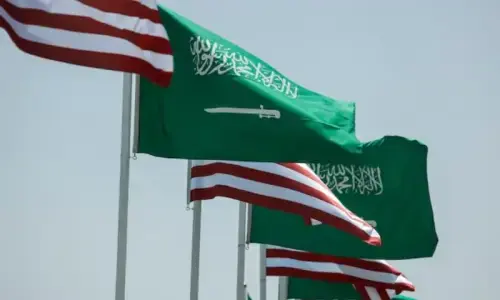
ARE we or are we not a part of the newly formed Saudi-led ‘Islamic military alliance’? The contradictory statements emanating from the foreign ministry have deepened the puzzle. First, there was an appearance of surprise when the Saudi deputy crown prince named Pakistan among the 34 countries in the alliance. ‘We were not consulted’ was the reaction from the foreign secretary. A day later, the Foreign Office endorsed the Saudi move. What caused this sudden turnaround is anyone’s guess.
It is yet another foreign policy disaster in the making. The confusion exposes the complete disarray in our decision-making process on a critical foreign policy issue that has direct bearing on our national security. Sartaj Aziz, the adviser on foreign affairs, told the Senate that he was still unaware of the full details of the new alliance.
How come we have committed ourselves to a coalition in whose formation we had no role? We are not even clear about its tasks. Is it not bizarre that the adviser had no clue about the assurance of support we might already have given to the Saudi rulers?
The Saudi role in fighting IS that has established its brutal rule in parts of Iraq and Syria has remained dubious.
The Saudi move seems to have taken many other Muslim countries, supposedly part of the alliance, by surprise. Except for Turkey and some Gulf countries, that are already part of the Saudi-led military coalition against Yemen, no other Muslim country has endorsed the ‘Sunni’ alliance.
Although the declared objective of the proposed military alliance is to fight global terrorism, it is largely seen as a means of promoting the Saudi agenda of dividing Muslim nations along sectarian lines and solidifying an anti-Iran coalition. The Saudi role in fanning the Middle East civil war has hugely contributed to the rise of the militant Islamic State group that the alliance is supposed to counter.
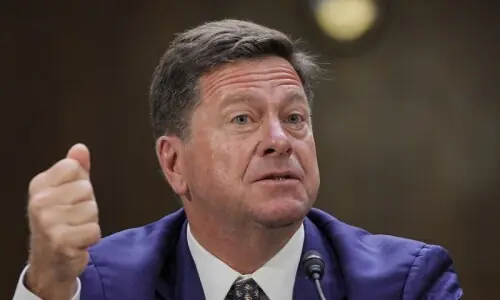
Unsurprisingly, the announcement of the formation of the alliance came from none other than the young Saudi deputy crown prince Mohammad bin Salman who is believed to be responsible for his country’s disastrous military entanglement in the Yemeni civil war. The detail of what task the new alliance would undertake has deliberately been left vague. Saudi officials maintain that the modalities of how to move forward remain to be worked out. Predictably, Iran has been excluded from the list of the members.
One of the objectives of the new alliance is to fight IS. But the Saudi role in fighting the militant group that has established its brutal rule in parts of Iraq and Syria has remained dubious. The kingdom has been actively backing some of the extremist Islamist groups the elements of which later became a part of IS.
The power struggle in Syria that has left millions of people dead or homeless has largely turned into a proxy war between Iran and Saudi Arabia with other countries on one side or the other too. While Iran backed the government of Bashar al-Assad, the Saudis provided financial support to rebel groups that also included the Al Qaeda-affiliated Jabhat-al Nusra.
Furthermore, the Saudis are actively supporting some of the Sunni rebel groups fighting the Iranian-backed Baghdad government. The kingdom has actually played no role in fighting IS so far. Instead, its focus has been diverted to Yemen, where it is combating what it says are Iran-backed Houthi rebels.
Meanwhile, the role of Turkey, one of the main sponsors of the alliance, also raises questions about Ankara’s commitment to fighting IS. It is not only Russia that has accused Turkey of buying oil from IS that helps the terrorist group finance its war. Some other reports also confirm the allegation of Turkey looking the other way as foreign IS fighters cross into Syria.
Turkey has also been actively involved in the Syrian civil war supporting some of the Saudi-backed Sunni rebel groups. Its Kurdish separatist movement that has roots across the border in Iraq and Syria dictates Turkey’s position on the Syrian war. For Ankara, perhaps, the IS presents a counterweight to the Kurds in both Iraq and Syria.
Interestingly, Saudi officials maintain that one objective of the alliance is to fight the scourge of terrorism in Iraq, Syria, Libya, Egypt and Afghanistan. But the names of three of them — Iraq, Syria and Afghanistan — are absent from the list of alliance member countries. Iraq is obviously left out because of its closeness to Iran. So, how is the military alliance going to fight terrorism in those countries without their participation?
In this situation, the proposed military alliance would only sharpen the polarisation in the Middle East along sectarian lines, further worsening the civil war and making it more difficult to counter IS. For sure, there is an urgent need for uniting Muslim countries to fight terrorism, but a Saudi-sponsored military alliance with its headquarters in Riyadh can hardly bring together a Muslim world that is divided along sectarian lines. How can any counterterrorism alliance work with some member countries directly or indirectly supporting some of the militant groups?
In fact, it is hard to see a country that itself has long been seen as the sponsor of extremism and radical Islam — that is a major source of militancy in various countries, particularly in Pakistan — as a leader of the alliance.
The funding for radical madressahs involved in the sectarian conflict is believed to be coming from Saudi charities.
Surely, terrorism in all its shapes cannot be eradicated without countering extremism. It does not require a military alliance; rather it is the end of the sectarian-based proxy war in the Middle East that should be on the decision table.
Joining the Saudi-led military alliance spells more trouble for Pakistan waging its own war against militancy. In some ways, it has already been drawn into the proxy war with both Saudi Arabia and Iran reportedly recruiting Pakistani fighters for their respective proxies involved in Syria and Iraq. Pakistan’s joining the Saudi military alliance could just make the situation totally combustible.
The writer is an author and journalist.
Published in Dawn, December 23rd, 2015


Comments (28) Closed
Pakistan should inform alliance leaders that Pakistan role will be restricted to fighting ISIS only.
Great policy - Join the alliance and then ask questions later!
Good article. Agree coalition is like theifs opening police station
Not flawed , with Pakistan as part of this alliance it has now become the strongest military group in the world , far superior than NATO.
For the record, unlike Pakistan which Saudi Arabia has included without prior consultation, recently the Saudi ambassador in Kabul, has approached the Afghan ministry of foreign affairs, extending his government's invitation for Afghanistan's participation in the Saudi-led coalition. The Afghan government's responce has been that it would carefully examine the pros and cons of the aforementioned invitation. Saudis are not Afghanistan's benefactors and proud Afghans are not at their beck and call as some countries are at their's
@Fazal Karim and where will Pakistan fight ISIS
On the face of it, the Saudi led military alliance seems to be thoroughly ill considered, and more of a panic stricken reaction than a carefully planned strategy to combat the ever growing threat of the IS. Pakistan had been wise, not to have gotten involved in the Yemen imbroglio; and should tread its path carefully even now. The sharing of strategic intelligence is the most that it should offer, a contribution that our well reputed agencies are equipped to make.
The Saudi role in fighting IS is NOW NOT 'dubious'. With Putin's intervention the situation has been clarified. He has brought Iran & Saudis (Shias & Sunnis) together though Turkey has unnecessarily made Putin an enemy. There is now a Saudi-Iran agreement 'made in Russia' that is secret but it is obvious to me that the Asad Family will retain some power that will be shared with Sunnis in Syria. Unlike the destruction & havoc created by the USA in Muslim countries, Russia's intervention promises that the Middle East inc. Iran will find a solution to their problem without alien dictation.
@Zak Joking or simply delusional?
Good article.
I agree with the analysis and the conclusion. This alliance is a foul attempt to make a block against countries with Shia population (Iran, Iraq, and Syria). It would increase the sectarian violence in Pakistan. It is a pity, that we have no full time active Foreign Minister. It leads to an ad-hoc, non-professional performance, as shown by the Government of Pakistan in this particular case!!
"...It is yet another foreign policy disaster in the making. The confusion exposes the complete disarray in our decision-making process on a critical foreign policy issue that has direct bearing on our national security."
Yes, the confusion has to be there because despite having a population of nearly 200 million you do not have a Foreign Minister and your Foreign Service has many outsiders in its cadres, people who should not have been there at all. What can be expected of such a tainted diplomatic service?
Pakistan should keep distance fro anything Saudi whether its Saudi Money or alliance....apart from Hajj Pakistan should not came near to any thing Saudi
Its good news that Pakistan is now a member of an anti-terrorist alliance... Pakistan has been fighting terrorists for many years now... perhaps some alliance members can contribute their troops to fight along ours, facing bullets and IEDS. It would be even better, and a mark of true leadership if some Saudis came over and fought along the side of innocent civilians and brave soldiers... for a change.
Indeed! status of Pakistan is oblivion in Saudi made alliance.
Excluding Iran means its a sectarian conflict clearly. Pakistan should stay out of it or bring Iran in. But fighting Daesh is not what the Saudis have in mind I suppose.
Good article, Pakaistan should stay away from anything Saudi led/sponsored.
I appreciate you in spite of the difficult situation you always try to speak truth. Come what may in Mideast the wars have become the wars between the two sects ,although such a phenomena never existed in Islamic history . The casualties of the war are the general innocent public at large their suffering are unprecedented, I think this is what others were trying for in centuries .This is a recipe for the disaster of Muslim countries in times to come.
The ideal country to lead the coalition is definitely Iran
@Zak
The ones who set your house on fire are also the ones who are asking you for water to douse the flames. That makes sense!
I agree to the honourable writer that the alliance is a fail and bizarre sort of alliance completely. It would not be able to gain its ends without the concerted participation of the key countries where the action is going to be taken.
It is better for Pakistan to bring order at home. Pakistan should avoid taking part in the conflict that is purely on sectarian basis. Such an alliance shall prove bitter for Pakistan in the long running.
@Zak , It is good to be enthusiasts and possess high spirit but not knowing the realities turns into stupidity.
The political and military leadership ruling Pakistan have ties and are visiting Saudia on regular basis.Surtaj Aziz once announced that they joined the Saudi alliance,now came up with different remarks.What ever the writer writes or Pakistanis want,does not matter,the ruling military and political figures will do,what they want they want to do. They are nor even committed to act against Molana aziz in the centre of Capital,a subsidiary of isis,the alliance of a husband and a wife,openly challenging the writ of military and govt of Pakistan.How can they really fight the real isis.
@Fazal Karim Your idea ok in theory but not in practice....
better to let them do the fighting themselves....there are over 200 million Arabs in the neighboring countries....why us?
@Nisar Ali :Very true Nisar.Your following comment, "They are nor even committed to act against Molana aziz in the centre of Capital,a subsidiary of isis,the alliance of a husband and a wife,openly challenging the writ of military and govt of Pakistan.How can they really fight the real isis."is the true picture of "HOW"serious they are in taking any action against DAESH's proxy just sitting behind their backyard.I am sure they will never venture to decide going for a fight in the unknown and unfamiliar territory just to please their long time benefactor ignoring the dangerous consequences which are unfathomable.
@Muzaffar Ali Truly this is one of the worst foreign policy disasters. The so -called alliance is built along sectarian lines. It will spell disastrous consequences to our own war against TTP and other militants groups. Pakistan has hardly learnt a lesson form its past mistakes. Instead of profiting from the opportunity of closer ties with Iran with sanctions lifted and we are like a mercenary falling in the Saudi trap. Saudis have for decades promoted extremisn thought their primitive version of Islam and the entire Muslim world especially Pakistan is suffering at their hands. Pakistan need to wake up and stay neutral in the witches brew of the Middle East war which is entirely the making of Saudis. Even IS has been funded and nurtured by the Saudis. The decision to join this nefarious alliance should be taken to the parliament to avoid another major foreign policy disaster.