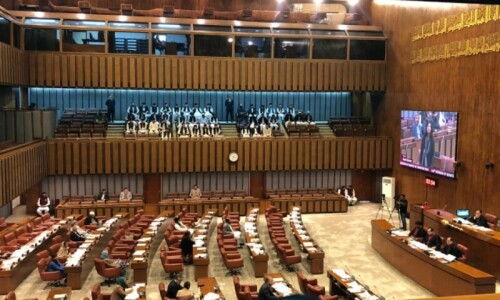
UNITED NATIONS: Pakistan called on Tuesday for enhanced cooperation among states and other stakeholders to strengthen security in the use of information and communication technologies (ICTs), saying their malicious use in cyberspace posed risks to users.
“Use of cyberspace by criminals and terrorists cannot be permitted and we, as responsible members of the global community, must ensure that such elements do not operate in cyberspace to further their nefarious designs,” Information Technology Minister Anusha Rehman Khan told the UN General Assembly, which is considering the application of ICTs ten years after the historic world summit.
“The growing menace has serious implications for international peace and security,” she said in a speech to the 193-member Assembly’s high-level meeting.
Also read: Dear Anusha Rehman, congratulations on winning the UN award, but...
Ms Khan urged a collective approach to confronting attacks against critical infrastructure and underscored the need to optimise cyberspace management under an institutional framework.
“The global community needs to agree on minimum standards of protection for human dignity, particularly for women and children being the most vulnerable communities of the cyberspace,” she said.
Opening the meeting, Mogens Lykketoft, president of the General Assembly, said that since the 2005 World Summit, when leaders had declared a common desire and commitment to build a people-centred, inclusive and development-oriented information society, huge progress had been made in the information and communications technology (ICT) field. However, challenges remained, such as the digital divides among countries, as well as Internet security and human rights issues, he said.
Secretary General Ban Ki-moon raised some concerns, noting that while more than 80 per cent of households in developed countries had Internet access, two out of three in developing countries did not.
Additionally, 200 million fewer women than men had access.
He urged the international community to bridge those divides, especially in light of the new 2030 Agenda for Sustainable Development, which included information and communications technology targets.
In her remarks, Anusha Rehman Khan said that ICT was a true driver of economic growth.
Broadband proliferation was Pakistan’s policy priority and it had achieved notable progress in that regard through legislative and policy frameworks.
Published in Dawn, December 17th, 2015