This piece was originally published on September 24, 2015.
Following our annual family tradition, this year too, we visited the cattle market to buy a sacrificial animal for Eid-ul-Azha. It was hot and humid at Asia’s biggest cattle market on the Super Highway, but meeting a camel stylist for the very first time, more than made up for it.
The market has a separate section reserved for camels, where hundreds of camel are brought every year from traders in rural Sindh.
“Buyers prefer to look for the most beautiful ones,” says Naeem, a trader and owner of camels. “We sought the services of camel barbers like Ali Hassan to give the animals a 'makeover' to appease buyers and onlookers.”


Ali Hassan is a farmer by profession. He belongs to a small town of Tharparkar and has learned the art of camel hair designing from his forefathers. Every year, he visits Karachi a few weeks before Eid-ul-Azha in a bid to get a reward for his unusual artistry.
Ali says he charges two to three thousand rupees for one camel and it takes about four hours to complete one side of the camel 'hair cut'. Having earned 30,000 rupees last year, he anticipates good money this year too.
He further said, “I can make more than 15 types of different designs. Depending on the size and colour of the camel, I make the design that most suits the animal.”
In a huge market of more than 500 camels, there were only a few camel hair stylists. Not every trader believes that a hair cut will enhance the value of their animal.
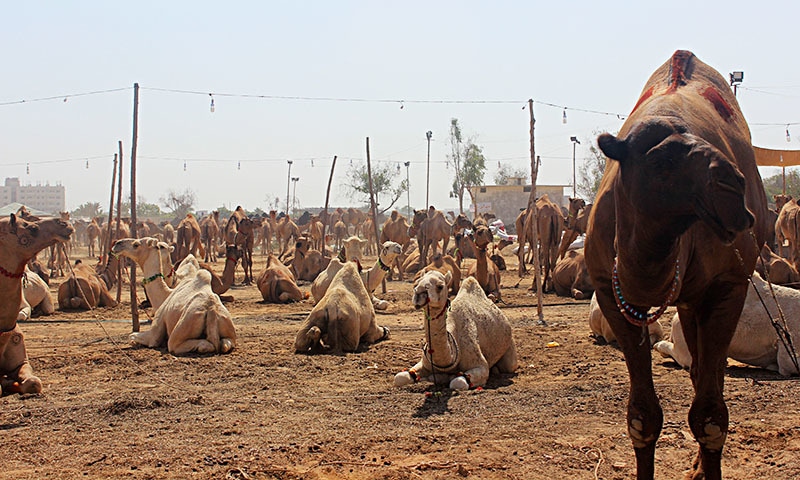

But Rizwan Junejo, a trader from Tharparkar has brought in 15 camels for sale in the cattle market and plans to get hair cuts for all his animals. According to him, a customer looks for an attractive animal and a hair cut makes the animals stand out.
“I can easily charge 10-15,000 more for a shaved camel as compared to a simple one,” says Junejo.
I decided to stay on to observe the four-hour long process. Ali started by taking a few measurements with the help of a rope, so that both sides of the camel’s body looked similar.
He then made an arc followed by a big circle in the centre and squares in the upper and lower part of the circle; then, he went on to carve intricate designs inside the big circle and squares.
Interestingly, all he used was a small rusted pair of scissors as his tool.


—All photos by author