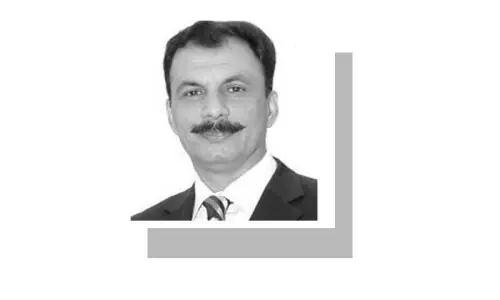
KARACHI: Abdul Hafeez Pirzada, the celebrated author of the country’s unanimously adopted Constitution, was a lawyer par excellence who quite belatedly discovered that his unparalleled skill inside a courtroom did not pose to him the risks of the political path he had adopted in his youthful years that put him in the corridors of power and as well as behind bars.
Born to a famous family of lawyers in Sukkur on February 24, 1935, the late Pirzada was the third generation of lawyers since his grandfather who was among the first of Muslim lawyers in that part of British India. However, his father Pirzada Abdul Sattar was the first in the bloodline to enter politics. He was a federal minister in the first cabinet of Pakistan and later enjoyed a brief stint as the chief minister of Sindh in 1953.
Pirzada’s association with former prime minister Zulfikar Ali Bhutto began in 1959 when he started appearing before the West Pakistan High Court from the late Bhutto’s chamber. Later, he set up his own firm and then became eligible to practise in the Supreme Court.
Also read-Editorial: Abdul Hafiz Pirzada
He secured around 64,000 votes in the Malir constituency of Karachi in the first general elections in 1970 and later became the information and culture minister of the country when Mr Bhutto assumed power in December 1971. He won the same seat in March 1977’s controversial general elections.
During his tenure in the information ministry, the PTV ‘mistakenly’ showed the footage of the army’s surrender in East Pakistan that sparked immense public outcry and the tape was never re-telecast.
He was made law minister where he headed a committee comprising lawmakers from the government and the opposition to meet the demand of the country for a constitution that it did not have for a quarter of a century since its inception.
Pirzada was considered to be an all-rounder in Mr Bhutto’s cabinet where he headed numerous portfolios, including the provincial coordination ministry, and went on to present the last budget of the PPP’s second term in June 1977. In between, he represented the government in a committee with Maulana Kausar Niazi and Attorney General Yahya Bakhtiar to finalise the 2nd amendment to the Constitution with the opposition’s Mufti Mahmud, Prof Ghafoor Ahmad, Maulana Shah Ahmad Noorani, Chaudhry Zahur Elahi, Ghulam Farooq and Maula Bakhsh Soomro to declare Ahmadis non-Muslim.
He was in Mr Bhutto’s team for talks with the opposition Pakistan National Alliance to settle outrage over alleged rigging in 1977 elections and reached an agreement, but that could not stop Gen Ziaul Haq’s military coup three days later. He was jailed along with several other politicians.
Pirzada also made all-out efforts to save his leader’s life in a murder case. In March 1979, after rejection of the review petition by the Supreme Court, he filed an application to the president praying him to change death sentence to life imprisonment. He then told the press that Bhutto had told him that he was prepared for death and would not file a mercy petition. However, later Bhutto’s sister Sherbano Imtiaz filed a mercy petition for her brother’s life.
In early 1980s, Pirzada nearly joined Mumtaz Bhutto, Mehrullah Mengal, Afzal Bangash and others to form a platform – Sindhi, Baloch, Pashtun Front – to vie for a confederation system in the country. Before formally quitting the PPP, he and Mumtaz Bhutto received show cause notices by the leadership as they published literature supporting the confederation system.
A few years later, Pirzada as a low-profile politician decided to devote himself to his profession, in which he represented almost every big shot irrespective of the client’s positions and political affiliation.
Imran Khan was his last client weeks before his demise to represent him in the judicial commission.
He represented Benazir Bhutto and Asif Zardari in graft cases, retired general Musharraf’s regime in Steel Mill privatization case and Shahbaz Sharif and Dr Mubashir Hassan against Mr Musharraf and Benazir Bhutto in the NRO case.
He remained a busy lawyer until he was admitted to a hospital in London where he died on Tuesday.
Published in Dawn, September 3rd, 2015
On a mobile phone? Get the Dawn Mobile App: Apple Store | Google Play