0
0

“My East is your West” is the title given to an exhibition that signals the challenging of fixed perceptions and viewpoints. And this is quite in sync with what Pakistan’s contemporary art icon Rashid Rana’s artistic discourse tends to be about. This time round his narrative found a place in the inspiring and almost mind-boggling environs of the 56th Venice Biennale, alongside Indian artist Shilpa Gupta. Both of these internationally recognised artists came together through the facilitation of the Gujral Foundation in India, in partnership with the Italian-based Fondazione Antonio Mazzotta.
The concept of the exhibit was conceived by Gujral Foundation’s director and founder Feroze Gujral, with Natasha Ginwala as curatorial advisor. Presented as a Collateral Event at the Biennale, the work of the artists was showcased at the Palazzo Benzon, in the centre of Venice on the Grand Canal. Neither Pakistan, nor India has a permanent pavilion at the Venice Biennale, but this presentation has made history by not only giving artists of both countries a rare opportunity to have a presence in one of the most prestigious international art events but also by bringing together these two ‘arch enemy’ countries for the first time, on a common platform.
As Gupta reiterates, “Whilst we share a common history, we have a divided present. We are now working together for a more collaborative future.” Whether or not such collaboration can actually impact the politically charged differences between India and Pakistan is a debatable matter, but it does indeed reinforce the ethos of art as a medium that can surmount human differences. Political and geographical boundaries may divide humanity, but art highlights the shared commonalities of human beings.
Rashid Rana and Shilpa Gupta collaborate to highlight the shared commonalities of the sub-continent, writes Saira Dar
“My East is Your West” responds to the current theme — “All the World’s Futures” — of the Venice Biennale that was put forth by its curator, Okwuii Enwezor. Its narrative, as envisaged by its curators, attempts to “re-imagine the complexity of the Indian subcontinent in the 21st century — unfolding amid rationalised terror, circuits of hyper mobility and social imagination.”
The artistic practices of Rana and Gupta are brought together, and are yet separate entities, and involve a variety of mediums including drawing, video, installations, digital printmaking, text-based pieces and performance. Here one would focus on Rana’s work, which is displayed over five rooms in the Palazzo Benzo. The installation in ‘Room Three’ is of particular interest, as it connects through communication technology to a replicated space here in Pakistan, as a public space in the heart of Liberty market Lahore. The entire series by Rana, labelled as “Transpositions”, were conceived and executed between 2013- 2015.
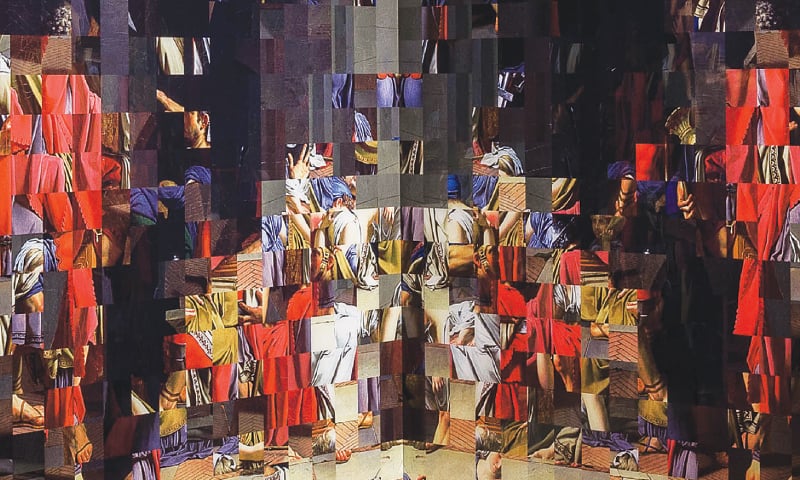
“The War Within” in Room One, is in Rana’s quintessential style where digital images are put together like an intricate mosaic to create a photomontage. It reassembles the 18th century Neo-classical painting ‘Oath of the Horatii’ by Jaques Louis David, and appears to comment on the concept of overt gestures of loyalty to the state. Works in the other rooms engage the viewer in three-dimensional experiences, creating illusions of double spaces, both imaginary and located elsewhere. This concept is epitomised in the aforementioned ‘Room Three’, where audiences both in Venice and Lahore are given an opportunity to interact.
Having visited the Liberty Market site, one can vouch for the fascinating impact of the experience. The Lahore project was facilitated by the Lahore Biennale Foundation (LBF) in partnership with a local Bank. The LBF is particularly committed to promoting art in Pakistan’s public spaces, and indeed this project is a feather in its cap.
‘The Room Three’ project is poetically titled in Urdu as “Shuhuudo-o-shaahid-o-mashhuud” (The viewing, the viewer and the viewed). The installed structure allows viewers to not only see a part the interior of Palazzo Benzo, but one wall becomes the instrument of instant communication through digital technology. Imagine a full scale ‘Skype’ style communication of the Lahori viewers with those in Venice and vice versa.
The constant influx of viewers at the site in Lahore bore testimony to the success of this venture and the camaraderie of people from “East and West”, as they cheerfully waved to each other, was a unique and endearing experience. While talking to Rashid as he stood in Venice, and the writer in Lahore, it was obvious that his simple contention that “human beings are quite the same all over the world” was befittingly reiterated through his creative ingenuity.
Published in Dawn, Sunday Magazine July 12th, 2015
On a mobile phone? Get the Dawn Mobile App: Apple Store | Google Play