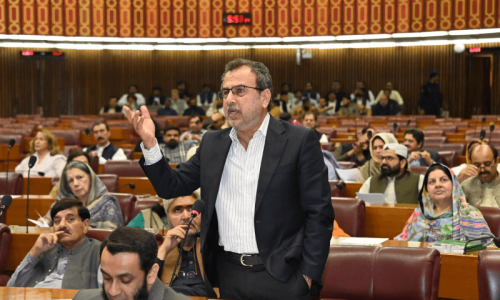
THE skies over Gilgit were lit with fireworks and rattled with gunfire for hours on Friday night as people celebrated the swearing-in of Gligit-Baltistan’s second elected chief minister, Hafiz Hafeezur Rehman, a young and energetic political activist of an area that is yet to be constitutionally recognised as a province.
Hafeez, as friends call him, inherited the leadership of the Pakistan Muslim League-Nawaz’s Gilgit-Baltistan chapter from his brother Saifur Rehman, who was assassinated outside his home in Kashrot, Gilgit city, in 2003. The killer was incensed by Saif’s efforts to build peace in the conflict-stricken Gilgit city following sectarian tensions and killings, which have characterised the area since Gen Ziaul Haq’s misrule. Saif, 36, was serving as the education, finance and revenue adviser in the then set-up.
Before assuming the mantle of the PML-N’s regional leadership, Hafeez, 45, had been loosely associated with the Jamiat Ulema-i-Islam-Fazl. A Hafiz-i-Quran, he received his early education in a madressah before graduating from the University of the Punjab. Much of his political career revolved around Muslim League politics, first as an informal political adviser to his brother and later himself as the party’s head in the region.
The newly-elected chief minister is known as a hard-working and tireless campaigner with a strong understanding of the grass-roots issues of Gilgit-Baltistan, its development challenges and political dynamics. Like his predecessor, Pakistan Peoples Party chief minister Syed Mehdi Shah, and also interim chief minister Shahjahan Mir, he comes from GB’s Kashmiri-origin community.
Hafeez in Gilgit and Akbar Taban in Skardu have been the two time-tested, steadfast pillars of the PML-N in Gilgit-Baltistan, where politicians normally switch loyalties at the drop of a hat. Hafeez’s rise to the position of the PML-N’s chief minister following a clear majority for the party in the recent elections in Gilgit-Baltistan also demonstrates the high hopes the region’s people have pinned on Prime Minister Nawaz Sharif’s promise of reforms and a development package.
Lining up a strong and capable cabinet to implement the prime minister’s pre-election directives, which include upgrading key roads and airports, developing hydropower, setting up new educational institutions, and carving out new administrative districts as well as negotiating political reforms — including a review of Gilgit-Baltistan’s constitutional status — will be high on his list of things to do.
Gilgit-Baltistan is on the cusp of enormous development opportunities as the gateway to the upcoming conversion of the Karakoram Highway into a full-spectrum China-Pakistan Economic Corridor. Given the area’s particular ethnic and religious diversity, as well as past flare-ups, the biggest challenge for the new chief minister and his team is to maintain the delicate inter-regional and inter-religious balance and harmony through the provision of inclusive, transparent and clean governance.
The writer is a policy analyst from Gilgit-Baltistan
Published in Dawn, June 28th, 2015
On a mobile phone? Get the Dawn Mobile App: Apple Store | Google Play