10
10

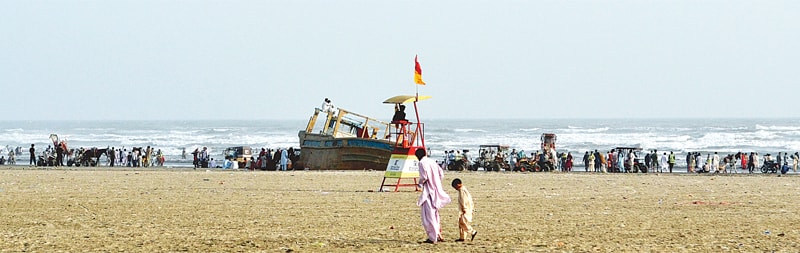 |
| A LIFEGUARD sits on a watchtower on Seaview beach thronged by picnickers.—White Star |
KARACHI: With the arrival of hot summers and stifling humidity, most Karachiites head to the seaside to dip their feet into the cool waters, splash about and sometimes plunge deeper into the sea. However, it seems the city administrative authorities have put a slight damper to their wishes by imposing a ban on swimming and bathing in the sea for six months.
Lifeguards and residents say the ban is unjustifiably long and instead of imposing arbitrary punitive measures, authorities need to bring the people and the sea closer by taking public-friendly actions.
According to Karachi Commissioner Shoaib Ahmed Siddiqi, it is better to err on the cautious side and hence the ban for six months under Section 144 (6) of the criminal procedure code.
“The sea is unpredictable during these six months. And so it is unfit for swimming,” he replied when asked why the restriction has been placed for half the year when earlier it was imposed for three months. Even experienced swimmers have difficulty in navigating the waves and “these are amateurs”, he said.
With hardly any recreation places for the denizens of the city, how are they to enjoy themselves? “Nobody is stopping them from enjoying. They can sit by the seaside, eat at different stalls but should not go into the sea as that is not entertainment,” replied the commissioner.
Keeping in view the last year’s tragedy at the Seaview beach in which around 40 picnickers drowned, he said, the ban was necessary because the police needed a legal cover to stop the people from going deep into the sea and it also served as a kind of public awareness campaign.
When it was suggested to him that better measures could have been made, Mr Siddiqi disagreed and insisted that people should just not go into the seawater. “We have lifeguards, constructed watchtowers and plan to set up more but we don’t have elaborate arrangements. It is better that one shouldn’t swim in the sea.”
Noted journalist Ghazi Salahuddin — also a member of a civil society group called the Karachi consortium which is working to revive socio-cultural activities in the city — supports the imposition of the ban but feels the authorities needn’t be killjoys and make life more difficult for the already overburdened citizens.
“During summers, the sea is definitely dangerous and the ban is necessary but it should be imposed properly. There are traps in our seas that lead to drowning incidents. Our beaches are not like those of Thailand where one can slowly go deeper and deeper without drowning. And it is a fact that our public is not disciplined to stop itself from going into the sea especially when it is choppy. However, it is not enough that law enforcement agencies take punitive action. They should not make life difficult for people. No one should be punished for simply enjoying themselves.”
He also highlighted the class issue centring around the beaches. “Even the sea has become elitist. The poor have been kept far apart from the sea. There is hardly any public transport to take the lower class to the beaches. And it should not be so. It is a marvel and a source of joy for them.”
Syed Mohammad Ahsan of the Pakistan Life Saving Association said he was surprised when he found out that Section 144 had been imposed for six months. “But I saw tickers running on a TV channel which said that it does mean people are being stopped from going to the beaches. They are being stopped from going deep into the sea.”
He also clarified that this section is applicable only for certain beaches. “Paradise Point and Cape Point have shallow water and susceptible to drowning incidents.”
Speaking about precautionary measures especially for the Seaview beach, where a large number of picnickers lost their lives, he said: “We used to have our lifeguards in Seaview till around 2007-2008 but the Defence Housing Authority administration stopped us because they disagreed with the branding of our clothing and signage. However when the drowning tragedies happened last year we were called in by the Karachi commissioner to safeguard Seaview. We explained to him our dilemma and he had it resolved. We started patrolling the beach in April. Up to McDonalds there are nearly eight watchtowers and soon we will have more on the other side of the floating ship which divides Seaview into two main parts. We have also placed several public service messages in Urdu and English. Our life guards are at the beach till 9pm.”
Mr Salahuddin says the police can be friendly with the public and instead of scolding them to use their persuasion skills. “Saving lives is necessary but we should not deny people their enjoyment of the sea.”
Published in Dawn, June 8th, 2015
On a mobile phone? Get the Dawn Mobile App: Apple Store | Google Play