Pakistan is not a failed or even a failing state, and is actually walking further away from the abyss gradually. Though it still performs poorly on many developmental and security indicators, a Somalia- or Yemen-like failure is implausible. However, Pakistan is surely a highly flailed state: flailed endlessly by both external and internal stakeholders. If anyone ever invents a Flailed States Index, Pakistan would justifiably rank near its top, unlike its dubious high ranking on the Failed (now renamed Fragile States Index.
Also read: Failed State? Not really
Externally, Pakistan is flailed for harbouring terrorists and urged to ‘do more’ against them by the Americans, much to Pakistanis’ irritation. While the flailing is excessive and one-sided in ignoring American contributions towards spreading terrorism globally, the world’s gripes with Pakistan are not entirely unjustified.
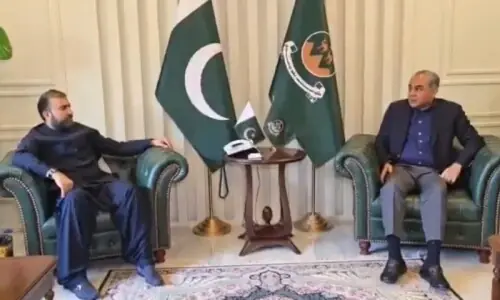
The civ-mil leaderships are now on the same page, we are told, regarding terrorism. Unfortunately, that same page seemingly is a blank page or at least an abbreviated one, as a clear, unified response remains elusive. Differences of opinion persist about ‘good’ vs ‘bad’ militants across the civ-mil divide. In popular public perception, the ‘good’ military Sharif is leading the war against terrorism while the ‘bad’ civilian Sharif is plodding along reluctantly.
One would expect Pakistan to squirm, blink and be responsive.
However, even the ‘good’ Sharif seemingly views Baloch militants, Karachi crime mafias and Pakistan-focused militants as ‘bad’ militants, but India- and Afghanistan-focused militants still as ‘good’ militants who escape the thrashing others are receiving. Meanwhile, the ‘bad’ Sharif sees some good in Baloch and even Pakistan-focused militants and wanted talks with them earlier, but likely views India-focused ones as ‘bad’ militants who hinder peace with India.
Both Sharifs remain ambivalent about sectarian militants. Consequently, while gradually winning against the Taliban and Karachi crime mafias, Pakistan is still losing against sectarian militants since it has not even started that war earnestly yet. Unsurprisingly, sectarian terrorism represents the bulk of casualties in 2015. These complex cross-perspectives between the ‘good’ and ‘bad’ Sharifs about ‘good’ and ‘bad’ militants keep Pakistan insecure and the world perplexed.
Ironically, while Pakistanis resent the external flailing, the internal flailing is actually harsher and more unfair. Internally, Pakistan is flailed for not measuring up to the standards of exceptional countries like South Korea. It is generally assumed that Pakistan at some point had a real chance of developing as rapidly as these countries and missed this easy opportunity due to bad leadership. The bulk of the blame is laid at the doors of ‘bad’ politicians. Such analysis obviously ignores the multitudes of political, social, economic and external factors which influence the developmental trajectory of different countries, explaining which would take a full article.
Take a look: Why Pakistan is not a failed state
Suffice here to say that even countries doing better than Pakistan presently like India, Brazil and Turkey have not been able to replicate South Korea’s trajectory. While Pakistan is not like South Korea today, mercifully neither is it like North Korea. To compare Pakistan with highly dissimilar countries like South Korea and worse enough to suggest half-baked alternatives to democracy based on such improper comparisons seems insensible. However, it is definitely sensible to chastise Pakistan for falling behind similar countries like India, Indonesia and, on some dimensions, even Bangladesh, and constructively demanding betterment.
In the face of such intense all-round flailing, both justified and non-justified, one would expect the Pakistani state to squirm, blink, be responsive and change track. However, impervious even to the justified element of the internal pressure for good governance and the external pressure for good neighbourly behaviour, the Pakistani state responds phlegmatically, changing not at all or at most glacially.
This obstinate stoicism reflects the low level of accountability Pakistani rulers, both military and elected, experience internally and externally. This low level of ruler accountability in turn is rooted in the very fabric of Pakistani society where most ordinary people are regularly trapped in exploitative low-accountability social, economic and political relationships with tribal leaders, landlords, religious leaders, traders, money-lenders, industrialists and criminal mafias.
An improvement in Pakistan’s performance and a reduction in its flailing will come from a governance system which is more accountable in the long term. Global experiences reveal that even highly unaccountable democratic systems ultimately become accountable with time and continuity, while unelected systems only become more unaccountable over time, before eventually collapsing. Thus, Pakistan’s future is inextricably linked with democracy, however poor its current performance may be.
The writer is a development and political economist.
Published in Dawn, May 17th, 2015
On a mobile phone? Get the Dawn Mobile App: Apple Store | Google Play