0
0

Are the times taking their toll? The quirky antics and cheeky humour once so obvious in Waseem Ahmed’s paintings has given way to a sombre narrative. His recent show at Chawkandi Art, Karachi, “In the Name of Faith” contains untitled artworks but their muted, abstracted gravity is easily understood by a viewership now so accustomed to deciphering grim realities.
Initially it was socio-political chaos in Pakistan that triggered subversive, gritty art. This was the contemporary, defiant face of homegrown art that attracted international acclaim. Today, as the turmoil escalates and the country continues to roil, some of the characteristics of this art mannerism have become pronounced, to the extent of being repetitive.
Drained of comic relief and witty barbs the art now centres on morbid visions of death and destruction referencing actual events. And the ploys / strategies of juxtaposing tradition with modernity and use of paradox, contradiction, allegory or symbolic inference to reveal/conceal issues is now so common and current in contemporary art making that it has regressed into a formula. However, ground realities are so devastating that the method still works. Formulaic as it maybe the art is still a compelling reflection of its immediate volatile environment.
Waseem Ahmed portrays ‘negative’ subjects in an amazing, subtle and complex way
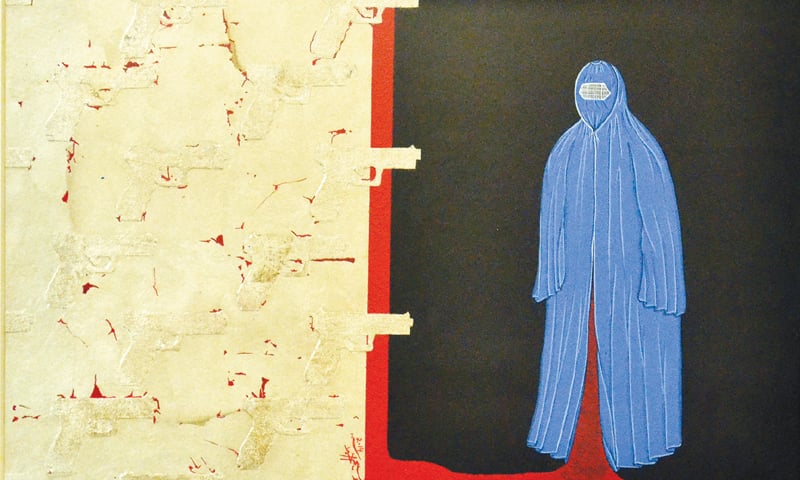
This is the new normal that Ahmed also paints in his present series. His miniature of a glowing cityscape defaced with bloody cuts and marks defines Karachi, once extolled as the “golden city” of lights, whose booming metropolis was bordered with tall palms and sandy beaches. Women in black burqas huddling behind a bullet-riddled wall and a painting of a mosque smirched with blood re-enacts the Lal Masjid imbroglio. A black bull’s eye centre inked with Arabic calligraphy and encircled with images of the Panjtan hand emblem is an instant reminder of the Hazara genocide.
Most of the works had familiar overtones. Other than methodologies the déjà vu syndrome also extends to a recurrent vocabulary of guns and grenades, blood stains and bullet holes, bomber jackets, fictional Gardens of Paradise, burqas and beards that artists are using. This imparts a degree of sameness to their expressions.
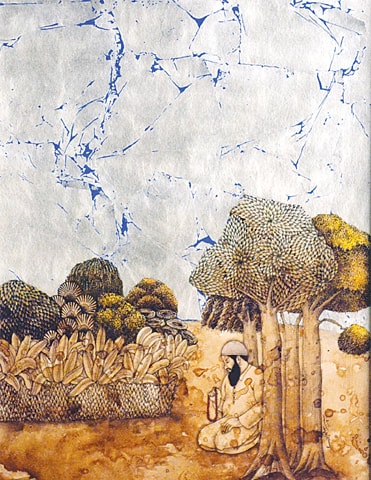
His art issues and terminology are similar as well (unlike his original and popular “Krishna Series” where the deity’s improvisations are pitted against modern goddesses like Marilyn Monroe) — but the artist in him is maturing. He renders the fine line with exquisite delicacy and paints the figure with ease and precision and whilst improvising the Mughal / Persian miniature landscape he lavishes concentrated attention on the intricacy and detail of floral and foliate pattern.
His six-week participation in project Dahlem Karkhana at Museum für Asiatische Kunst, Staatliche Museen zu Berlin, Germany (where he was termed “an outstanding representative of this art movement”) as well as exhibiting at Gowen Contemporary, Paris for the last two years has brought a fresh wave of experimentation in his present body of work.
 |
| Untitled |
Subtle and prominent use of special effects and treatments highlight and add meaning to the stories being told. Inspired by printmaking techniques Ahmed makes contemporary use of silver and gold leaf applications. Crusty and layered the foiled surfaces crackle with flakes and shards of embedded colour and crunched imprints illustrate damage and disruption.
Repetitive images of the Quaid’s mausoleum, guns and cannons embossed onto the paper are another technical variation the artist has utilised to advantage. What appears as a bland surface from afar becomes rife with meaning when repetitive paper pressed images become visible up-close. Holes punched into the paper surface alternate as bullet marks and open wounds. Areas of flat luminous colour (orange and blue) create spaces of calm in a busy picture. Concentrating only on creating random streams and clusters of Arabic alphabets he employs calligraphy as an image rather than as a textual message. Trained in the art of Khatati he writes with fluency.
Harsh realities are unsettling but when presented with grace and sensitivity they uphold the positivity of beauty. Waseem Ahmed opted for miniature painting “because this was the only medium where I could portray negative subjects like hatred, bloodshed, etc. in a beautiful, delicate and intricate way”.
Published in Dawn, Sunday Magazine, May 10th, 2015
On a mobile phone? Get the Dawn Mobile App: Apple Store | Google Play