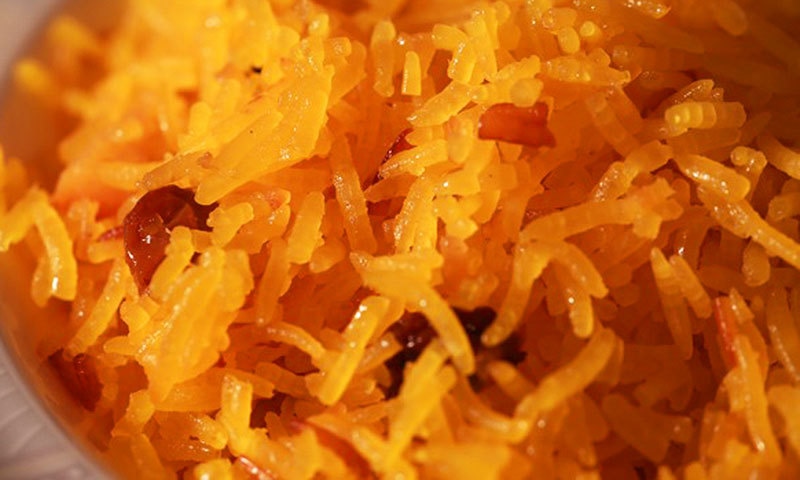


'Zarda' happens to be the simplest of desserts, defining the best of joys; a sweet delight served at shaadi (weddings), raksha bandhan (a Hindu festival celebrating the bond between brothers and sisters) and many other sub-continental celebratory occasions.
For me, zarda never held much appeal, until maturity set in and I started appreciating the subtle sweetness of diluted sugar playing magic with basmati rice, the royal fragrance of cardamom and the golden hue of our life force, the sun.
Rice desserts are an ancient cuisine; they have been enjoyed by people over a multitude of ethnicities, cultures and eras. Rice pudding can be traced back to grain pottage developed by Middle Eastern cooks.
Lizzie Collingham in her book Curry talks about 'zard biranj', the original food that evolved to the modern day zarda.
Many of the recipes, like the one for zard biranj, used large quantities of raisins and pistachios. Combinations of meat and dry fruit were common in Persian dishes. Cartloads of sultanas, dried apricots, figs, and almonds were imported into India along the new roads that were constructed to facilitate trade throughout northern India, central Asia, and Persia.
Indeed, the development of Mughlai cuisine was sustained by the availability of a wide variety of new and imported ingredients, which made it all the more delectable.
 |
By synthesising different cuisines [from Hindustan, i.e. the subcontinent, Arabia, Persia, central Asia and Europe] and importing raw ingredients, the Mughals gave the region the sweet rice delight zarda and the sweet and savory mantanjan.
Many of the modern sub-continental foods have evolved to their current form, and are greatly influenced by the cuisine prepared in the royal kitchens of the Mughals. It is well established that Akbar, the grandson of Babar, actively participated in the happenings of the royal kitchen. He enforced stringent rules of kitchen etiquette that the staff adhered to without exception.
The Ain-i-Akbari (the life chronicles of Akbar the Great, as written by Abul Fazl), categorically suggests three classes of cooked dishes, in order of hierarchy.
'Sufiyana' was considered the premium class of food; meatless and consumed by the Emperor on his days of abstinence. It included rice dishes such as zard biranj (modern day zarda) sheer biranj, khushka and khichree, wheat dishes, various kinds of lentils, some greens and varieties of sherbets and halwas.
Needless to say, zarda falls in the premium category, hence its celebratory significance in the subcontinent.
The recipe of zard biranj as chronicled by the courtier Abul Fazl in Ain-i-Akbari:
10 seer of rice; 5 seer of sugar candy
3½ seer of Ghee
½ seer of each: raisins, almonds, and pistachios
¼ seer of salt
1/8 seer of fresh ginger
1½ dams saffron
2½ misqal of cinnamon
(1 seer = 2 ½ lbs., 1 dam = ¾ oz., 1 misqal = 6.22 grams)
This will make four ordinary dishes. Some make this dish with fewer spices, and even without any.
The yellow zarda is a favoured dessert distributed at Sufi shrines that dot the subcontinent. I have enjoyed eating it at Baba Abdullah Shah Ghazi’s Shrine, Lal Shabbaz Qalandar’s Shrine and at Mongo Pir, and since, at the time, I was never a big fan of zarda, I always mixed it up with savory biryani or pulao to make a mantanjan of sorts.
When it was my time to make zarda, I asked my dear Gulzar auntie, a fabulous cook, for her recipe. Here it is, from my kitchen to yours.
 |
Ingredients
2 cups basmati rice
4 oz. butter
1 cup and 1 tbsp. sugar
1/4 to 1/3 cup blanched and halved almonds
¼ cup raisins
Pistachio (optional, I prefer not to add them)
2 to 3 tbsp. freshly squeezed orange juice
½ to 1 tsp. orange zest
4 to 6 green cardamoms
2 to 3 strands saffron (optional)
Yellow food colouring
Method
Parboil rice with yellow food colouring and set aside.
In a pan, melt butter, adding sugar and stirring for a few minutes (ensuring not to over cook), adding nuts, cardamom, orange juice, orange zest, (saffron and pistachio, if desired) parboiled rice and a little water, eyeballing the amount of water.
On adding the rice and water, initiate dum (seal pot method of cooking in steam) on low heat.
Maintain low heat for 10-20 minutes, or until the rice is fluffy and puffed.
Enjoy the warmth of simple sweet goodness like none other.
 |
Explore more food stories here.
—Photos by Fawad Ahmed