1
1


WASHINGTON: US officials on Friday announced a $20-million pilot programme to help equip law enforcement agencies across the country with body cameras.
The programme is part of a general push by American police agencies to outfit officers with cameras to provide clear recordings of arrests, and is part of a proposal by President Barack Obama last year to invest $75m to purchase 50,000 body cameras.
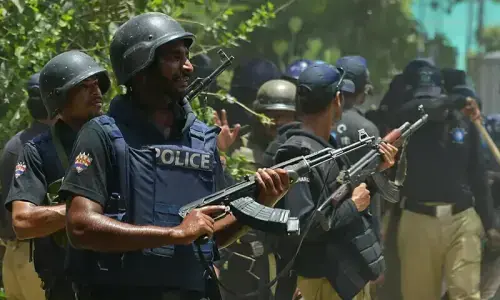
The move comes amid growing calls for transparency and accountability in the law enforcement community after a string of high-profile deadly encounters between white police officers and black men.
“Body-worn cameras hold tremendous promise for enhancing transparency, promoting accountability, and advancing public safety for law enforcement officers and the communities they serve,” the new attorney general, Loretta Lynch, said in a statement.
Riots broke out in Baltimore on Monday and protests took place in several American cities this week as demonstrators rallied against the death of Freddie Gray, a 25-year-old black man who died after sustaining severe neck injuries in custody.
The demonstrations echo protests that erupted in a St Louis suburb last year when a white policeman shot dead an unarmed black teenager, and then flared again in major US cities when a grand jury declined to indict the officer.
The Justice Department said it expects to provide 50 awards to law enforcement agencies.
Still, the roll-out of body cameras at a national level is very complicated. America has some 18,000 separate law enforcement agencies and privacy rules vary by state.
“This body-worn camera pilot programme is a vital part of the Justice Department’s comprehensive efforts to equip law enforcement agencies throughout the country with the tools, support, and training they need to tackle the 21st century challenges we face,” Lynch said.
The pilot programme will be administered by the Bureau of Justice Assistance.
“Body-worn camera technology is a valuable tool for improving police-citizen relationships,” the bureau’s director Denise O’Donnell said.
The $20m includes $17m in competitive grants for the purchase of body cameras, $2m for training and technical assistance, and $1m for the development of evaluation tools, officials said.
Published in Dawn, May 2nd, 2015
On a mobile phone? Get the Dawn Mobile App: Apple Store | Google Play