0
0
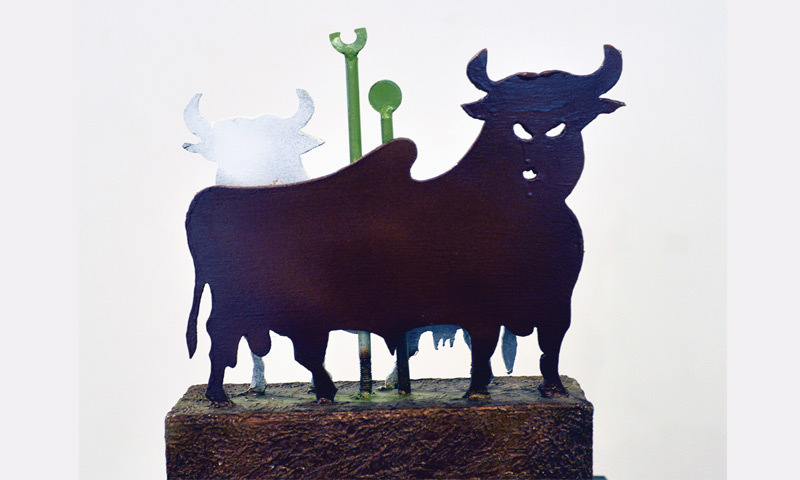

Though artists have always been excited by new media, the inclination to study historic times and art is also their passion and ardour. Anjum Ayaz is an internationally known sculptor whose work has travelled extensively all over the world. The artist is showing a collection of contemporary sculpture titled “New Dimensions of Indus Bull” at the Momart Gallery, Karachi, and his theme conveys a tribute to the zebu bulls portrayed in pottery, painting and sculpture of the Indus Valley era, discovered in excavations from Mohenjodaro.
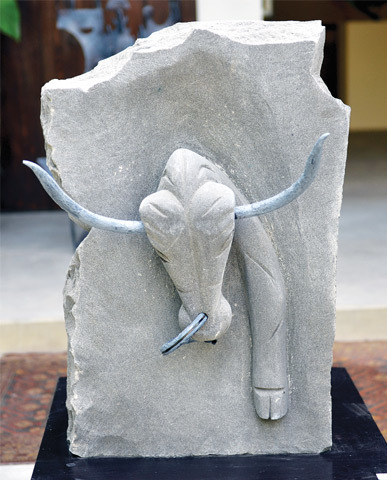
In the latest series of 30 artworks, one discovers variations in varied media; Hub stone, steel, red stone, sandstone, mixed media and drawings carved in steel. His research in the field of sculpture led to his theory of the zebu bull as the leader of the herd — symbolising the powerful clan leaders of Mohenjodaro and Harappa.
Ayaz’s work in exhibition includes powerful yet dignified representations of the zebu bull worked from Hub stone. Among the artworks displayed, he includes a recreation of the bull seal worked on a large scale with mixed media, as well as delicate, carved pieces creating dancing movements initiating a light hearted mood.
A fitting tribute to the zebu bulls of the Indus Valley civilisation by Anjum Ayaz
 |
| Birth |
The artist began his study of art at the National College of Arts, Lahore and in his third year, left Lahore and settled in Karachi where he joined the Karachi School of Art (KSA). After graduating from the KSA in 1970, he set up his studio and began carving and moulding sculpture. His work was first seen in exhibition in 1975, at the Karachi Arts Council, and selected for an exhibition shown in Montreal, Canada. He mounted his first solo exhibition in Karachi in 1976, and in 1978, held a solo exhibition in Paris. Since then Ayaz has shown his work in Japan, South Korea, US, Australia, Germany, Singapore, Holland and China — where he displayed a chiseled 18 feet marble sculpture.
Earlier this year his work was shown in Australia and in Germany.
He is an artist who prefers to exhibit his work outdoors. Karachiites will remember an exhibition at the Frere Hall in ’98 that attracted a wide audience, became a meeting place and actually encouraged people to stroll along the footpaths. This was followed by a similar event at the Shakir Ali Museum, Lahore, and in Islamabad at the National Art Gallery. Four years on, after installing large pieces in public places, Ayaz’s sculpture exhibition at the Karachi Arts Council was a welcome addition to art activities in the city.
He continued to work using a variety of stone: marble, Gadap stone, Hub stone, as well as cast iron and mixed media, expressing his involvement with smooth, figurative shapes and human emotions. The artist went on to set nine carved stone and four metal assemblages placed approximately 100 yards apart, overlooking the sea. Not aspiring to monumental forms, he carved and moulded the forms to stand on strong pedestals. The total artworks measuring between three and five feet in height were enabling people to walk around them. He explained that the work was chemically treated to withstand the changing moods of the sea. Unfortunately, the collection of stone sculpture set around the sea was destroyed by vandals, as was a fellow artist’s sculpture placed close by.
Published in Dawn, Sunday Magazine, November 30th, 2014