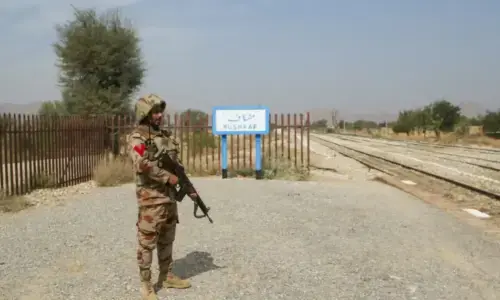
WHILE certain sections of the geostrategic community in Pakistan have always touted the geographic importance of the country and the enviable place it has as a regional trade corridor, the reality is that the state’s borders have more often proved a liability than an asset over the decades. With friction on the Pak-Afghan border having been a near constant over the last decade and the Pak-India border — or, more specifically, the Line of Control and Working Boundary with Kashmir — having flared up recently, a third border has seen a rise in tensions over the last week: Iran-Pakistan. A flurry of diplomatic activity has followed the killing of a Pakistan Frontier Corps soldier in an attack on Pakistani soil by Iranian border security forces and the Iranian side at least seems to be in a bellicose mood. This is not the first time this year that the Iran-Pakistan border has been a flashpoint: earlier the abduction of Iranian border guards caused a sharp response from Iran and small, localised incidents on the border are frequent enough.
The basic problem is well known. Iran accuses Pakistan of allowing its territory in Balochistan to be used to destabilise the Sistan-Baluchestan region in Iran — though the Iranians usually make the connection to foreign (read Western) intelligence services operating in the Balochistan and southern Afghanistan region. Yet, the problem is much wider than what Iran often claims and not necessarily uni-directional. The porous Iran-Pakistan border that runs over 900km is a magnet for smugglers — of humans, drugs and petroleum products — criminal elements and even militants. While Iran has invested more than Pakistan in shoring up its border controls, security officials here have privately over the years suggested that Iran is not above interfering in Balochistan and southern Afghanistan, especially given the Shia Hazara population in the region.
Identifying the problem though does not mean that either side has been particularly keen on solving it — not that cross-border movements in remote regions can ever really be fully eliminated, especially when there is a significant financial incentive. But surely, given the alarming potential for friction that exists on the Pak-Iran border, it is in the interests of both sides to go beyond diplomatic barbs and systematically diminish the threat. The Pak-Iran relationship has over the years been characterised by coolness towards each other, not just because of Pakistan’s closeness to Saudi Arabia and its relationship with the US, but also because neither country’s leadership has been willing to think in creative or innovative ways to improve ties. The physical links that the IP gas pipeline, surplus electricity supply from Iran to Pakistan and higher volumes of official trade would create could help make ties mutually beneficial and move them away from the present security-centric character. But for that to happen the leadership on both sides would need to show greater vision.
Published in Dawn, October 22nd, 2014