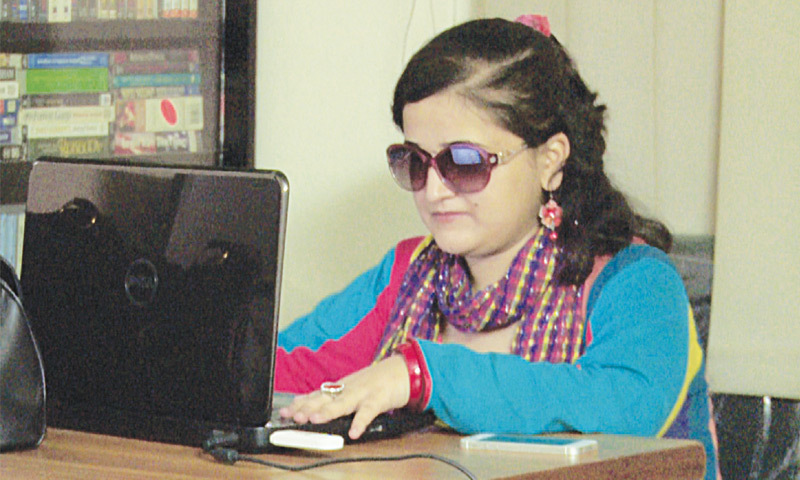
Ammara Anwar strides into a room with confidence; she is smart, articulate and very forthright. It takes a few seconds for anyone to realise that she is in fact blind.
Her ‘disability’ — though she has an aversion to this word — is visible to the world, but she, like me, believes that we are all disabled in one way or another, some of us are just able to hide it better than others.
Imagine: 10 per cent of Pakistan’s population is disabled. To give you perspective, that is like the entire city of Karachi being disabled! Yet, we don’t see them anywhere. They are hidden inside homes, many of them seldom go out, and when they do, they don’t want to attract attention and for good reason; we are a very unforgiving society.
Ammara shatters all our stereotypes about disabilities. She works with the Pakistan Foundation Fighting Blindness (PFFB), to provide education and employment to the visually impaired. “Technology has enabled us to do anything we want to,” she says. “We just have to be given the opportunity.”
In a society of competing dualisms between rich and poor, urban and rural, developed and undeveloped, it is not hard to imagine the challenges that people with disabilities must face
PFFB does everything from providing psychological counseling to informal computer training. They have a library and resources, which enable people to study right up to the PhD level. They are a one-stop shop for visually impaired people in Pakistan, which is a blessing since only 20 educational institutes exist across the country for close to four million people having visual disabilities.
If you think that is bad, consider these statistics:
There are only 17 special education institutes for the 7.2m people with physical disabilities.
There are 24 institutes present in all of Pakistan for the 1.8m people with hearing disabilities.
There are 15 institutes for the 3.6m people with mental disabilities.
Rather than lament about the sad state of affairs, Ammara and her colleagues have decided to take the challenge head on. “We have to convince people that they are an integral part of our society and they should be equipped with the necessary tools to function like everyone else,” she says.
“It is not so easy to be confident,” she says. “Some people start reciting verses from the Quran in an attempt to atone for their sins when they see us in the street. I am strong, but some people are sensitive and they stop coming out of their houses because of this.”
Ammara was born in a village near Faisalabad and moved to Islamabad when she was in grade 7. “Faisalabad was hard for me,” she says. “People behaved negatively towards me, but when we moved to Islamabad, the situation improved.”
She went on to do her BBA and then her MBA and made it her life’s mission to empower others around her to “reach for the stars”, as she says.
A blind woman has a double disadvantage in our society, because she is considered most vulnerable. Most people who have blind daughters hesitate to send them out; lest someone takes advantage of them. “If I am walking on the road holding a guy’s hand, the perception is that we are boyfriend and girlfriend. It is hard to fight against these stereotypes,” says Ammara “When I board a plane for a flight, they make sure that they send a female to hold my hand, even if I end up missing my flight.”
And it doesn’t end there … “We cannot open our own bank accounts or be issued an ATM card. When we go to get a job, we are discouraged and throughout life, many people dissuade us from getting an education using the excuse that our blindness will only get us so far,” she says.
People often ask me, what inspires me and I always say “the resilience I see in other people.” I cannot even imagine Ammara’s reality or how she feels on a day to day basis. But I am inspired to know that she has taken into her stride whatever curve balls life has thrown at her.
All of us are guilty in one-way or another; we contribute to these curve balls. Ammara doesn’t need our sympathy; she and millions like her need our encouragement.
She awaits the day that a visually impaired Pakistani is elected to the parliament; I am waiting for a day when all of us who are challenged in one way or another step into Ammara’s shoes to realise just how inspiring her attitude is.
To watch Ammara’s story: http://www.aaj.tv/aes/disabilities.html
Published in Dawn, Sunday Magazine, October 12th, 2014