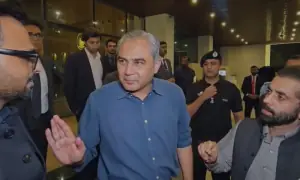
ISLAMABAD: Imran Khan is not in a forgiving mood. The Pakistan Tehreek-i-Insaf (PTI) chairman wrote to the speaker of the National Assembly on Friday, seeking the de-seating of three dissident PTI lawmakers who have not submitted their resignations alongside other PTI parliamentarians.
In letters dated September 24, Mr Khan, as party chief and parliamentary leader of the PTI, quoted Article 63A of the Constitution and asked the speaker and the chief election commissioner (CEC) to consider the seats of MNAs Nasir Khattak (NA-15), Gulzar Khan (NA-4) and Ms Musarrat Zeb (reserved seat) vacated for violating party discipline.
Know more: ‘Angry’ PTI MNAs opposed to resignation form group
The PTI chairman, in three separate letters, has informed the speaker and the CEC that the three MNAs had not complied with the party’s unanimous decision, taken on August 4, whereby all party lawmakers were to hand over their resignations to the party leadership. The PTI core committee also endorsed the decision.
However, Mr Khattak, Mr Gulzar and Ms Zeb “in disregard and disobedience of the unanimous decision of the party failed to tender their resignations and, therefore, were issued show-cause notices. Their replies to the notices were found unsatisfactory and untenable,” the letters said.
“In accordance with the PTI constitution, the PTI chairman terminated their basic membership.”
As the three have defected from the party, their seats are liable to be vacated in terms of Article 63A of the constitution, Mr Khan was quoted as saying in the concluding paragraph of the letters addressed to both the speaker and the CEC.
However, legal experts have differing opinions about the PTI chairman’s ability to invoke Article 63A.
Talking to Dawn, former law minister S.M. Zafar, who was also part of the constitutional committee that drafted the seminal 18th constitutional amendment, said, “At least 63A doesn’t cover the charge which the PTI chairman is using to seek their (the three MNAs) ousting from the house.”
The Article 63A lays down certain preconditions, which lead to disqualification on the grounds of defection. It says, “ If a member of a parliamentary party, composed of a single political party in a house, resigns from membership of his political party or joins another parliamentary party; or votes or abstains from voting in the house contrary to any direction issued by the parliamentary party to which he belongs, in relation to (i) election of the Prime Minister or the Chief Minister; or (ii) a vote of confidence or a vote of no-confidence; (iii) a money bill or a constitution (amendment) bill.”
As long as this constitutional provision is concerned, Mr Zafar insisted, neither the speaker nor the CEC could entertain the PTI leader’s application.
However, PTI’s resident legal expert and former president of the Supreme Court Bar Association, Hamid Khan, argued that according to the spirit of 63A, if someone was outside the party, he/she shouldn’t hold the seat they had won in the name of that particular party.
The issue isn’t whether the speaker or the CEC can accept the PTI’s contention. “It’s a message which the PTI intends to send out loud and clear, i.e. the party has taken a principled decision to quit the National Assembly and whosoever defies it has no future in the party.”
The PTI had 33 MNAs in the National Assembly, of whom 30 have submitted their resignations, which are currently with the speaker. Mr Ayaz Sadiq has asked the resigning PTI lawmakers to personally appear before him to confirm their notices. But the PTI argues they should be treated as one group and invited together.
It is worth noting that if Imran Khan’s resignation from the National Assembly had already been accepted, as the party insists, he would not be in a position as the parliamentary leader of PTI to even make this request.
Published in Dawn, September 27th , 2014