
SYDNEY: Deepening engagement between Australia and the United States will be discussed at high-level talks in Sydney on Tuesday (today), with analysts saying it could lead to a greater American military presence Down Under.
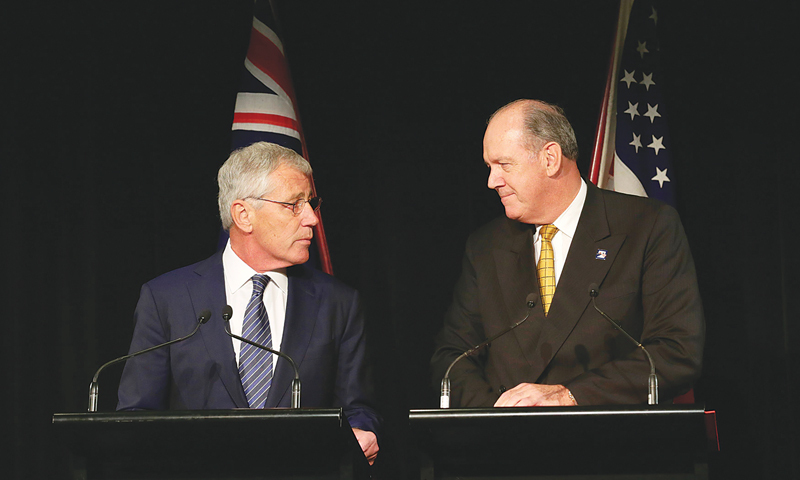
US Secretary of State John Kerry and Defence Secretary Chuck Hagel meet Australian counterparts Julie Bishop and David Johnston at the annual Australia-US Ministerial Consultations which focus on regional security and enhanced military cooperation.
The meeting is likely to confirm details of the rotation of US Marines through northern Australia, first announced by US President Barack Obama in 2011 as part of his “pivot” towards Asia, analysts say.
Under this strategy of withdrawing US military, economic and human resources from Middle East wars and deploying them to emerging Asia — referred to as a “rebalancing” — Washington plans to move more than 2,500 Marines to the northern city of Darwin by 2016-2017.
Hundreds have already arrived
“I don’t think we will see increased numbers, I think the goal will still be to have about 2,500 Marines rotating through Darwin but it’s the more nitty-gritty stuff” that will be confirmed at the meeting, said Ben Schreer, senior analyst at the independent Australian Strategic Policy Institute in Canberra.
This could include upgrading facilities in the north to better enable amphibious operations, while an agreement to intensify training between the nations’ elite forces was also on the cards, he added.
But Schreer said a concrete agreement that American destroyers or smaller warships might start rotating through Stirling base in Western Australia was likely still premature.
“I think what you might see ... is that both sides agree to continue exploring possibilities for greater or increased use of naval facilities by US warships and submarines,” he said.
“Making an announcement on upgrading Stirling, permanently basing US warships there, that’s quite a step forward and I don’t think that both sides are prepared to do that now.”
Announcement rankled China
Bates Gill, chief executive of the US Studies Centre at the University of Sydney, said the talks would be an important next step in what appeared to be “a growing degree of access and presence for American assets both human and materiel on Australian territory”.
Gill said progress had been slow but careful since the announcement that Marines would rotate through Darwin, an agreement which rankled China.
It also caused concern for some Asian neighbours who saw it as a statement by Washington that it intends to stand up for its interests in the region amid concern about Beijing’s growing assertiveness.
Despite this, US officials were clearly taking the rebalancing of US interests towards Asia forward, Gill added.
“If one looks at what America is doing, it is quite clear that the rebalance is alive and well and there is increased engagement across a number of areas,” he said, adding that this included both in military and diplomatic activity.
“I think they are looking to what next? What similar types of arrangements which would equate to increased American and Australian engagement in Australia, what similar ones can be now moved towards?” James Brown, military fellow at Sydney’s Lowy Institute for International Policy, said while previously discussion of the rebalance was broad, officials were now getting down to the nuts and bolts of it.
“I think they are really at the point now of trying to work out, well, what are possible strategies for the region and how might Australia and the US cooperate on that. And they are really starting to talk detail now,” he said.
The United States currently has only a limited deployment in longstanding ally Australia, including the Pine Gap Joint Defence Facility spy station near Alice Springs.
Australia-US Ministerial Consultations was last held in Washington in 2013.—AFP
Published in Dawn, August 12th, 2014