KARACHI: Nearly three quarters of the public regard the federal government’s performance so far as no better than average, an opinion survey conducted by the Herald in partnership with the Islamabad-based Sustainable Development Policy Institute reveals.
The survey, conducted as the Sharif-led government completes its first year in power, engaged 1354 respondents from across all four provinces and revealed a public not just disillusioned but also deeply divided on key political issues of the day.
Respondents from Sindh exhibit the greatest antipathy towards the federal government, with 26.52 per cent terming its performance ‘very poor’, the lowest ranking available.
Equally disdainful of the state of affairs in their own province, 25.24pc Sindh-based respondents deem the performance of the Qaim Ali Shah government as also ‘very poor’.
The performance of the Punjab government is regarded as the most effective among provincial governments by 65.73pc of all respondents, followed by that of Khyber Pakhtunkhwa at 16.54pc.
Only 2.44pc of all respondents regarded the Balochistan government’s performance as the best. Within the province itself, however, the number of respondents who view their provincial government’s performance as being the best is significantly higher at 15.38pc.
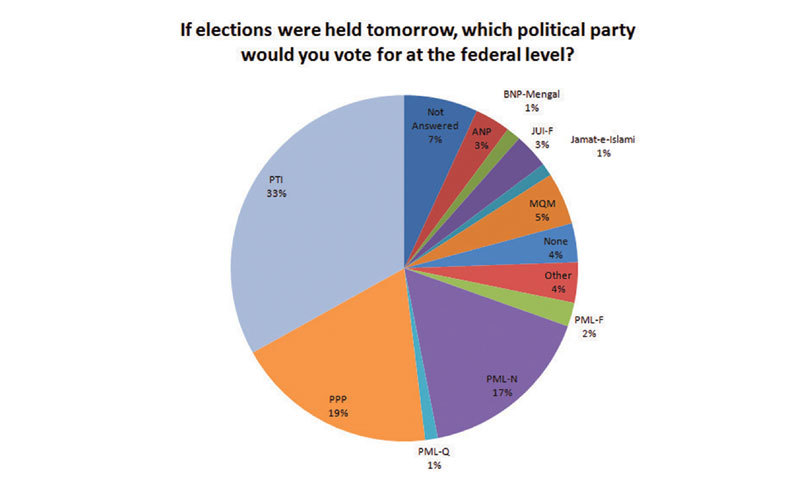 |
Almost 50pc of all respondents regard Chief Minister Punjab Shahbaz Sharif to have been the most effective chief executive in the past year, followed by Chief Minister Khyber Pakhtunkhwa Pervez Khattak (15.36pc) and Chief Minister Syed Qaim Ali Shah (11.15pc). Only 10.49pc of respondents regard Prime Minister Nawaz Sharif to have been the most effective chief executive in the past year.
A plurality (45.72pc) of respondents from across the country also believes that the ruling party at the centre has completely failed to fulfil its election promises, with a similar number (42.02pc) believing the same of the party at the helm of their respective provinces.
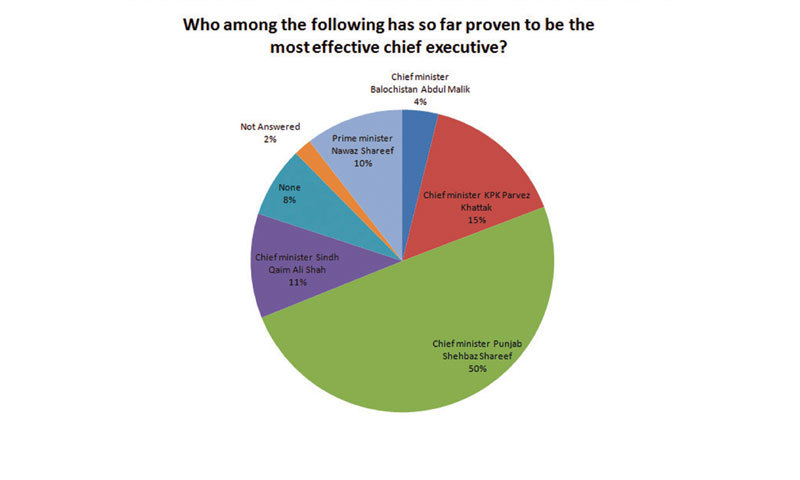
Reflective of this disillusionment and perhaps in line with the anti-incumbency sentiment exhibited during the previous general election, respondents say they will vote differently were elections to be held tomorrow. Survey results indicate that the top three parties at the federal level, were elections to be held immediately, would be the Pakistan Tehrik-e-Insaf, the Pakistan People’s Party and the Pakistan Muslim League-Nawaz--in exactly this order.
 |
According to the survey findings, there appears to be no consensus on specific political issues of concern to the country at present--such as the decision to engage in talks with the Taliban and to try Retired General Pervez Musharraf. On the former, 34pc of all respondents favour negotiations whereas 29pc are against this mode of engagement with the Taliban; a further 32.87pc admit that their views on the matter are mixed. The greatest degree of support for negotiations is recorded among respondents from Balochistan (40pc) and Punjab (38.35pc).
Forty-seven pc of respondents disapprove of the government’s decision to try Musharraf while 35.75pc are in favour of doing so. The highest degree of support for the trial is recorded among the Baloch and Pashto-speakers (59.18 and 57.89pc respectively) whereas an overwhelming majority of Urdu speakers (81.44pc) disapproves of it.
A plurality of respondents believes that relations between the government and the judiciary have improved during the tenure of the current federal government but civil-military relations have deteriorated during the same period of time.
The opinion survey, conducted during the month of May, employs a sampling methodology that closely reflects nationwide demographic trends, including those pertaining to gender, ethnicity, age and rural-urban divide. The survey sample also takes into account a variety of income groups and educational levels.
Full results of the survey will be published as a supplement with Herald’s July 2014 issue
Published in Dawn, June 7th, 2014