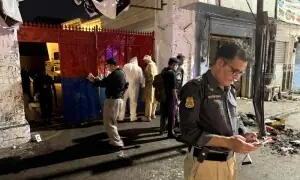
WASHINGTON: More than 1,025 civilians and 475 security forces personnel were killed in terrorist attacks in Pakistan last year, says a US report released on Wednesday.
In its country reports on terrorism, the US State Department warned that the presence of Al Qaeda, TTP, and other militant groups continued to threaten both US and Pakistani interests. The TTP claimed responsibility for the majority of the frequent attacks that targeted civilians and security personnel. Terrorist incidents occurred in every province.
The report says that in 2013 Pakistan continued to confront terrorist groups, including Al-Qaeda, Tehreek-i-Taliban Pakistan, the Punjabi Taliban, and Lashkar-e-Jhangvi, all of whom mounted attacks against police, military and security forces, or engaged in sectarian violence and criminal activities against all sectors of society.
But Pakistan did not confront Lashkar-e-Taiba, which continued to operate and raise funds with its front organisations.
Al-Qaeda and the Haqqani Network continued to plot against US interests in the region, including US diplomatic facilities. TTP posed a threat to both US and Pakistani interests, and carried out numerous attacks against Pakistani armed forces, civilians and government institutions.
The State Department noted that the PML-N government had pursued negotiations with TTP while also targeting the group militarily. Pakistan continued to support the Afghan peace process.
It also noted that Karachi continued to suffer from political and ethnic violence inflicted by different groups, including militant organisations, fundamentalist religious groups, and the militant wings of political parties.
Legislation: Pakistan’s government is in the process of implementing four significant laws passed in 2013: the National Counter-terrorism Authority Act, the Fair Trial Act, amendments to the Anti-terrorism Act of 1997, and the Protection of Pakistan Ordinance of 2013. The government continued to make use of the reinforced counter-terrorism legislation; however, the judiciary moved slowly in processing terrorism and other criminal cases in general.
UN-designated terrorist organisations in Pakistan continue to avoid sanctions by reconstituting themselves under different names, often with little effort to hide their connections to previously banned groups.
In 2013 Pakistan’s military worked with civil society to operate the Sabaoon Rehabilitation Centre, a de-radicalisation programme for youth in a military camp in Mingora, Swat.
Militancy-exposed youth are rehabilitated through a combination of education and counselling. Sabaoon centres claim success in reintegrating militant youths into society and there are now nine such centres operating in KP and Fata.