TONY Blair, the former British prime minister, says the world fails to understand the challenge posed by radical Islam. He believes we need to “take sides” with those Muslims who favour modernity and join their fight.
There is plenty to agree with in what Blair had to say in his ambitious speech at Bloomberg’s London office earlier Wednesday. He is right, for example, that our desire to wash our hands of the Middle East — after the bitter experiences of Iraq and Afghanistan — is a mistake. We should be doing more to help where we can, such as in Tunisia. We should also have a more strategic and coherent vision of what it is we want to achieve in the region.
Yet this wasn’t the new or challenging part of Blair’s speech. The core of what he had to say was about how we should approach Egypt and the Muslim Brotherhood, and what should be the touchstone of our decisions to cooperate or oppose governments in the Middle East.
Here is what he said: “Here we have to understand plainly what happened. The Muslim Brotherhood government was not simply a bad government. It was systematically taking over the traditions and institutions of the country. The revolt of 30 June 2013 was not an ordinary protest. It was the absolutely necessary rescue of a nation. We should support the new government and help.”
And here is Blair’s rationale for choosing sides: “It means supporting the principles of religious freedom and open, rule-based economies. It means helping those countries whose people wish to embrace those principles to achieve them. Where there has been revolution, we should be on the side of those who support those principles and opposed to those who would thwart them.”
Notice that Blair doesn’t mention democracy, civil rights or the rule of law in this statement of principle. So Blair doesn’t want us to demand that governments set out a framework in which their people can choose how to be ruled. And we have to make sure the right side wins regardless of the means used.
Blair is asking us to accept radical Islam as an existential threat akin to communism during the Cold War, a threat so insidious and potent that the requirements of fighting it should override our usual principles. So, for example, we shouldn’t distinguish between Al Qaeda style radicals who use terror to secure their goals, and Islamists who seek to reach them by non-violent means (such as the Muslim Brotherhood). What matters, Blair say, is that both seek to impose religion on politics.
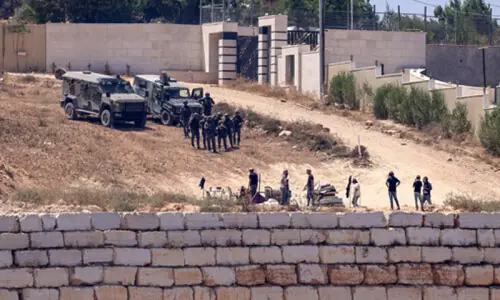
Because the Muslim Brotherhood is the Islamist enemy, we should also overlook the violence and abuse of basic human rights that is being perpetrated by Egypt’s military regime in order to crush the movement. Never mind that the military shot dead more than 1,000 unarmed people in its bid to crush those who protested the June 2013 coup; or that a court recently sentenced 500 people to death in a mass show-trial; or that the Brotherhood represents at least a quarter of the population and won a series of fair elections. They are Islamist, so we must swallow hard and take sides with the military junta.
Blair is misled by his evident belief that the world, including the Muslim one, is marching at different stages toward the same goal of open, Western-style societies. The raw expression of this belief was made by Francis Fukuyama in his famous 1989 essay, The End of History . Yet the end of the Cold War instead renewed the importance of cultural difference, including religion, and history.
History already came back to bite us in Yugoslavia. Now, Russia’s President Vladimir Putin is busy rejecting the post-Cold War order and “modern” Western values, too. China is building a system that can trade with the West, while at the same time rejecting its values and ideas.
Nor does Blair’s absolutist approach help the cause of suppressing radical Islamism. There were few radical Islamists in Chechnya before Russian forces first invaded. There was little Islamist terror against the regime in Egypt until after the military began its brutal crackdown. The needless invasion of Iraq probably strengthened Al Qaeda and its adherents.
Blair, as the man who did most to articulate and sell the flawed case for intervention in Iraq, is probably the wrong person to persuade us to re-engage in the fight to shape the Middle East the way we want it. The principles we should stick to in Egypt should be the same as those in our approach to Russia and Tunisia.
Egypt’s Muslim Brotherhood government was, indeed, terrible. Yet President Mohamed Morsi and his government were paragons of tolerance and compromise compared with the military regime that replaced it: they didn’t hold mass trials and they didn’t resort to mass murder to secure power. Had there been no coup, they would already have faced a new round of elections that they might well have lost.
—By arrangement with Bloomberg-The Washington Post