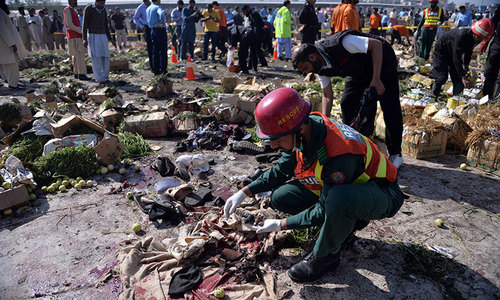
ISLAMABAD: Investigators have picked up the trail of the guava crates that housed the explosives used in the Sabzi Mandi bombing and traced them back to the south Punjab town of Qabola.
According to officials close to the investigation, police have arrested the manager of the farm where the crate of guavas originated from.
Officials told Dawn that a consignment of 40 crates was loaded onto the roof of a passenger bus traveling from Qabola to the Fruit and Vegetable Market in Islamabad.
Investigators had earlier examined the crates found in the vicinity of the bomb. Further probing helped identify the individual who had paid for the consignment of fruit. However, the buyer was among those injured in the attack and it was unlikely that he was directly connected with the bombing, officials said.
Based on information provided by the buyer, police raided a farm in Qabola, near the town of Vehari. Ten suspects, including the farm manager, were picked up for questioning. During interrogation, the manager said he had the crates loaded onto the passenger bus.
Investigators also picked up the bus driver and his helper, who revealed that en route to Islamabad, unidentified individuals had ridden atop the bus along with their luggage, but they did not recall seeing them with any crates that resembled the fruit containers.
“The evidence gathered so far suggests that the explosives were put in the crates at Qabola,” sources close to the investigation said.
However, it is still unclear when the crate housing the explosives was added to the pile; en route from the farm to the bus terminal, during loading or en route to Islamabad.
“We are trying to compare the bombers’ modus operandi with that of the Tehreek-i-Taliban Pakistan and the United Baloch Army,” officials told Dawn, adding that investigators had also been in touch with Balochistan police to determine whether this attack was linked to another bombing at the Quetta Sabzi Mandi on April 12 or the bombing of a train in Sibi on April 8.
The officials said that the last two attacks in Islamabad – the attack on the district courts in F-8 and the Sabzi Mandi bombing – were carried out by highly skilled terrorists who left behind little or no evidence.
Before last week’s attacks, crates of fruit had been used twice in the past to deliver a payload of explosives. On August 17, 1988, a case of mangoes exploded aboard an airplane carrying then-president General Zia-ul-Haq, senior military officials, members of the plane’s crew and with the American ambassador.
Then, on September 9, 2000, explosives concealed in a crate of grapes imported from Afghanistan, went off as the fruit was being auctioned to retailers at the capital’s Sabzi Mandi. The explosion claimed the lives of 15 people and injured 75.