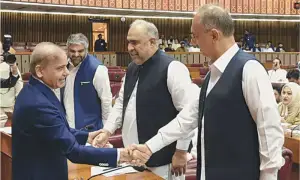
THE issue of madressah reform was raised in the National Assembly on Tuesday when the house adopted an opposition resolution demanding that the government take steps to “improve and regulate” education in seminaries.
As militancy has gained ground in Pakistan over the past few years, the role of madressahs, particularly those promoting extremist mindsets or worse and acting as nurseries for jihadi and sectarian groups, has come under close scrutiny.
Though it would be wrong to tar all seminaries with the same brush as many madressahs genuinely focus on purely religious studies and do not promote violence, ever since the 1980s, the politicisation of seminaries, in the shadow of the Afghan ‘jihad’, has resulted in some madressahs becoming hotbeds of extremism. Attempts have been made to ‘reform’ the seminaries, including during the Musharraf years and the last PPP government’s tenure.
Yet these have made little difference mostly due to the pressure of the religious right. Religious parties feel that the government wants to control the madressahs under the guise of reforms, hence they are guarding their turf fiercely. But reforming madressahs should not necessarily be about control of institutions or doing away with religious education.
Rather, it should focus on ensuring that madressah curricula do not contain hate material, and, in fact, equip the thousands of graduates that seminaries produce every year with marketable mainstream skills that will help them get jobs in different sectors.
The fact is that madressahs have also mushroomed because the state has failed to create a viable, equitable system of public education. Our system is class-based and skewed against the poor.
Though some people do send their offspring to madressahs out of religious beliefs, many simply have no other choice. Either there are no public schools in their native areas, or the schools that do exist hardly deliver quality education.
Meanwhile, the free boarding and lodging many madressahs offer is an added advantage to poor parents. Madressah reform is essential and religious quarters should work with the state to bring seminaries into the mainstream.
But more important is the need for the state to overhaul the broken public school system to deliver decent education to youngsters that will help them become productive, enlightened citizens.