0
0
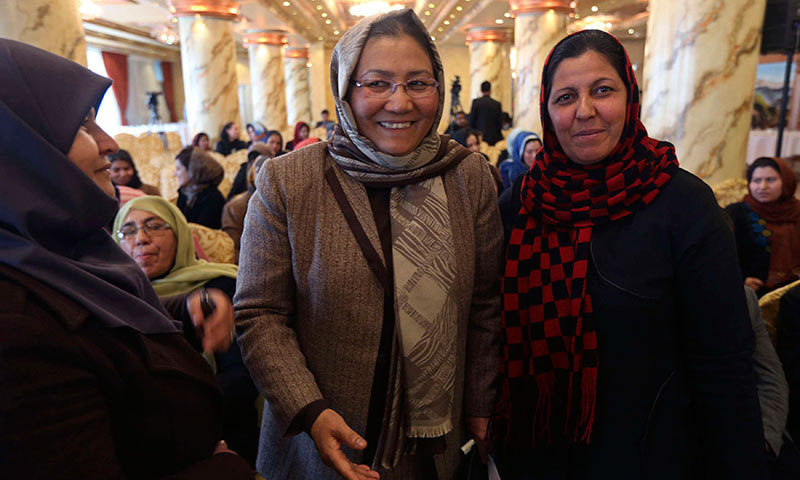

KABUL: The deeply conservative, all-male crowd at Afghanistan’s Kandahar stadium stared in disbelief as the small woman in a modest black headscarf stood up and reached for the microphone.
Habiba Sarabi’s speech in the southern Taliban heartland city lasted only a few minutes, thanking the crowd for supporting her candidacy in next month’s presidential election. It was met by a few jeers, wolf whistles and, after a stunned silence, scattered clapping.
During their strict rule from 1996-2001, the Afghan Taliban had banned women from education, voting and most work, and they were not allowed to leave their homes without permission and a male escort.
Today, Sarabi is one of three female vice-presidential candidates in the April 5 poll and the only one on a front-runner’s ticket. The 57-year-old pharmacist and former governor is supporting Zalmay Rassoul, a former foreign minister endorsed by the president’s brothers.
A fair election would mark Afghanistan’s first democratic transfer of power, a monumental achievement for Afghans struggling to end decades of bloodletting and cement fragile gains in education, health and human rights.
Sarabi, appointed as Afghanistan’s first female governor in 2005, says she hopes to stop conservative leaders from whittling away hard-won rights for women after most foreign troops leave at the end of the year.
“I’m persuading women to vote for me so they can recognise they are part of the political power,” Sarabi told Reuters, a large bodyguard standing by her side.
Like most prominent Afghan women, Sarabi says the death threats against her are too numerous to count.
“There’s definitely a decline of women’s rights and people are afraid it will get worse,” said Fawzia Koofi, an outspoken Afghan parliamentarian and activist who has survived several assassination attempts.
Koofi’s attempt to outlaw violence against women failed to pass. Instead legislators sought to reintroduce stoning for adulterers and a law to prevent victims from testifying against relatives in cases of domestic violence.
President Hamid Karzai, who is barred by the constitution from standing again in the election, intervened in both cases to prevent the proposals from becoming law.
Education for girls
If Sarabi wins, one of her priorities will be getting more girls into school. Her own father never encouraged her to study, she said, and was indifferent to her pharmacy degree until he was dying of kidney failure and she was able to help him.
“I used my skill and I was very kind to him so at least I can prove that the daughter can also be very helpful,” she said. “In our society they think that the daughter cannot help us, it is only sons.”
Sarabi claims to have made some notable changes during her term as governor of Bamiyan.
The province has 21 women police officers, up from zero. Nearly half of the children in school there are girls, she said. A 150-km paved road was built and the country’s first national park set up, she said.
Swing voters
Sarabi appeals to young, urban and educated voters concerned about notorious warlords running alongside two other front-runners. That demographic is a small but important swing vote.
“I will vote for her because she can feel the pain of Afghan women,” said 18-year-old student Farana Shahidani. “There is too much violence against women and it must be stopped.”
Although women students might debate the election in the capital, in the conservative rural south few women will vote, said Shahida Hussain, a member of the High Peace Council, the body tasked with overseeing talks with the Taliban.
“There’s no way women will vote in the districts. Low education levels are the biggest challenge,” she told Reuters in Kandahar.
Hussain bravely promoted women’s rights undercover when she worked as a midwife under the Taliban, but today, she still cannot leave the house without a burqa. She says there is little support in Kandahar for her cause.
“Nothing is done. All the money that is arriving in the name of women goes to corruption. So there are no fruitful projects to empower women,” Hussain said.—Reuters