IT has been almost a year since a Chinese company took over the management and operational control of the Gwadar port in Balochistan.
The objective of giving the deep-water port into the control of the Chinese company was to make it fully functional at the earliest by constructing extensive and expensive rail and road links between Gwadar and western China through the development of an economic and energy corridor.
An agreement to develop the corridor during Prime Minister Nawaz Sharif’s visit to Beijing shortly after his return to power last summer had reinforced hopes of an early start to work on this trade link.
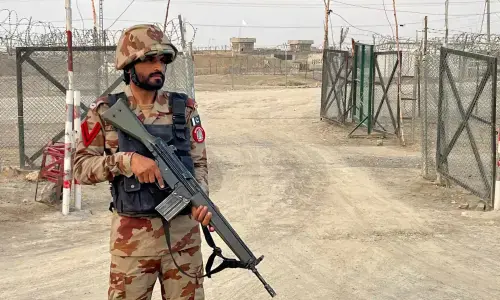
However, the insurgency in Balochistan is thought by many to be a major hurdle in the way of Chinese investment in the development of the port.
In its present state, the initiative has the look of the classic example that shows a government how not to attempt economic development in isolation of politics and security. The political remedy that should have accompanied the project has failed to materialise and without it progress remains elusive.
The equation is unchanged as a recent visit of the top China Overseas Port Holding Company official to Gwadar signals the revival of Chinese interest in the early development of the port.
China is now said to have agreed to start implementing major development projects in the area, including the expansion of the port itself and to undertake the construction of an airport. In all, nine projects will be executed at a cost of $1.8bn.
Some Chinese companies have also shown an interest in the oil and gas sector and approached the authority with their plans to set up refineries in Gwadar. Yet it is unclear as to when the Chinese investors will begin work on the schemes whose completion is considered crucial to the port’s operations.
The completion of the port at the mouth of the Gulf close to the Strait of Hormuz — one of the world’s key oil supply routes — is crucial to turn Gwadar and the rest of Balochistan into a major regional trade hub connecting the landlocked Central Asia with the rest of the world through Afghanistan and providing Beijing the shortest access to the Gulf and to Iranian oil.
If successfully executed, it will bring in billions in foreign investment and benefit millions of people in Balochistan and the rest of Pakistan. It will also enhance connectivity between South Asia and East Asia.
But before that happens, Islamabad will have to address Baloch grievances, bring the separatists into the mainstream and assure the people that their rights to the resources of the province will not only be respected but kept above every other consideration.
Unless the Baloch agree to own the project the dream of a functional, busy Gwadar port and Pak-China trade corridor will remain unrealised.