It has been almost two years since Pakistan renewed its commitment to providing free and compulsory education to its population of five to 16 year olds. Article 25-A became a clause in the Constitution of 1973 making it mandatory for the state to implement this law in the shortest period of time.
Clause Article 25-A states that “the state shall provide free and compulsory education to all children of the age of five to 16 in such a manner as may be determined by the law.” Two years down the road, Pakistani citizens are still awaiting ordnances pertaining to this Act which will bring into motion a campaign to put all children in the specified age group into schools.
The out of school children in Pakistan number about 25 million and, statistically, Pakistan is placed second in the world after Nigeria for out of school children. Despite a few interventions on the part of civil society to extend schooling to disadvantaged children, the state continues to remain silent on implementation of Article 25-A.
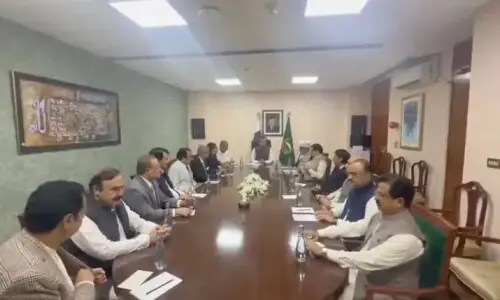
Recently, Idara-i-Taleem-o-Agahi hosted a seminar on Article 25-A in Islamabad and invited speakers from Bangladesh, Afghanistan, Nepal, India and Pakistan to discuss aspects of access and learning quality in the light of the Right to Education Act and the post-2015 development agenda as Millennium Development Goals expire in 2015. The prospect of South Asia as a region by itself is growing and countries like India, Pakistan, Afghanistan, Bangladesh, Nepal and Sri Lanka are reaching out to each other to develop as a region. Commonality of interests, trade, power generation and pooling of resources seems a sensible step to take these countries forward.
India being the largest country of the region also struggles with poverty and out of school children. In 2009, India’s parliament passed the Right to Education Bill and its enforcement began in 2010 with a three-year period for implementation. Right to Education is a central act but each state within India is required to implement it and form rules to do so. The discourse on the act is dependent on inputs, i.e. enrolment, while learning outcomes and quality is not mentioned in the act. A good outcome has been School Management Committees in which parents of good and weak students comprise half of the committee and have powers to monitor teachers’ absences. To increase enrolment, 25 per cent of seats at the entry level in private schools are to be reserved for disadvantaged children but patronage has taken away from this morally upright idea. Since the emphasis is on student enrolment, quality has suffered particularly in low-income schools.
War-torn Afghanistan has managed to continue its education system by focusing on mainstream subjects and teacher education. Three and a half million children are still out of school of which 75pc are girls. Gender bias is diminishing as nearly 34pc of the teacher force now comprise women. However, 50pc of these teachers are under-qualified with less than 14 years of education. Thus, Afghanistan is concentrating on teacher certification and accreditation through 180 Teacher Training Colleges and in-service teacher training programmes. Moreover, Shura committees play a pivotal role in decisions regarding matters of education that affect the community.
Bangladesh’s 160 million population is divided into 64 districts and is not plagued by provincialism. Education Policy is equitably applied and easier to implement and monitor. In 1990, education was made compulsory and the government rapidly expanded the primary education sector to increase literacy. Hundred per cent enrolment was done under the new Education Policy and the NGO BRAC significantly aided the government in providing education to the poorest sections of society. Access to schools has been achieved but quality has suffered as it was not made an integral part of the implementation of the Right to Education law.
Nepal is the least developed country with one million children out of school and the literacy rate is 66pc. It has 123 different language groups. In 2009, Nepal initiated its Right to Education policy for free and compulsory education under Article 17 of its constitution. This act ensured equitable access to quality basic education for children in the five to 12 age group with each community having the right to basic education in their mother tongue. Licensing of teachers is also an integral part of the education system.
Pakistan has much in common with its South Asian neighbours in terms of educational issues. There are many similarities in the psyche of the people of this region and education systems are governed in much the same way. All countries are struggling to educate the masses with scarce resources. Thus, Pakistan’s experience is not unique but political instability and apathy combined with years of military rule has made its education system regressive. Government schools are no longer ‘public’ schools as now only disadvantaged children enrol there, whereas public schooling is for all segments of society and is meant to create cohesion in society and ensure a quality education across the board.
Despite efforts to reform Pakistan’s education system, more often than not, the desired results have not been achieved due to ineffective implementation of education policies. No political party has taken up education as its priority number one and till that is done, implementation on a large scale with all components of the system being addressed at the same time is unlikely to take place.
The writer is an educational consultant based in Lahore.
ismatriaz70@gmail.com