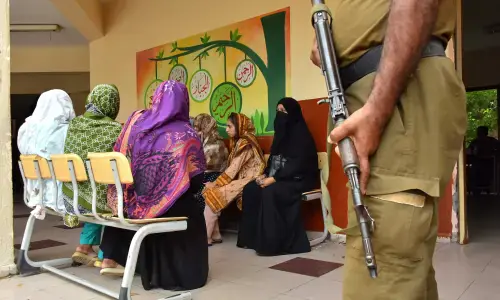
IT’S been talked about and heard of and debated for months, but finally, Interior Minister Nisar Ali Khan’s much-touted National Internal Security Policy 2013-18 may be ready for its public debut. As reported in this newspaper on Sunday, the policy gets much of the historical analysis right when it comes to the roots of militancy and terrorism in the country today, but appears to be weak in both clearly laying out the true scope of the threat and how it can be effectively combated. However, with the policy yet to be officially unveiled, tweaked and debated, it may be more relevant to focus on how the government has diagnosed the origins of the present-day militancy problem. By specifically mentioning flawed policies on Afghanistan, India and Kashmir, long periods of military rule, poor governance and declining institutions, the policy essentially pulls together the sins of omission and commission over decades that have combined to create the Pakistan of today: reeling, uncertain and confused.
Yet, why is it the case that when allowed to diagnose a problem away from the media spotlight and over a sustained period of time, politicians are able to get the basic ideas right, but somehow are never able to see their implementation through? If flawed Afghan, Indian and Kashmir policies are partly to blame for the mess the country finds itself in, then surely it is the responsibility of its elected leadership to try and wrest those policies away from the control of other institutions first and then begin to implement their own vision. Somehow though, governments have not been able to make the transition from having the right ideas to being able to see their implementation through.
Part of the answer is surely time: keeping the democratic transition on track will go a long way to helping politicians, with the support of civil society, believe that they have both a right and duty to lead on policies of fundamental import to state and society. But time and space alone will not provide the solutions. For that, the political leadership must demonstrate a willingness to translate what they believe and accept privately into public policy. And after that, they must accept that turning diagnoses into positive action requires a lot of heavy lifting, patience and commitment. It is simply an inescapable reality of the country today that vital institutions have been allowed to atrophy and wilt away. The declining capacity of the state to undertake everyday responsibilities like providing safety and security in the neighbourhoods where much of the citizenry resides is what has allowed militancy and terrorism to spread so far and wide. If the government truly wants the policy to be a national turning point, it is the government itself that must lead the way.