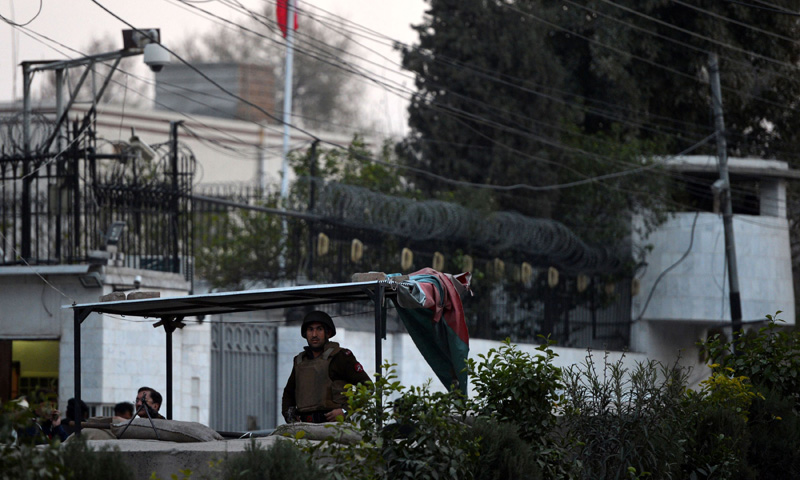

PESHAWAR: A spokesman for militant commander Mast Gul, once acclaimed in Pakistan for his role fighting Indian rule in Kashmir, has claimed responsibility of a suicide attack at Iranian consulate in Peshawar which killed two paramilitary soldiers and wounded ten others on Monday.
“We sent a suicide bomber to target the Iranian consulate and Iranians inside the building,” the spokesman told Reuters.
“They unfortunately remained safe. We will continue to target Iranian installations and the Shia community everywhere,” he added.
The bombing took place in the up-market University Town area of the northwestern city of Pakistan, where many non-government organisations (NGOs) are also based.
Police said a suspicious vehicle stopped near a security checkpost near the Iranian consul-general’s office, following which a blast was witnessed.
“We have two bodies of paramilitary soldiers and ten wounded have been admitted to hospital,” Farhad Khan, a spokesman for Khyber Teaching Hospital where the casualties were taken told AFP.
A senior police official, Mohammad Ejaz Ahmed, said it appeared to be a suicide bombing.
Confirming the incident and casualties, Khyber Pakhtunkhwa Health Minister Shaukat Yousafzai told reporters that Iranian consulate was the apparent target of the attackers.
Meanwhile, Iran's foreign ministry strongly condemned the bombing in a statement, the state broadcaster reported.
Its spokeswoman Marzieh Afkham called for “close cooperation” of regional countries to combat the “spread of terror acts and extremism, particularly (attacks) against diplomatic missions.”
Iran is Pakistan's predominantly Shia Muslim neighbour to the west. Sunni militants frequently attack Shia targets and mosques in Pakistan.
Pakistani Shia pilgrims are often attacked as they travel across the country to visit holy sites in Iran.
The attack on the Iranian consulate came as the government of Prime Minister Nawaz Sharif tries to engage the Taliban in peace talks. Negotiations broke down this month after a string of attacks and counter-attacks by both sides.
Mast Gul, also known as Haroon Khan is a leader of the Hizbul Mujahideen who had risen to fame following a gun battle with Indian security forces and his dramatic escape from Charrar-i-Sharif in Indian-held Kashmir in 1995. He hails from Sadda in Kurram tribal region.
He was given a hero’s welcome by the Jamaat-i-Islami (JI) which showcased him at public meetings but later distanced itself from him after finding him to be violating the organisation’s discipline.
The 47-year-old militant survived an ambush near Peshawar in August 2003 and little was known about his whereabouts since then.
Earlier this month, Pakistan entered into talks with the Tehreek-i-Taliban Pakistan (TTP) aimed at ending their seven-year insurgency.
But the militant group continued carrying out attacks on a near-daily basis, and the dialogue was suspended last week after the insurgents claimed they had executed 23 kidnapped soldiers in a northwestern tribal region.
Since then the air force has been carrying out attacks in the volatile tribal regions which border Afghanistan, killing dozens.