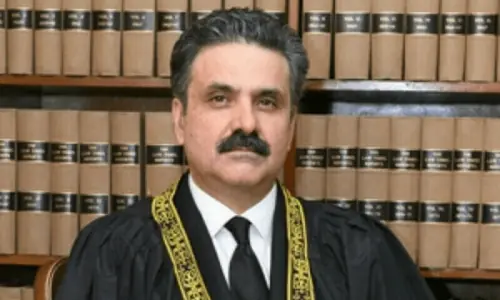
THERE will be no military court for Pervez Musharraf’s treason trial; the special court that has been convened to try Mr Musharraf for suspending the Constitution in November 2007 has turned down the former strongman’s demand to be tried under military jurisdiction. While there was never any cogent legal reason for Mr Musharraf’s request to be acceded to, the special court’s decision is nevertheless a welcome one. For it establishes the precedent that crimes against the Constitution, drawn up and approved by civilians, in a system designed to be led by civilians ought to be tried by a civilian court. Anything else and the perpetuation of the civil-military imbalance that has so blighted the political, social and economic history of this country would have been underlined further. In 2014, that would have been an unmitigated disaster for the democratic project.
Still, rejecting Mr Musharraf’s demand for the case to be handed over to a military court does not mean the path has been cleared to a trial and conviction of the former army chief. That the court has bent over backwards to accommodate the demands and recalcitrance of Mr Musharraf so far could be seen, in a generous context, as the special court’s desire to afford Mr Musharraf every possible right to due process and a fair trial. However, there is also a less generous view: the court, in endlessly delaying even the indictment of Mr Musharraf, is giving a high-profile accused with an expensively assembled and prominent defence team special treatment. There is a line between what transparency and fairness demands and special treatment, and a case could be made that the special court has come uncomfortably close to crossing that line. With the key jurisdiction issue now dispensed with, perhaps the court will look to speed up the process — while continuing to grant Mr Musharraf every right to due process and a fair trial that he is entitled to under the law.
Of course, given the obvious political overtones, the future of the Musharraf trial cannot be assessed solely through a legal prism — desirable as that may be. That a civilian court can decide to try a former army chief after an elected civilian government carried out an independent investigation and drew up charges against the former army chief is a significant step forward for the transition to democracy and civilian supremacy. Those are unequivocal gains for the democratic project and should not be squandered by delay on the part of either the judiciary or the government-appointed prosecution. Behind-the-scenes civil-military machinations, a defendant who is at best reluctant to be tried, a military operation that may or may not begin soon, a TTP leadership that may either agree to a ceasefire or turn up the heat more — that and more are factors that can muddy the trial waters. The trial must move ahead soon.