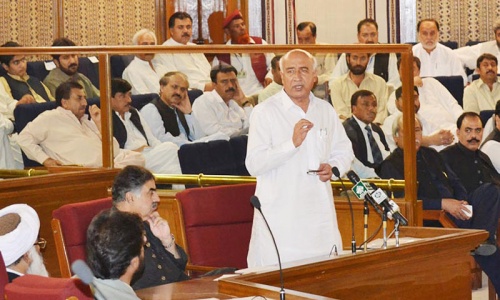
QUETTA: Release of funds almost each year for repair and renovation of the same schools has served to promote corruption in the education sector, Adviser to Balochistan Chief Minister Kaiser Bengali has said.
Speaking at launch of the Annual Status of Education Report (ASER) for 2013 here, Mr Bengali said: “When I was in Sindh government, I observed that every year officials released government funds on the pretext of repairing and renovating the same schools, roads and other government installations; projects for which they had released funds in the previous years also.”
Former federal education minister Zubaida Jalal and provincial Education Secretary Ghulam Ali Baloch were present on the occasion.
Lamenting the poor condition of government schools where teachers remained absent and facilities were non-existent, Mr Bengali called for reforms without delay.
“In the West teachers do not give students homework but in Pakistan teachers burden their pupils with loads of homework,” he said.
He called for introducing computer laboratories and mobile libraries in the schools which lacked such facilities. “A library and a computer lab set up in a container are capable of catering to the needs of five schools a month,” he said.
Ms Jalal said she had helped evolve an education policy under which students of class four or below were to be taught only three subjects – English, Urdu and mathematics.
She lamented that the government had shelved the policy instead of implementing it. “It’s our political culture that every new government terminates the standard policies and projects launched by the previous one.”
Politicisation, she said, was badly damaging the education sector.
Mr Baloch said there were a large number of government teachers who regularly drew their salaries but did not take classes. “All stakeholders, including politicians and media personnel, will have to work towards compelling government teachers to carry out their duties diligently,” he said.
The ASER 2013 revealed that only 34 per cent of government teachers were graduates, 71pc schools had no drinking water, 75pc schools no boundary walls, and 83pc lacked proper toilet facility.
Only 7pc had computer labs, 23pc had libraries and 18pc playgrounds. It further said the majority of schools did not receive grants in 2013.
For the report ASER Balochistan collected data from 16,952 households in 839 villages across the province. Just over 53,400 children of three to 16 years were interviewed out of whom 38,930 were tested for language and arithmetic competencies.
The report said that 81pc of the children of three to five years were currently not enrolled in any early childhood schooling.
Sanaullah Panezai of Unicef, Qaisar Khan Jamali of Unesco, Farooq Akbar of the Pakistan Reading Project and Amjad Aziz also spoke on the occasion.