0
0
WEARING a light blue shalwar-kameez with a matching shawl, Khadija, 13, is lying on an adjustable hospital bed at Peshawar’s Paraplegic Centre.
Her elder sister Sakeena, in her late teens, stands close to the bed that is placed in the shadow of a tree on a sunny February day in the backyard of the centre’s female ward. Khadija has been under rehab treatment here since June 21, 2013. “She was injured when a mortar shell hit our house at Shandrung Killay, Bara, Khyber Agency,” says a pink-faced Sakeena, adjusting the dupatta covering her head.
A soft smile spreads across Khadija’s slender face as she narrates the events of Aug 18, 2011. “I heard a loud noise as something big with force landed on our roof,” recalls Khadija. She says she was helping her mother cook the evening meal when the roof caved in. Her mother, Noor Bibi, died whereas Khadija has never been on her feet since then.
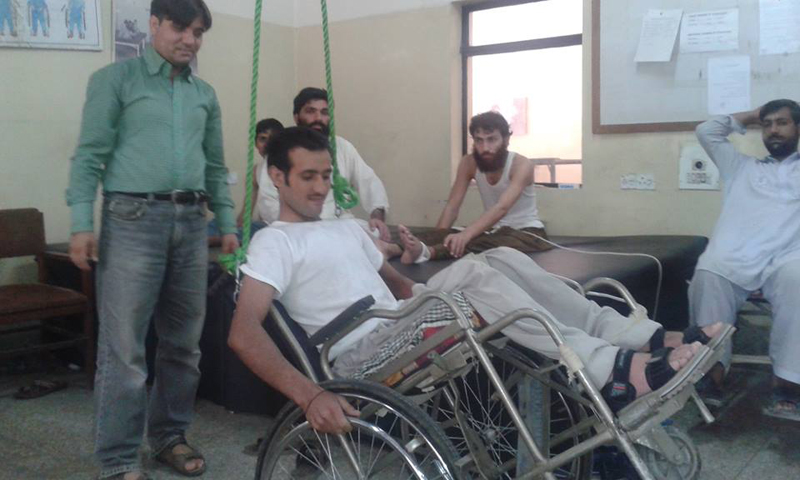
“She’s completely paralysed below and will never be able to walk again. She has no bowel and bladder control,” explains physiotherapist Syed Mohammad Ilyas, chief executive of the Paraplegic Centre, a provincial public-sector institution.
The centre comes to life early in the morning as some of the patients transport themselves in their wheelchairs to the in-house mosque for Fajr prayers.
This writer saw a few patients with sore backs lying on their stomachs on custom-made beds brought out into the open where they could enjoy the sunshine.
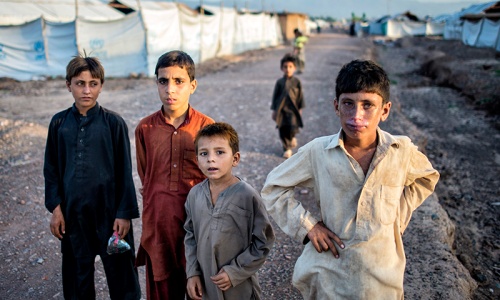
The Bara sub-division of Khyber Agency was a militancy hot spot when Khadija, a student at a Punjab seminary, came home for vacations. The military operation against a local militant 'commander’, Mangul Bagh, led to human misery in the short run and some stability in the longer run. About half a million people had to leave their homes, taking shelter in a tented village at Jalozai near Peshawar.
Khadija said her family could not move out in time because her father, a labourer in Saudi Arabia, was not there and the women could not decide to leave in his absence.
As she was narrating her ordeal, a fair, eight-year-old boy walked close to her bed, pushing a wheelchair by its handles. Ali, one of the 78 paraplegic patients currently registered at the centre, survived a deadly attack in the militancy-affected Darra Adam Khel in September 2011.
“He was returning home when his school van was fired upon. He injured his spinal cord,” says Ali’s mother, whose younger brother, and three other boys, all Ali’s age, died in the attack.
The boy, says Ilyas, had been readmitted to the centre after developing pressure sores over a month ago. “He does not have sensation in his backside and if he does not take care he develops sores,” says the physiotherapist.
When asked how it feels to walk with a calliper wrapped around his leg below the knee, he moves away without saying anything, dragging his left foot and holding a half-filled urine bag in his left hand.
The men, women and children with permanent disabilities caused by militancy-related violence is a comparatively new phenomenon at the centre where a majority of patients suffered spinal cord injuries due to falls from poles and trees, according to the physiotherapist.
“Every nook and corner of the building, including the mosque, is wheelchair-accessible,” said Zia-ur-Rehman, chairman of the centre’s board of directors.
Set up by the ICRC in 1984 to treat patients with spinal cord injuries from Afghanistan and Pakistan during the Afghan war, the centre was also utilised by the Taliban government in Kabul.
Its utility, said Ilyas, was second to none for the growing paraplegic population of Pakistan. On an average about 300 patients annually left the centre. Annual costs were about Rs70 million of which Rs50m came from the provincial government this financial year, according to Rehman.
Apart from providing free medical and rehab treatment, it also provides free meals to patients and their attendants throughout their stay. It imparts occupational training to help the disabled become functional by relearning some of the movements they lost.
Similarly, it has separate vocational training facilities for male and female patients, a workshop to produce callipers and wheelchairs, an incinerator and a gym.