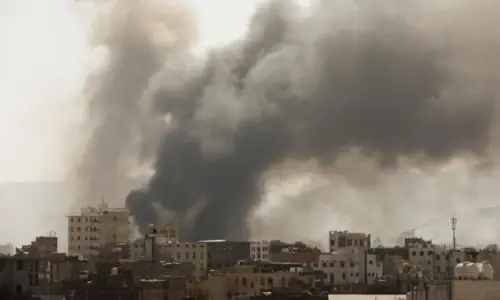
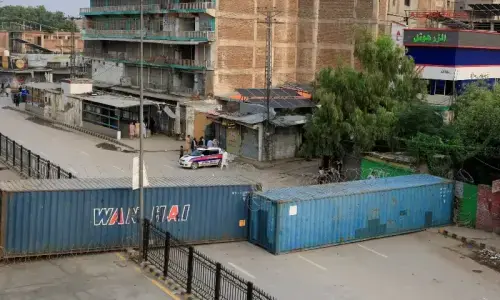
FALLUJAH: Iraq is preparing a “major attack” to retake militant-held Fallujah, a senior official said Sunday, spelling a new assault for the city, west of Baghdad, where US forces repeatedly battled insurgents.
Washington said it would help Baghdad in its battle against al Qaeda-linked militants but that there would be no return of US troops.
The takeover of Fallujah and parts of Anbar provincial capital Ramadi, farther west, is the first time that militants have exercised such open control in major cities since the height of the bloody insurgency that followed the US-led invasion of 2003.
“Iraqi forces are preparing for a major attack in Fallujah,” a senior Iraqi official told AFP.
Special forces have already conducted operations inside the city, the official said.
The regular army has paused on the edge of the city to allow residents time to leave, awaiting orders to launch “the attack to crush the terrorists”.
Fallujah is in the hands of fighters of the al Qaeda-linked Islamic State of Iraq and the Levant (ISIL), a senior security official said on Saturday.
Secretary of State John Kerry said on Sunday that the United States would provide assistance to Iraqi forces in their battle against the militants but that it was “their fight”.
Kerry said Washington was “very, very concerned” about the resurgence of ISIL but said it was not contemplating any return of US ground troops, after their withdrawal in December 2011.
“We are not obviously contemplating returning, we are not contemplating putting boots on the ground, this is their fight,” Kerry told reporters in Jerusalem.
“But we're going to help them in their fight... We are going to do everything that is possible to help them.”
'Wait for what is coming'
ISIL militants seized control of the village of Bubali near Ramadi after heavy fighting on Sunday, a witness said.
And AFP journalists reported sporadic clashes both inside Ramadi and on the outskirts of Fallujah.
Iraqi ground forces commander Staff General Ali Ghaidan Majeed told AFP that security forces killed 11 militants from countries including Afghanistan and various Arab states on the highway from Baghdad to Fallujah.
Majeed admitted “we do not know what is happening in Fallujah,” but said the city should “wait for what is coming”, a reference to the impending assault.
On Friday and Saturday, more than 160 people were killed in the worst violence to hit Anbar province in years.
Both Ramadi and Fallujah were insurgent strongholds in the years after 2003, and Fallujah was the target of two major assaults in which US forces saw some of their heaviest fighting since the Vietnam War.
American troops eventually wrested back control of Anbar from militants, with the support of Sunni Arab tribesmen of the Sahwa militia, who joined forces with the US from late 2006.
US forces suffered almost one-third of their Iraq dead in Anbar, according to independent website icasualties.org.
But two years after US forces withdrew, the power of militants in the province is on the rise.
Fighting erupted in the Ramadi area on December 30, when security forces cleared a year-old protest camp where Sunni Arabs demonstrated against what they see as the marginalisation and targeting of their minority community by the Shia-led government.
The violence then spread to Fallujah, and the subsequent withdrawal of security forces from parts of both cities cleared the way for militants to seize control.
Prime Minister Nuri al-Maliki had long sought the closure of the protest camp outside Ramadi, dubbing it a “headquarters for the leadership of Al-Qaeda”.
But its removal has caused a sharp decline in the security situation.
ISIL is the latest incarnation of al Qaeda's Iraq affiliate and has made a striking comeback this year, taking advantage of widespread discontent among Sunnis and its newfound bases in neighbouring Syria, where it has become a major player in the nearly three-year-old conflict.
Violence in Iraq last year reached a level not seen since 2008, when the country was just emerging from a brutal period of sectarian killings.