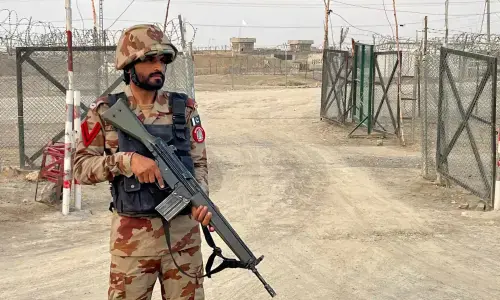
WHEN it comes to law and order, crime and insecurity, and the state’s diffident response to serious threats, the story has become a depressingly familiar one: lamentation and more lamentation; inaction and more inaction. The killing of an Islamabad leader of the Ahle Sunnat Wal Jamaat, Munir Muawia, in the federal capital on Friday ought to be alarming, but it is already destined to become yet another bloody footnote in the once-again simmering sectarian wars and the state’s inability to control them. It is not even surprising anymore that a drive-by shooting can occur in Islamabad and the assassins simply melt away — it ought not to be the case, but helplessness seems to be the only reaction of the heavily financed and resourced capital police. And if the heart of Islamabad cannot be made safe by security officials, then what hope for Peshawar, Quetta or Karachi?
Next, a familiar question. What is the government’s strategy to handle the rising sectarian pressures? Ignorance of the problem is surely not a possibility. Punjab has long been the heartland of sectarian tensions and while the infrastructure of hate has spread far and wide across the country, Punjab, under the control of the PML-N, remains very much a hub of the problem. This is not even about immediately rolling out long-term solutions: that will necessarily require the input and full cooperation of many arms of the state, provincial and federal. But the warning lights on sectarianism are again blinking furiously and urgent steps are needed. Fire-fighting after the problem erupts, as happened in Rawalpindi over Ashura, is only a recipe for awaiting the next big conflagration. The sectarian killers and militants are in most cases known to the intelligence apparatus. While there is sometimes random violence, much of the violence is orchestrated by small cadres at the fringe of the main sects. The religious leaders who can influence events are well known too. Why, then, the inaction by the state? There are few reassuring answers.