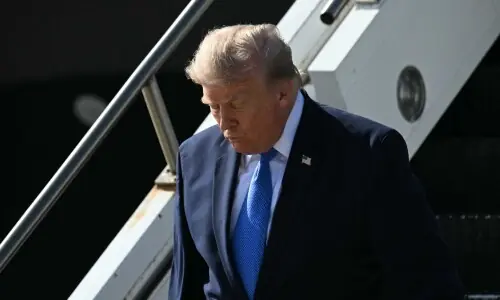
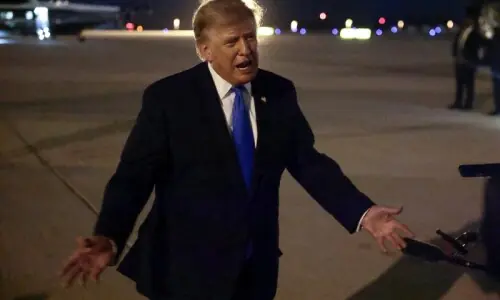
IT could be the last throw of the dice by a desperate man. Indeed, there is little reason to believe him. But former president-cum-army chief Pervez Musharraf’s claim that he has the support of the army as he tries to fight off an imminent trial for treason has raised a number of awkward questions for that most awkward of equations: the civil-military imbalance. Thus far, the army has not taken Mr Musharraf’s bait, refusing to either distance itself from or comment on the former dictator’s claims about the institution he led for nearly a decade. Silence, as is the wont here, can be interpreted either way: it could be yet another manifestation of the post-Musharraf army leadership’s decision to steer clear of overt politics or it could be that Mr Musharraf has once again spoken brashly and revealed behind-the-scenes pressure and bargaining. Whatever the truth — and the truth is rarely, if ever, known to the public when it comes to the doings of the army leadership — this is a certainly a delicate moment for the new military leadership.
As ever, the problem is that the perpetrator is also a victim of sorts and the victims, perpetrators of sorts. Mr Musharraf is clearly and unquestionably guilty of overthrowing the Constitution and illegally installing himself in power in 1999. That coup was facilitated by many, endorsed later by some and finally indemnified by parliament. It was never a single individual’s decision or doing. But the former dictator is not even facing trial for 1999; he has only been charged with the imposition of emergency in 2007. And while everyone — including then-prime minister Shaukat Aziz — has tried to distance themselves from the November 2007 emergency, there is little doubt that there were many supporters of that move too. So if Mr Musharraf is puzzled or bewildered, as his flurry of recent interviews seems to indicate, why he alone faces trial, he does have a point. But the civilian leadership is quiet on that matter, preferring to cast Mr Musharraf as the only villain in the piece.
Elsewhere too the civilian leadership is silent: there is no movement at all on the Supreme Court judgement in the Asghar Khan case which set the stage for the trial of another former army chief and a director of the ISI. Presumably, that is because of the awkward issue of the principal beneficiaries of the rigged 1990 elections being back in power today. Nevertheless, while the civilians continue to fail on some fronts, the onus really ought to be on the army. No more protected class; Mr Musharraf’s fate should be decided by the civilians and the courts.