12
12
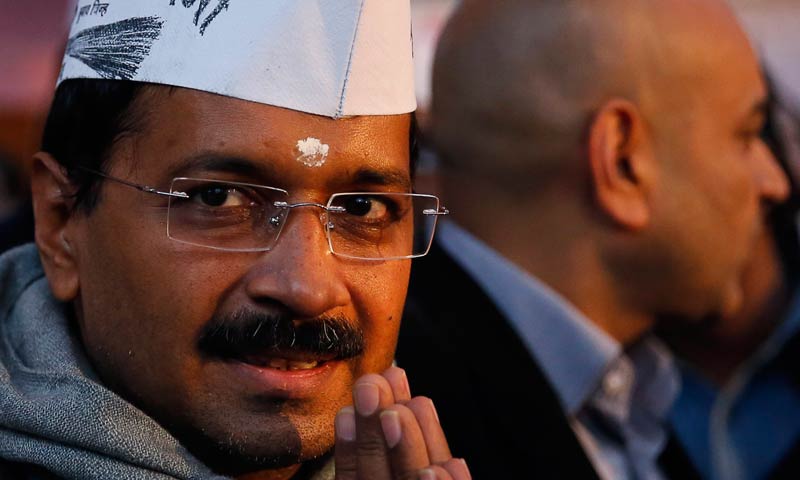

Finally, Delhi is going to have a government by the Aam Aadmi Party with outside support of the Congress. But the government formation has turned out to be primarily an exercise by the three protagonists — the AAP, the BJP and the Congress — in calling one another’s bluff.
In the era of coalition politics Delhi is having a coalition government without a common minimum program chalked out by the partners. The two parties have come together ostensibly to avoid a constitutional crisis of sorts that would have been imposed on the people with fresh election within weeks of an election and a drain on the public exchequer.
The real purpose of this government formation for which the three main contenders were locked in a triangular contest is, however, to beat one another at their own game.
For the first time in India’s electoral history, the party (BJP) securing the maximum number of seats (32 out of a total of 70) has decided to sit in the opposition instead of exploring the possibility of forming a government which has for years become a euphemism for horse-trading.
The second largest party (AAP) bagging 28 seats also initially decided to sit in the opposition. An unprecedented situation was created with neither of the two major winners staking its claim to form the government and the distant third — the Congress — with a paltry eight seats in its kitty volunteering to supply the numbers for forming the government.
Nitin Gadkari, former BJP president, has branded the AAP as “a right-wing Maoist” outfit. In a way he is uncannily right, if Maoism in this context means destabilising a political order that is reeking of corruption and taking people for a ride after mollycoddling them for getting their votes to capture power. But, if the left-wing Maoists have no respect for the country’s constitution while trying to achieve their end, the “right-wing” Maoists are using the very constitution to cleanse the system.
It’s the AAP which set in motion a new wave political thinking by deciding neither to take support from nor give any to the BJP or the Congress for forming a government. For it, the two established parties are the “two sides of the same coin of corruption” and as such it couldn’t have any truck with either of them. It was also a clever way of prodding the electorate not to give a fractured mandate, but choose without any ambiguity either the AAP or the BJP. Given the mood, AAP is confident of winning simple majority if fresh election is held. That would have put it in a position to implement its agenda without having to oblige either the Congress or the BJP for enabling it to form the government. The Congress, however, desperately tried to make the best out of its ignominious rout by writing to the Delhi governor that it would provide outside support to the AAP if the latter formed government.
It’s a multi-pronged strategy as the Congress wants to deny the BJP the opportunity to be in the saddle in Delhi, refurbish its image as a fountainhead of corruption by collaborating with the AAP that professes to be a crusader against corruption and let the AAP bubble burst too soon.
But then again, the AAP has carefully choreographed its rise to political stardom. First, it has won the confidence of a large number of people by convincing them about their incorruptibility and zeal to work for them as being their very own eschewing the trappings of power. Then, it exposed the sham of post-poll arrangements of naked and cynical opportunism. The political establishments were so scared that first the BJP avoided horse trading like plague and then both the BJP and the Congress laid the snare for the AAP by going to town with the propaganda that the AAP was shying away from forming the government and therefore betraying the people who voted for it to deliver what it had promised.
The dilemma that the AAP faced was that if it took the Congress’ help, the BJP would accuse it of collaborating with the corrupt that it seeks to fight against. If it formed a government with the BJP’s help, the Congress would dub it a collaborator of communalism.
The AAP has cleverly wriggled itself out of the trap by using the method it understands best — going to the people and taking their consent for forming a government with the Congress. It would silence criticism of both BJP and Congress that the AAP only makes tall and unrealistic promises and is incapable of providing governance. Nor could AAP be charged with being greedy for power since it hasn’t reversed its position of not taking from or giving support on its own to the Congress and the BJP.
The far greater advantage of forming a government with the Congress or for that matter taking the BJP’s help with people’s approval is that the AAP can go ahead with its plan to implement its manifesto and expose “the corrupt in the Congress and the BJP”. If the Congress pulls the plug, it would be all the better. If it doesn’t, which is unlikely, the AAP can enhance its credentials as a clean crusader. Already the AAP’s latest strategy is yielding dividends — the BJP, which was goading it to form a government with Congress support, is now calling it a collaborator of the corrupt. The Congress announces its support is not unconditional, a veiled threat that it will topple the AAP-led government if the goings become too hot for it.
Up until now everything is going the AAP way and the BJP and Congress are not only a confused lot, but have run out of ideas to combat the so-called political "upstart". It looks like India may be spared the either-or situation where the Congress and the BJP take turns at running the country. It's also a testing time for the Third Front or the Federal Front, the brain child of Mamata Banerjee.
The writer is The Statesman chief of bureau, Kolkata
By arrangement with The Statesman/ANN