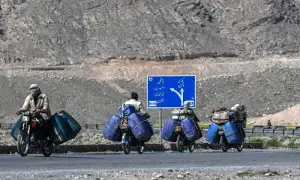
WHEN US Secretary of Defence Chuck Hagel visited Islamabad earlier this month, he kicked up a storm of controversy for allegedly threatening Pakistan that the continued disruption of the Nato/US ground supply route through Pakistan would result in punitive measures by the US, including the withholding of military aid. The Pentagon then hastily clarified that Mr Hagel had not threatened Pakistan, but had merely conveyed that the mood in the US Congress was souring on Pakistan. Now, less than two weeks later, a bill is winding its way through Congress that limits military reimbursements and aid to Pakistan if the supply route is disrupted and the defence secretary cannot certify that Pakistan is doing enough in the fight against Al Qaeda and other militant groups operating along the Pak-Afghan border. The White House will try to play down the latest Pakistan-specific bill and pledge that it is committed to improving ties and working together with Pakistan, but the tensions are unmistakable.
As ever, one side’s intransigence appears to have elicited a frustrated response from the other side — and none of it was necessary. For the US, the principal objectives over the next year are to get the bulk of its troops out safely and to nudge an intra-Afghan political settlement along to keep that country relatively stable going forwards. For both those objectives, the US needs substantial help from Pakistan. So how does it make sense to threaten to withhold military assistance to Pakistan at this stage? Good politics it may be for the US Congress, but in the realm of foreign policy and national security, the space for politicking ought to be much narrower. On the issue of the ground supply route through Pakistan, there is little meaningful opposition to it here per se. What it has become tied up with, and that too through the attempts of a provincial government and not the federal government, is the issue of drone strikes occurring while the option of talks with the TTP is yet to be pursued. But the US Congress appears to have stripped all actions here of their domestic, and possibly even legitimate, context and is seeing them simply through the prism of its own ideas and political requirements. Unhappily, the White House appears to be playing along too.
Still, no story of American self-defeating annoyance is complete without the Pakistani half of the mistake. Even now, even at this late stage, Pakistan has no clear strategy against militancy inside Pakistan and its policy on Afghanistan seems to have been reduced to a series of denials of complicity with the Afghan Taliban that no one else appears to believe. Unable to put its own house in order, unable to lead on a viable option for stability in Afghanistan — is it any wonder hawks in the US Congress view Pakistan so suspiciously?