Prayers haven’t worked for Pakistan — Anwar Maqsood
 Several Indian and local publishers have contacted noted humour and satire writer Anwar Maqsood with offers to publish his TV plays and serials that may fill several volumes if printed, but he has so far not accepted the offer. “I don’t have the courage to publish my works,” he says without elaborating in an interview with Dawn on Wednesday.
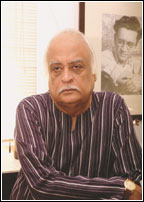
Many of his fans fondly recall a young Anwar Maqsood, with an extraordinary white flowing mass of hair framing his face, burst onto the TV screen in the 1970s. He scripted his own stage shows and wrote memorable plays and serials such as Aangan Tehra, Sitara aur Mehrunnisa, Show-Sha, Studio Dhai and so on. He has never looked back since, continuing to produce programmes, combining his typical wit, humour and satire, for one entertainment channel or another. Besides interviewing important personalities for the ARY channel, where he holds a senior position, he presents a play at least once a month. But Anwar-Rama is a 13-episode weekly show that will go on air in a month or so, most probably on Eid-ul-Fitr, on the channel..
 Once he contributed a weekly column to the Hurriyet daily. But apparently he trod on the toes of influential persons, who could not digest his biting satire and would have his columns banned for several months. “After every two columns, I had to wait as long as six months to resume.” He, however, has agreed to contribute a weekly column to an Urdu daily and it is hoped that his fans will be able to enjoy it soon and the bigwigs in the democratic set-up will also bear with it.
Anwar Maqsood’s morning begins at 6am when he does the reading and writing work in the morning before going to office between 10am and 11am. He goes to bed between 10.30pm and 11pm. “Even if I’m in a show and come home as late as 3am, I get up at my usual time.”
Asked if he saw any improvement in the situation in Pakistan, he said in his typical witty fashion: “We have been praying for Pakistan daily for the last 61 years. Prayer hasn’t worked. Now we should try curse, in the hope it will have its reverse effect on the country.” He is, however, happy that democracy has finally arrived in the country. “Democracy is a good thing, indeed.”
When reminded of his bitter-sweet relationship with Gen Zia-ul-Haq, he said: “It is easy to become friends with the rulers, but it is difficult to keep this friendship going.
“I have friendship with none but my grandchildren. Rather than calling me Dada or Nana, they simply call me Anwar, unless there are guests in the house.”
Asked if he had any plan to enter politics in the future, he said: “To enter politics one should have heaps of ill-gotten money. I do not even have much of my hard-earned one.”
Anwar Maqsood is one of the 10 siblings, three of whom including his bureaucrat brother Ahmed Maqsood Hameedi, have died. About his late brother he says: “I have yet to come across a person who is as well-read as Ahmed Bhai was.”
All his siblings, including renowned playwright Fatima Surayya Bajia, poet Zehra Nigah, kitchen maestro Zubaida Tariq and broadcaster Sara Naqvi, have distinguished themselves in their respective fields. But he does not believe that creativity runs in genes. “We had a literary environment at home and a good library, where would sit and read books. So, it was natural that we all developed a reading habit and benefited from it.” About the relationship with his siblings, he says: “We live apart, but live like a single family. No day passes by when we do not meet.”
He began writing when he was a schoolboy. “Our teacher Khwaja Moinuddin, who wrote such classic plays as Laal killay say Lalukhet tuk and Mirza Ghalib Bundar Road Par, was a great writer. Nobody could write as beautiful sentences as he did. He inspired me to try my hand at writing. I began writing with parodies of popular poems.”
He is reluctant to name any particular writer as his favourite and says: “I do listen to him who sings good and read him who writes good. Among Urdu columnists, however, none has matched Ibn-i-Insha.”
Although he is better known for his TV programmes, he is a very good painter also. Though his drawing room is adorned with paintings by other painters, such as Bashir Mirza, he says “whatever I paint sells out immediately Therefore, he doesn’t have his own paintings in the house”. Anyhow, every four or five years, he manages to hold a painting exhibition.
Painting is what he says that helps run his household. How did he start painting? “As a boy, I used to paint on walls with pieces of charcoal. Seeing my keenness for painting, Sadequain and Shakir Ali (the two giants of art in Pakistan), who used to visit our home, provided me with painting paraphernalia and put me on the path to become a successful painter. I got my first award for painting in 1973.” He paints for eight to 10 hours on Saturdays and Sundays, when he is off from office.
When asked if he was satisfied with the immense work on popular TV channels, he said he wasn’t. “Though it was satisfying to try to create ripples of smile on weary faces, I couldn’t have any positive influence on society.”
Apparently believing in Edison’s saying “Genius is one per cent inspiration, ninety-nine per cent perspiration”, Anwar Maqsood has lived a really busy life. Asked what he aspires to accomplish more, he recites a verse, implying that he has seen and done a lot, and now is the time to relax:
Kia seir iss kharabay ka buhut/ ab chal kay sau rehiyay/kisi dewar kay sayay mein/ munh pay laykay daman ko
Will king’s men be taken to task for making mockery of sports?
Sports, like most other fields, is in line for a big reshuffle following the departure of President Pervez Musharraf. An overhaul at such junctures is an age-old phenomenon in Pakistan and the blue-eyed boys of the present regime, who were kept at bay during the last decade or so, are favourites to replace the old guard.
It is no secret that the country’s sports have nosedived like never before and the standards, perhaps, are the worst-ever in the 61-year history of the nation.
The results at the ongoing Beijing Olympics are true indicators of this, thanks to the inefficient sports officials who have continued to plunder millions on joyrides beside enjoying hefty perks at the expense of country’s reputation.
Be it Nasim Ashraf, Zafarullah Jamali or the retired General Arif Hasan, they have all been King’s men and have therefore, ruled like kings. Dr Ashraf was the first one to step down from the prized post just minutes after Musharraf said adieu in a televised speech on Monday.
Jamali heard the ‘sad’ news in the Chinese capital where he is honeymooning with his ‘yes men’ as Pakistan hockey team struggled to remain afloat in the Olympics.
As for Gen Arif, he has too much on his plate as boss of Pakistan Olympic Association (POA), Pakistan Sports Trust (PST) and Fauji Foundation at the same time but he has not been able to do justice to even one of them.
As for the Olympics, the writing was on the wall months before Pakistan’s 37-member contingent departed for Beijing.
It is a pity that despite Pakistan sports being in such a shambolic state, those who matter in the corridors of power had the audacity to make tall claims in print and electronic media about the country’s athletes and hockey team making it to the podium.
It is a possibility that former prime minister Jamali will be shown the door upon return from Beijing alongwith his team of people. The only exception can be PHF secretary Asif Bajwa, who took up his post recently. But will the sacking serve any purpose? The order of the day is that such officials should not be spared for their deeds.
Press reports emanating from Beijing say that Pakistan will now be eyeing the SAF Games, the Commonwealth Games and the 2012 London Olympics. What a joke!
It was early this year when Gen Arif, sensing the political turmoil in store, got himself elected as the POA chief for a second term in a hurriedly-organized polls before the expiry of the first term.
He seems to be least bothered of the tug-of-war among the various parallel sports bodies in some disciplines at Punjab and Sindh and is more interested in saving the skins of his near and dear ones in the federations by compromising on the sports policy.
It is no secret that Arif, during his term, distributed millions of rupees to federations and officials for their foreign trips and for organising sub-standard domestic competitions but has been least bothered about the pathetic, medal-less show by Pakistan in the global events during the past few years.
It is an established fact that sports academies play vital roles in creating a pool of budding players for most countries and had Gen Arif establish just one such institution four years ago, it would have yielded fruitful results today.
Are ‘A’ level exams getting easier to pass?
 Higher educational institutions in England are at a loss how to accommodate so many ‘A’ level high graders to choice courses as the pass percentage in the high school examination rises yearly. This would be the 26th year in a row when the percentage has gone up marking a record 97.2 per cent in the results announced last week. More than half of all the grades awarded were As or Bs. Educational experts doubt the government claim that standards are going up because teachers and students are doing better and better. Have teenagers really become brighter and more hard-working year on year, asks the Sunday Times and says many teachers and universities have their doubts.
This is not being questioned in Pakistan where teaching standards are far poorer and private schools preparing students for the ‘A’ level examination are purely commercial enterprises whose ranking as educational institutions can only be determined by the amount in thousands they charge as fee. And yet as newspaper pictures of high achievers of our Islamabad elite schools, getting seven or eight As (rare and almost unheard of even in England) show, there must something be the matter with this entire issue of examination quality sliding and qualifier quantity rising. And for overseas students, it is quite likely, this standard may have been lowered even further to encourage more of them to opt for this system in preference to their national high school curriculum. Education export is big business for advanced countries. It would be interesting to know how much money in expensive foreign exchange Pakistani students are paying annually as fee for O and A level examinations.
In Britain, more than one in 10 of the 300,000 A-level students now achieve at least three A grades, making it difficult for the top universities to adjudge who is the best. At Oxford last year, it is reported 5,000 applicants were refused admission to choice courses who had come with three As to their credit. The glut of high achievers has forced universities to introduce their own qualifying tests. According to a report, there are some 57 separate university entrance tests, many for popular courses such as law and medicine. The Imperial College, London, has minced no words in saying, “we can’t rely on A-levels any more. Everybody who applies has got three or four A’s.”
Commenting on the situation, columnist Rod Liddle wrote: Our young people are so clever that this year only 2.8 per cent of them failed their A-levels; cynics say that this is because the exams are so easy that a pig’s ladder on a stick could gain a B grade – but, as we are often reminded, comments like this demean the very real achievements of our students and should not be tolerated. Instead, let us look forward to the day when there is a 100 per cent pass rate, or even greater -- and every abject cretin can go on to read applied concrete, or may be media studies, at the University of Central Thanet. One wonders quite what level of imbecility is required to gain entry to that exclusive 2.8 per cent. But, I dare say we will find out when the next edition of Big Brother comes to our screen.
These are indeed irrelevant matters and would hardly occur to the largely ignorant ruling class or even to the education establishment of the country. Had it not been so the educational system left by the colonials would have been trussed and trimmed to suit our national needs? It was blamed for creating a servant class and destroyed by corrupt educationists during the sixties and seventies although it had created eminent scholars and men of learning the equals of whom no later system of education introduced in Pakistan was able to produce. Now between the Urdu and English medium syllabi and the madressah and O/A levels systems the national body of education has been so split apart, it is a schizophrenic prescription for disunity of thought and feeling. Instead of nurturing the creative genius of the people, it has created a confused mass of youth that is running helter skelter like motley flocks in a safari park. Most of them would fly away if they got the chance; yes, even the ultra zombies of the suicide squads.