0
0

War against Aids far from won
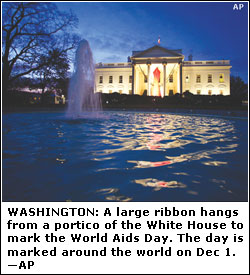 PARIS: This year’s World Aids Day sees health watchdogs battling against complacency, warning that Aids still kills some 6,000 people each day even if the estimated toll of infections has fallen and life-saving drugs are being rolled out.
The Dec 1 event is traditionally a time of grim stocktaking.
Aids campaigners sound the alarm over the disease’s rampage through Africa, the threat it poses to Asia and former Soviet republics and the risks to vulnerable communities such as sex workers, drug users and gay men.
Superficially, 2007 is a rare moment for celebration — and this is what worries the experts.
On Nov 20, the agency UNAIDS announced that the prevalence of HIV or AIDS — the percentage of the world’s population living with the HIV virus or the disease it causes — peaked sometime in the late 1990s.
UN Aids also reduced its estimate of the number of people living with HIV or Aids, from 39.5 million in 2007 after 33.2 million in 2006, after overhauling its methods for collecting data. The tally of new infections has fallen, too, from 3.0 million in the late 1990s to an estimated 2.5 million in 2007.
Meanwhile, the agonising effort to bring antiretroviral drugs to Africa, where more than two-thirds of the people with HIV/Aids live, is now bearing fruit.
At the end of 2006, more than two million people were getting the vital pills, a 54-percent increase over the previous year, according to the World Health Organisation (WHO).
Put together, these figures may give the impression, for some, that a once-irrevocable death sentence is now a manageable chronic disease.
But experts and advocacy groups say that this is a dangerous mirage.
“Despite substantial progress against Aids worldwide, we are still losing ground,” says James Shelton of the US Agency for International Development (USAID) in a commentary appearing on Saturday in The Lancet, a London medical journal. Despite progress in the drug rollout, treatment is still only available to about 10 per cent of those in need, notes Shelton.
In developing countries, “the number of new infections continues to dwarf the numbers who start antiretroviral therapy in developing countries,” he points out.
“We must not be complacent about the Aids crisis,” Paul Zeitz, executive director of the Global AIDS Alliance, said.
“There is still a huge unmet need for basic HIV/AIDS services, including for orphaned children,” he said.
The revised toll “does not change the fact that only a tiny fraction of HIV-positive pregnant women are getting the treatment they need to avoid passing the virus to their newborns and to stay alive to raise them.” One of the biggest areas of concern is money.
The war against Aids “continues to be undermined by a global resource gap,” says Alvaro Bermejo, executive director of the International HIV/Aids Alliance.
According to the United Nations, there is currently an eight-billion-dollar shortfall in resources to fight Aids, including for basic prevention, treatment and care for orphaned children.
To meet the Group of Eight (G8) goal of providing universal access to antiretrovirals by 2010, 42 billion dollars will be needed -- so far, only 15.4 billion is in the kitty.
Looking to how the battle against Aids unfolds in the coming years, experts predict a combat that will increasingly be less monolithic.
“In the future it is likely that there will be two different kinds of epidemics -- a generalised one centered in sub-Saharan Africa and a concentrated one in specific high-risk groups worldwide,” The Lancet said Friday in an editorial.—AFP
| © DAWN Group of Newspapers, 2007 |