0
0

For whom the bell tolls
 While Pakistan’s leadership is in the process of adjusting itself to unpalatable new realities, here’s another one to ponder: it is no longer possible to muzzle the country’s electronic media. The space they occupy and the power they wield cannot now be diminished.
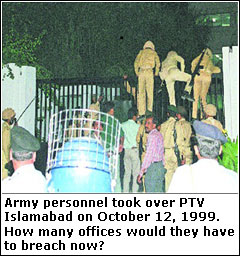
Times have changed since the establishment – or for that matter, any public body – could hope to conduct nefarious business under the shroud of censorship. The past is another country, as they say, and Pakistan is no longer the place where the transmission of information can be prevented by the simple expedient of sending soldiers to scale the walls of a state-owned television network, as happened in the unfortunately historic events of 1999. Given that the local news channels are children of the new millennium, these shocking images were then broadcast only by international networks that the majority of the country could not access. When similar tactics are attempted today, a huge local audience almost immediately suffers vicariously the effects of intimidation and harassment — a point effectively made when the Islamabad offices of Geo TV were invaded by the police on March 16 and those of Aaj TV were besieged by gunmen in Karachi on May 12. (Which is not to say that the geniuses in charge learn from past experience.)
Rapid technological advances in the media paired with the growing interdependency of nations mean that there is increasingly little room in which leaders such as General Musharraf can manoeuvre. In Pakistan’s context, for example, if we accept for the purposes of argument that a leader, elected or otherwise, proves able to muzzle the press, influence broadcasts and interfere with the radio waves, such moves would nevertheless be followed in minute detail by the international press. Big Brother, omnipresent today as never before, will always be watching.
It is quite possible that the revolution-of-sorts that appears to have galvanised our judiciary could not have been achieved without the television cameras. In capturing the smugness of the president’s men, contrasted with the raw emotion on protestors’ faces and the determination of men such as Chief Justice Chaudhry and Barrister Aitzaz Ahsan, the coverage brought the issue to real and pulsating life, so close that a hundred and fifty million people could virtually reach out and touch it — and thereby invoking their loyalty.
The effects that have so far been felt of the constant scrutiny of public and/or official action are really only the beginning. At the moment, the media are merely stretching the wings of their recent independence and testing their strength. The changes yet to be wrought may well be immense. For example, it is certain that in the upcoming polls, voting procedures will be captured on film in as much detail as possible with cameramen actively searching out any hint of foul play or confusion. Given the significance of the elections, it is not difficult to imagine a television crew deciding to follow the journey of the ballot boxes collected from the polling booths, simultaneously bringing the electoral process closer to the citizens and rendering rigging that much more difficult.
A picture really is worth a thousand words, which gives television a certain edge over print in terms of immediacy. What remains to be seen, however, is how far the channels recognise their responsibilities in terms of honest and well-researched journalism, editorial responsibility and resisting the lure of ‘if it bleeds, it leads’ sensationalism.
Post script: The fact that the army was responsible for the assault on PTV Islamabad goes a long way towards explaining General Musharraf’s indignation over media coverage during CJ Chaudhry’s fight for justice and the Lal Masjid stand-off. He’s a military man, after all, and unlike civilians, soldiers do what they’re told without any backchat.
| © DAWN Group of Newspapers, 2007 |