0
0
A war cloaked in hypocrisy
THERE is much that is disturbing about the current US drive to war against Iraq — the prospect of war itself with its attendant death and destruction, the sidelining of the United Nations and thus the rule of international law, the threat that Iran or North Korea could be next, and so on. Perhaps most galling, however, is the veneer of justification and morality with which the whole exercise is being coated.
We are being told that this is a war to end Iraq’s sponsorship of terrorism; to disarm Iraq; to rule out the possibility of weapons of mass destruction (WMD) being used by the regime against its neighbours or western targets; to stop it from passing WMD to terrorist groups; to bring freedom, democracy and sustenance to the long-suffering people of Iraq; to bring peace to that other Middle Eastern hotspot: Israel-Palestine. All in a tone of righteousness and utter conviction.
War against Iraq is presented as an absolute necessity; not to do so would be a failure of duty and evasion of responsibility. As Tony Blair, one of the war most earnest proponents, put it: “I do not want to be the prime minister when people point the finger back from history and say: ‘You knew those two threats (terrorism and WMD) were there and you did nothing about it’.”
For all Prime Minister Blair’s earnest conviction and President Bush’s resolute righteousness, the fact is that the case presented for war simply does not add up.
In the seventeen months since the attacks of 9/11, the only connection that the Bush administration has been able to establish between Al Qaeda and Iraq is that Abu Musab al-Zarqawi had his leg amputated in a Baghdad hospital. Zarqawi is a Jordanian member of Al Qaeda. In making this link, the fact that Osama bin Laden and Saddam Hussein occupy completely opposite poles on the spectrum of Islamic thought — extreme fundamentalist versus total secularist — is conveniently ignored.
In sharp contrast to their political masters, both American and British intelligence agencies concede there is no Iraq-Al Qaeda connection. A top-secret British defence intelligence report dated January 12 and leaked to the BBC’s ‘Today’ programme states: “It is assessed that any fledgling relationship foundered due to mistrust and incompatible ideology. Osama bin Laden views the Baath as an apostate regime. His aim of restoration of an Islamic caliphate, whose capital was Baghdad, is in ideological conflict with present-day Iraq.”
Anglo-American concerns about Iraq WMD arouse scepticism both because of the shoddy and unconvincing evidence cited to prove their existence, and because of the West’s past record. Iraq demonstrated its WMD capability in the 1980s when it used chemical weapons against Iranian soldiers in the Iran-Iraq war, and gassed 5,000 of its own Kurds at Halabjah. At the time, the West shared opposition to Iran caused it to ignore those atrocities.
Much of Iraq’s arsenal of WMD was destroyed by Unscom inspectors in the 1990. Some undoubtedly remains: the question is how much? Is it weaponized and would Saddam use it? Unmovic inspectors are currently on the ground in Iraq trying to find answers to those questions. Their preliminary report to the UN Security Council presented evidence both in favour of and against Iraq possession of WMD. In closing they stressed the need for greater Iraqi cooperation and for more time to complete their work.
On Wednesday Colin Powell made a presentation to the UN Security Council, trying to prove the threat from Iraqi WMD. That, at least, was the American and British spin on his evidence. Many experts have disputed both the findings and the interpretation given to them. The overall credibility of Powell case can be gauged from an embarrassing disclosure two days later.
Powell cited and praised a Downing Street dossier, “Iraq, Its Infrastructure of Concealment, Deception and Intimidation”. It has since been revealed that much of the evidence given in that dossier was plagiarized word for word (including grammatical mistakes) from the PhD thesis of an Iraqi exile. The disturbing point about this revelation is not that the British government failed to play by academic rules and attribute the real author, but that the most compelling evidence it could find against Iraq came from an outdated academic paper. As Peter Kilfoyle, one of Blair former junior defence ministers, put it: “It just adds to the general impression that what we have been treated to is a farrago of half-truths, assertions and over-the-top spin.”
The final nail in the WMD-justification coffin is the attitude of Iraq neighbours. One would have thought that as the most likely targets of an Iraqi WMD attack they would be clamouring for war on Baghdad. Incredibly, they seem not to share Washington and London fears about the Iraqi threat. Even more incredibly, they are totally opposed to war against Iraq. Iraq neighbours are more alarmed by the humanitarian and geo-political consequences of a second Gulf War, than by the prospect of Iraqi chemical and biological warheads. [Note that the UN is predicting a humanitarian disaster: two million refugees, widespread famine, epidemics of cholera and dysentery, ten million civilians in need of urgent aid.]
George Bush shares their humanitarian concerns. In his recent State of the Union address, his message for the brave and oppressed people of Iraq was: “Your enemy is not surrounding your country, your enemy is ruling your country.” And he promised: “As we and our coalition partners are doing in Afghanistan, we will bring to the Iraqi people food and medicines, and supplies and freedom.”
Mr Bush must have been referring to some imaginary Afghanistan, for the real Afghanistan is a country in which the draconian rule of the Taliban has given way to the harsh oppression of regional warlords. The real Afghanistan is a country desperately in need of international peacekeepers to bring peace and security, and international assistance to begin the massive task of reconstruction. If that is the future being promised to the Iraqi people, they have every reason to worry.
The US president’s words are further belied by the utter lack of preparations to deal with a post-war humanitarian crisis. This is in sharp contrast to the advanced military preparations — massive troop deployment, every possible contingency covered. At the World Economic Forum in Davos, the UN High Commissioner for Refugees, Ruud Lubbers, took the unprecedented step of going public with his complaints: “There is not one government [which] has come to me with money.”
The final component of the post-war rainbow is peace in the Holy Land. Those presenting this scenario do not clarify how the removal of Saddam Hussein will make a viable Palestinian homeland — the essential ingredient for peace — more likely. Perhaps they expect that having resolved one Middle East crisis, the Bush administration will develop a sudden enthusiasm (wholly absent to date) to resolve the other. Perhaps they think Yasser Arafat will be cowed into reforming his beleaguered Authority, and making concessions on previous obstacles to peace such as East Jerusalem and refugees. Perhaps they expect that with the Iraqi threat gone, Ariel Sharon will be more ready to compromise on Israeli security by giving land to the Palestinians.
The route to peace in the Middle East is neither so simple nor so sure. The principal obstacle to peace so far has been the Israeli government: its failure to honour the Oslo accords, its continued expansion into the occupied territories, its continued oppression of the Palestinian people. That obstacle will not be removed by the ouster of Saddam Hussein. Quite the opposite: the assertion of American dominance in the region will be seen as a green light by Ariel Sharon to carry out further oppression and occupation. Peace will become an even more remote prospect.
In conclusion, there is neither a terrorism, nor WMD, nor human rights, nor Middle East peace justification for waging war against Iraq. All these are simply a veneer for the actual motives: an unsavoury mix of domestic politics and strategic interests.
War wins votes. The war on terrorism has brought a massive boost to Bush popularity. The war on terrorism failed to find its initial target, Osama bin Laden, and hence needs a new one. After two years in office Bush has nothing else to trumpet: sharp economic decline, corporate scandals, a foreign policy marked by more broken fences than mended ones. The American economy is heavily dependent on oil; Iraq has the second largest oil reserves in the world. These are the factors driving America to war. They are vastly different from the reasons being presented before the UN and public opinion, as a justification for military action against Iraq.
War against Iraq is now certain. None of us can stop it. But we can at least plead to be spared the justifications and moralizing — wholly unjustified and immoral — with which it is being waged.
Between the bar and the bench
THERE is an old Negro spiritual which starts with the words ‘I’d rather be on the inside looking out than on the outside looking in.’ In Pakistan, a good 98 per cent of the people who encompass a bewildering variety of trades and occupations in a vast panoply of artisans and farmers, ethnic groups and tribes, are on the outside, trying to get a peep into what is happening in the capital. One wonders what they might have made of the political events of the last six weeks.
First, there was the January 15 by-election for 10 National Assembly and 20 provincial assembly seats. There were no last-minute jack-in-the-box surprises, as happened in the case of Sattar Afghani of the MMA in the October national election in Karachi. As predicted, there was a low turn-out and a complete lack of enthusiasm, and in one of the NA constituencies in Sindh violence caused the death of three persons.
There were the usual accusations of rigging and kidnapping of activists of a political party by rival parties. The upshot of it all, however, was that the PPP, a mainstream political party, once again got the wrong end of the stick and the process of sidetracking or negating the will of the people was continued according to a preconceived plan. The boycott of the PPP parliamentarians resulted in a victory for politicians who have little or no actual representation in the province of Sindh.
The second bit of news that came down the pike was the obduracy of some of the senior members of the PML(Q) who, on taking up government office, were refusing to give up their party portfolios, at the risk of being disqualified from both under the provisions of the Political Parties Order. This is all the more astonishing, not only because the people are now beginning to take the PML(Q) seriously as a political party, but also because these were the very people who rebelled against Nawaz Sharif for hanging on to both party and government offices.
The popular fiction is that the PML(Q) was formed on the platform of introducing a more democratic structure. The party even went to the extent of passing an amendment to their constitution which prohibited holding of party and government offices by same persons, claiming loftily that this is what the founder of the nation would have wanted. It does look as if the scribes in the president’s government were impressed by this display of altruism , because the PPO expressed, in no uncertain terms, that party and government offices had to be kept separate and distinct.
In spite of the logic behind the move, the order does not really make much sense in a parliamentary democracy. This has now boomeranged on the office holders who do not relish the idea of new party leaders emerging and creating their own power centres. The ideal situation is to have a parliamentary leader and a party chief, in one and the same person. Could it be, a forty-something European diplomat asked me at a recent reception, that the PPO provision was deliberately designed to ensure that the King’s party parliamentarians were kept in check?
I took this to be a rhetorical question. But it did make me think. It also struck me as rather odd that the prime minister, who was the only PML(Q) member to have given up his party post on assuming his new responsibilities in the government, has not exerted more pressure on his recalcitrant colleagues to follow suit.
The third piece of delectable news, which intrigued members of the legal fraternity, and provided a sense of euphoria to defeated National Assembly candidates, was the scrapping of Article 8AA of the Conduct of General Election Order 2002, by the Supreme Court.
This order centred on losers being debarred from contesting Senate polls on the plea that the candidates had already been rejected by the electorate. In a unanimous verdict the court proffered two arguments : the decision was not part of the original LFO, and consequently those affected could not have known they risked disqualification by contesting NA elections; and that this article violates Article 25 of the Constitution which enjoins equal opportunity for all.
Interestingly, this is the first rejection by the Supreme Court, of a provision of the LFO, which it felt was in direct conflict with the spirit of the Constitution. The various bar associations, and politicians from the MMA and PPP, are biting their nails and wondering if this might be the first step in the gradual dismantling of the LFO. But there is really no evidence that this is likely to happen in a hurry. There is, in fact, another way of looking at the issue. The Supreme Court judgment has done little more than make a distinction between the original LFO and an amendment which was obviously something of an afterthought.
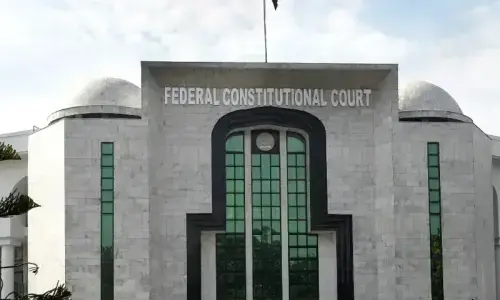
The fourth significant development is also in the legal arena. But the difference is that this time it is the lawyers who are taking on the judges. The bar is on a collision course with the Bench. The issue revolves around the retirement age of judges. The National Conference of Lawyers’ Representatives in Islamabad is ready to take the battle into the courtroom. At issue is the constitutional validity of an LFO provision extending the retiring age of the members of the higher judiciary. Cynics are now asking the question: would a bench of the Supreme Court be willing to knock down an order which allows them three more years of service beyond the previously prescribed tenure.
The conference has called on the judges to retire according to the age limit that was in existence in the past. This has now become a highly contentious issue, especially as one judge has decided not to continue beyond the ‘official’ retirement age. The conference has also thrown in a few spanners. Lawyers have threatened that they would not appear before judges who opts for the extension. They have also vowed not to challenge the LFO under the present judiciary. And that hoary old chestnut about judges who took an oath under the PCO requiring to take a fresh oath, has also been pulled out of the fire.
A suggestion was also made to their lordships that when they reach the ‘official’ retirement age, they should not attend court until the matter is satisfactorily settled. This gesture, the lawyers believe, would certainly enhance the prestige and reputation of the higher judiciary. Recent events have shown that this is no longer a local issue. The Supreme Court Bar Association has widened the spectrum by sending a copy of its resolution to the United Nations, in the hope that the latter might intervene.
The bar association has argued that the LFO provision extending the retirement age of judges is in breach of the 1948 Delhi Declaration, now part of the UN Charter, which binds all signatories to ensure the independence of the judiciary. The association has specifically pointed out that Pakistan is a signatory of the Declaration.
The independence of the judges came under severe scrutiny in the conference. The rhetoric was fierce and the criticisms of the judiciary harsh and unfair in many respects. The problem is, the judiciary is still being equated with the controversial verdict of the late Justice Munir on the 1953 dismissal of the Khwaja Nazimuddin government by Governor-General Ghulam Muhammad. ‘The doctrine of necessity’ is a phrase that Pakistani lawyers would wand expunged from the legal lexicon..
The seriousness of the conflict can be judged by the fact that the lawyers are planning to observe March 8 as a black day, if the Chief Justice of Pakistan does not retire on reaching the statutory age on 65. There are also plans to mobilize public opinion during the third week of March during which those judges who continue in service after superannuating will be identified.
The basic issue of whether the Supreme Court was, in the first place, empowered to allow the former chief executive to make amendments to the Constitution, has not yet been settled. Nor has the issue whether some of the amendments that the chief executive did make, particularly those which ensure that the military will continue to have a strong grip on the affairs of the state, exceeded the parameters set by the Supreme Court.
There is really only one way out of this legal quagmire. Let parliament sort out the mess. If the MNAs and the Senators, in their infinite wisdom, decide to re-fix the retirement age of the judges, it would remove much of the confusion and misgivings over the question of extension of the retirement age of the judges.
Email: a-mooraj@cyber.net.com
Powell’s prosecution fails
US Secretary of State Colin Powell used the UN Security Council on February 5 to make Washington’s case for war against Iraq. The widely respected Powell delivered a weighty indictment based on a mosaic of circumstantial evidence obtained by US intelligence.
Powell’s indictment encouraged those favouring war. Sceptics dismissed it as a farrago of dubious claims. A good defense attorney would have had most of Powell’s charges thrown out of court. France, Germany, Russia and China concluded: Powell’s indictment showed the need for stronger, continued inspections rather than war.
Powell’s charges:
* Recorded conversations — Iraqi officers discussing removal of a “modified vehicle” and deleting references to nerve gas from documents. If genuine, and not spliced, these radio intercepts suggest Iraq may have been hiding some biowarfare arms, or was racing to eliminate any residues or evidence of its 1980s weapons programme in advance of UN inspections. Considering the US military loses tens of millions of weapons and supplies each year, and the US Los Alamos nuclear centre has misplaced large amounts of nuclear materials, it is not implausible that Iraq has bits and pieces of chemical arms scattered about, such as the empty 122mm rockets recently discovered in a bunker, that escaped its UN-mandated inventory.
* Satellite imagery — Ammunition storage bunkers which Powell claimed were used for chemical weapons that were moved out prior to inspection. But UN inspectors examined them and found nothing suspicious. ‘Sniffers’ used by inspectors can detect the past presence of chemical and biological weapons.
* The infamous mobile biological weapons labs mounted on trucks — aka ‘Saddam’s vans of death.’ Powell claimed defectors reported there were 18 cruising around in Iraq. Defector information is always suspect. UN chief arms inspector Hans Blix said his men had examined some of the ‘death trucks’ and found they were, in fact, mobile food testing labs.
* Powell alleged 100-400 tons of chemical agents, including four tons of VX nerve gas, and some of its biological weapons, originally supplied to Iraq in the 1980s by the US, and secretly developed by British technicians, were still unaccounted for. This remains a major question. Iraq says it destroyed them, but lacks proper documentation. They may be hidden. But most were made 17-20 years ago, and may be degraded or inert from age. Nerve gas and germs are weapons of mass destruction. Mustard gas, the bulk of Iraq’s chemical weapons, is not, being no more lethal than napalm or the fuel air explosive the US and Russia are using in Afghanistan and Chechnya, respectively.
* Powell’s claims that Iraq was developing nuclear weapons were weak. UN nuclear inspectors have repeatedly contradicted US claims. They concluded the notorious aluminum tubes Powell claimed were for uranium-enrichment centrifuges were actually conventional 122mm rocket artillery casings.
* According to UN Resolution 687 after the 1991 Gulf War, Iraq is permitted missiles with 150km range. The US charges Iraq is testing missiles that have flown 14-20 kms further. This is nothing unusual when testing a new propellant system. Powell also accused Iraq of developing a 1,200-km missile that could reach Israel, based on photos of an enlarged test stand. Iraq may have a dozen or so old Scud missiles hidden away.
* Iraq is dragging its feet on private interviews of its nuclear scientists, Powell charged. True. Hawks in the Bush administration and Israel say the only way to ensure Iraq never builds strategic weapons is to jail or kill all of its 10,000 military scientists and technicians — who also face the wrath of Saddam Hussein if they appear to turn over incriminating evidence.
* Powell claimed he had proof positive that Iraq was linked to Al Qaeda through Ansar al-Islam, a small, 600-man Islamist group in the Kurdish region of northern Iraq (not under Saddam’s control), and through a “deadly terrorist network” led by one Abu Musa al-Zarqawi. The first charge was immediately dismissed by Ansar’s leader, Mullah Krekar, a long-time, bitter foe of Saddam Hussein. Zarqawi turned out to be an unknown nobody, not on any FBI wanted list. His name came from suspects being tortured in Jordan. Most reputable experts on terrorism scoffed at Powell’s overblown charges.
Sitting silently behind Powell was CIA chief George Tenet. His agency has directly contradicted White House claims that Iraq had nuclear capability and posed an imminent threat to the US or anyone else. In a recent article, former CIA Iraq desk chief Stephen Pelletiere debunked false claims, repeated by Bush and Powell, that Iraq gassed its own Kurdish citizens.
Note: America’s two most recent major wars — Vietnam and the Gulf — began with release of faked ‘intelligence’ information: the non-existent Gulf of Tonkin attack in 1964, and doctored photos of a non-existent Iraqi invasion build-up on the Saudi border in 1990.—Copyright Eric S. Margolis 2003
In Michael Jackson’s face
JUST when I think television is a “vast wasteland,” the networks announce a program that blows whatever mind I have left.
Recently, NBC announced as part of the February sweeps it will present a one-hour prime time special titled “Michael Jackson, Unmasked.” It will be devoted to a study of Michael Jackson’s career by studying his face.
A TV sweeps month is a very important time for the networks because they can set their advertising rates based on the ratings of shows. The word in Hollywood is that one of the NBC suits came up with the idea.
I got him on the phone. “How did you ever think of it?”
“It came to me after Michael held his baby over the balcony and the news was played for weeks on television. I said to myself, ‘This is a man of many faces.’ So we researched it.”
“And?”
“He was a superstar at age 11. He was beloved by his fans and made hit after hit at 14. And then he became addicted to plastic surgery. The first thing he did was make his nose more ‘white.’
“Then he got into trouble, not with his plastic surgery, but because he was accused of child molestation. Pepsi Cola dropped him as a spokesman, and he developed a persecution complex.”
“But he still could sing?”
“Yes, but his personality changed and he was no longer the happy-go-lucky entertainer he was before. He blamed his troubles on his face, so he got a new one. He received a fake chin implant and his face skin was stretched. He started wearing lipstick the same shade that Diana Ross wears.
“In his defense, he said millions of people have their faces uplifted without a lot of publicity.”
“I can see why you want to show this during the sweeps period.”
“In 1999, he got a new nose, new cheeks and a smaller jaw. Elizabeth Taylor still thinks he’s cute, and she will talk about all the Michael Jacksons she has known.
“We are trying to sell advertisements to a lipstick sponsor. Michael has an entourage of plastic surgeons on his payroll, and every time he has a free moment he gets a facelift.”
“Who is going to play Jackson?” I asked. “We conducted a search. We wanted a very virile person who could also wear lipstick and eye shadow.
“We want this show to have class. We intend to kick the reality shows in their buttocks. At the same time, we want to attract an older audience that has had facelifts or used Botox. We’re aiming for Super Bowl ratings.”
I admitted I was impressed. If the show is a big success, Michael Jackson will have a new career and then any nose he wants.— Dawn/Tribune Media Services
War-makers, bribees and media manipulation
ONE of the most dramatic features of the Bush-Blair drive to war — actually, “massacre” given the imbalance of forces — has been the split and struggle between governments and their citizenry. It might be argued that this on-going struggle demonstrates that democracy works. But such struggles occur even in authoritarian systems, where there are frequent protests and strikes.
In democracies governments are supposed to represent the people, so that there should not be a need for massive protests to get the government to do what the public wants done. We should not see “democratic” governments trying furiously to drag their country into actions that people oppose — and that many oppose passionately — even after being subjected to intense propaganda and disinformation.
War is extremely useful to elites, not only for carving out opportunities for business abroad, but for its internal effects. As Thorstein Veblen explained 99 years ago, war provides “the largest and most promising factor of cultural discipline.... It makes for a conservative animus on the part of the populace. During war time, and within the military organization at all times... civil rights are in abeyance; and the more warfare and armament the more abeyance.” And, crucially, war “directs the popular interest to other, nobler, institutionally less hazardous matters than the unequal distribution of wealth or of creature comforts.” (The Theory of Business Enterprise [1904], pp. 391-3).
Right-wing business administrations gravitate quickly to war and fear- mongering to help cover over their service to their principals (i.e., making income distribution more unequal): Immediately upon taking office in the early 1980s Reagan mounted a war on terror and on the “evil empire,” and his clone George W. Bush has done the same two decades later. They have both pressed for soaring arms budgets to meet inflated or manufactured threats, and both have been given aid and comfort by the Free Press.
Four-fifths of the US public believe Saddam was involved in acts of terrorism against the United States (according to a December 2002 Tribune/WGN-TV poll), and a majority today fear him and think that this regional bully, who has been almost entirely disarmed and who the Bush gang is toying with like a Bengal tiger might play with a malnourished mouse, actually poses a military threat to the pitiful giant. This is the ultimate propaganda system at work. But despite these irrational and manipulated fears, almost a third of the public (29 per cent) remains opposed to the war and a solid majority (59 to 37 per cent in a recent NYT/CBS poll) favours giving the UN and inspections more time.
On the basis of this opposition and these doubts a major peace movement has come into being to oppose the war—and it has come into existence and grown at a far quicker pace than during the Vietnam war. The February 15 demonstrations here and abroad were possibly the largest ever, to the consternation of the war party. This peace movement could stop the war if it had any kind of support from the mass media in focusing on the illegality of the Bush plan, the serial lies used by the war party, its compromised position in prior support of Saddam’s weapons of mass destruction, the hidden agenda (oil, support of Sharon, cover-up for Bush’s internal policies), and the recklessness and human and material cost of this forthcoming aggression.
But the US mainstream media is currently serving as propaganda arms of the state, which is helping the war party maintain just enough support and public inertia to sustain their political position (Blair in Britain is in a less favourable position as war-maker).
The dichotomy between governments and people as regards the Iraq war-massacre is a global phenomenon, reflecting both the power of the United States to coerce and bully and the fact that democracy in the New World Order is increasingly an undemocratic facade.
Bush himself is a coup d’etat president, who garnered fewer votes than his main rival even with an immense treasure chest from his corporate backers and the illegal disenfranchisement of large numbers in Florida. He was obliged to fall back on a corrupt Supreme Court to anoint him and a “liberal media” to swallow this coup without complaint (see Greg Palast’s account in The Best Democracy Money Can Buy).
Throughout the world corporate and financial power has drained democracies of substance and made them plutocracies. It is a matter of course now to find that “democratic” leaders systematically carry out important economic, social and arms/war policies that their people disapprove. The people increasingly have no effective choices—all the “practical” candidates (those electable in a plutocratic political system, as Ralph Nader was not) offer little or no alternative and regularly betray their promises to ordinary citizens when they had campaigned with populist messages.
So the line-up of governments versus people across the globe in joining the Bush massacre programme is entirely comprehensible. The “old Europe” resistance to the Bush war-massacre programme is exceptional, and reflects some residual responsiveness of French, German, Belgian and other leaders to mass popular demands, along with national self-interest in avoiding a potentially devastating war and feedback from that war. Many other western governments have gone along with Bush-Cheney despite massive public opposition (polls show oppositional votes of 75 per cent in Italy, 74 per cent in Spain, 70 per cent in Britain, majorities in opposition across the board).
In Eastern Europe also, while the governments line up in support of massacre, polls show massive public opposition—in Hungary, 80 per cent, in Latvia 74 per cent, a majority in Croatia.
It is notable that even the Voice of America acknowledged on February 6 that the ten East European countries that endorsed Colin Powell’s position at the UN Security Council “are seeking to join the NATO alliance.” It was implied that perhaps the desire to avoid jeopardizing entry might have affected their vote. It is well-known that the United States bullies, bribes and threatens allies who step out of line, and they often succumb.
Today, Germany and France are vilified in the United States and even these strong states are threatened with retaliatory action for opposing US plans. Lesser and weaker countries are even more vulnerable.
Poor Turkey, for example, a US client, military base, debtor, and aid-dependent, is under heavy US pressure to allow the stationing of Iraq invasion forces on its soil, when 85 per cent or more of its population is opposed to the war. Prime Minister Abdullah Gul stalls for time, but in one account, “Washington told him unequivocally that it expects full cooperation without restrictive conditions...” (Ha’aretz, Feb. 6, 2002).
The United States will get its way, because “The Turkish government and its military will not hide behind public opinion,” according to an official in the Turkish foreign ministry. In other words, what the people want will not affect government policy, which, according to this same official, “is what makes Turkey America’s most valuable ally” (Catherine Collins, “Turkey Juggles Duelling War Demands,” Chicago Tribune, Jan. 14, 2003).
The February 5 letter of the ten Eastern European governments most of which hoped to get into NATO, which cited Colin Powell’s “convincing evidence” for war, was written before he gave his speech, and an earlier letter of eight European leaders on “United We Stand” (including Blair, Aznar, Berlusconi) called for support of the Bush position and “full compliance” with Security Council resolutions to “maintain credibility” (as regards Iraq, not Israel, Turkey and Morocco, but no doubt these leaders will soon produce a letter covering those cases).
This letter by the eight had been organized by the Wall Street Journal to give a lift to the war party, and it was noted in the “news” column that this effort threatens to “isolate the Germans and French” and may “smooth a path to war” (Marc Champion, “European Leaders Declare Support For US on Iraq,” Jan. 30, 2003). Featured on the front page and with the letter reproduced along with photos/bios of these eight leaders on the editorial page, this is a pretty illustration of an integration of news and editorial operations in service to the propaganda needs of government.
A major difference between the “old” and “new” Europe is between relatively strong and relatively weak states, the former better able to resist bullying and more responsive to public demands; the latter, more needy, dependent, and with leaders handed down from a corrupt and authoritarian tradition.
Russia falls into the last class, with Putin jockeying to maintain good relations with his dear friend and patron George Bush while trying to keep an image of minimal independence and preserve rights to Iraq oil. Seamus Milne is surely referring to Putin when he writes of the US strategy as giving assurances of “oil contracts here and nods to ethnic cleansing there” (“Direct Action May Become A Necessity: The UN is being used as a fig leaf for war in the face of world opinion,” Guardian, Jan. 16, 2002).
The people are fighting back everywhere against the DC Axis of Evil and its plans. The people’s surge on February 15 is a set-back for the war party. Even further pressure is needed, however, to stop the war machine. High priority should be given to pressing the media to cease their unquestioning service to the war-makers. With even a modest change by the mainstream media in the direction of fairness and openness to views that are held by the global majority, the tide could be turned. — Courtesy: Z-Net