0
0

The MQM factor
Sindh is probably the most difficult province to govern. And with the PPP winning 67 and MQM 41 in a house of 168, the matter of governance seems to have become even more difficult. In any other situation, this result should have posed no unsurmountable problems as the two larger parties could have entered into a coalition arrangement on the basis of give and take and governed the province together for the whole term without much difficulty. But such a development seems impossible to countenance given the extreme hostility the two parties harbour against each other. The Muttahida can hardly be expected to forget and forgive Naseerullah Khan Baber’s Karachi campaign during the second Benazir government. The PPP, on the other hand, seems unable to forget and forgive the MQM for walking away from the coalition at the Centre in the first Benazir government when it was facing a no-confidence motion. Both the PPP and the MQM have their own respective self-serving arguments for what they did respectively in 1993-96 and in 1988-89. And the two have so far refused to accept that on both occasions they had willingly played into the hands of vested interests which conveniently used them against each other in order to promote some narrow anti-national selfish agenda.
In the early 1980s when the rest of the three provinces were at peace with the mighty Centre, it was Sindh and Sindh alone which had challenged the then military regime by supporting the pro-democracy movement of the MRD. The Centre at that time was rolling in Afghan-related US gold and had no dearth of resources to suppress the movement. So, it used its own guns and the US gold to the hilt to divide the province on rural and urban lines by sharpening on the one hand the sense of cultural superiority the Mohajir’s of urban Sindh have been suffering from since they crossed over to the province from India and on the other by making the rural Sindhis believe that Mohajirs were the real cause of their unending deprivations and destitution. For short term gains, the vested interests had caused a long time cleavage in a province that was known for its peace and tranquillity until the 1980s. And the city of Karachi which until that time had the best socio-economic infrastructure in the whole of Pakistan as well as the neighbouring Middle East was turned into a den for drug pushers, gun runners and mafia killers.
The then Sindh chief minister, the late Jam Sadiq, and then his prodigy, Muzzafar Ali Shah, caused further harm to the unity of the province by playing the hatchet men of the vested interests. Even Liaquat Jatoi, the present minister of industries, who became the chief minister of the province in the second Nawaz Sharif government, could not but follow the same line. All this was being done simply to punish the province for supporting the Movement for Restoration of Democracy (MRD) in the early 1980s and also to pre-warn similar elements in other provinces against harbouring such ideas. This time again, an attempt is, seemingly, being made to get Arbab Ghulam Rahim (who, perhaps, does not have the support of even 20 MPAs) elected as the chief minister with the MQM voting for him. Arbab is also likely to be given the same task as his predecessors. It was with MQM votes that the late Jam and then Muzaffar and lastly Liaquat were elected as the CM of the province. And during their respective tenures, they only deepened the cleavage between the rural and urban Sindh at the behest of the establishment. The tenures of Qaim Ali Shah and Abdullah Shah of PPP as chief ministers, too, were periods of mayhem and murder.
So, what is in store this time for Sindh when the provincial assembly meets on December 12 for oath taking? Well, in case it is not possible for PPP and MQM to join hands, then the larger of the two, the PPP, could enter into coalition with a couple of smaller parties and make the government. But then with whom? PML(Q) and MMA are out of the question. The PML(F) does not have enough votes on its own to help the PPP form the government. But there are two other factors which need to be considered seriously before opting for a PPP-led government. The first is the difficulties the provincial government would face in its relations with the Centre where the PPP has already opted to sit in the opposition. Secondly, it has been seen that the MQM while in government makes the life of its coalition partners miserable with an impossible demand a day, it becomes simply lethal in opposition. No government has been able to govern with any degree of confidence with the MQM sitting in the opposition. Such an arrangement would lead to a quick dissolution of the government.
With all other genuine options exhausted, we are left with only the Musharraf option. A PML(Q)-led government supported by the MQM. Somebody quoting Chaudhry Nisar Ali Khan of PML(N) said the other day that soon after the October 10 election Nawaz had advised his party to have nothing to do, whatever the circumstances, with the MQM. Both Nawaz and Nisar should know. They had ‘bought off’ the MQM or as Gen Aslam Beg disclosed later, he had delivered the MQM when Nawaz was spending right and left to oust the first Benazir government through a no-confidence motion. Next, in the first Nawaz government, Nisar won the hostility of the then COAS, the late General Asif Nawaz by openly opposing the Army’s campaign against MQM and then finding the same party creating serious governance problems for the second Nawaz government on Sindh issue. Now, perhaps, is the turn of the Chaudhry brothers to learn their MQM lessons. The jolt the Chaudhry brothers have already suffered at the hands of the MQM soon after obtaining their support at the Centre should give them an inkling about what they would be walking into in Sindh with the Muttahida as PML(Q)’s coalition partner.
There is, however, one last option which has never been tried before and may, if at last put to test, prove to be the last straw on MQM camel’s back. That is, give the ‘angels’ their due. Let the MQM form the government in Sindh with support from the PML(Q), the SDA, the NA, the PML(F) and the independents. The Centre would give such a provincial government every cooperation it would need as the MQM is a crucially important partner of the ruling PML(Q) in Islamabad. On the other hand with the responsibility of the entire province falling on its shoulders, perhaps, the MQM too would find it wise and prudent for a change to seek the cooperation of the opposition, both the MMA and PPP (MQM’s mortal enemies both) to govern Sindh in a fashion that would be different from what the province has suffered in the last 12 years mostly because of the intransigence and intractability of the MQM itself and also because the MQM had agreed more readily and more willingly than the other parties whenever the establishment needed its help to promote its narrow, selfish and anti-national agenda of keeping the province perpetually divided.—Onlooker
Why have libraries?
“What do we, as a nation, care about books? How much do you think we spend altogether on our libraries, public or private, as compared with what we spend on our horses?” Well, well, well. That was Ruskin asking this question in the year 1865. We, in the first dark decade of the inauspicious 21st century can say automobiles instead of horses and get a less respectable answer from our government than what the great British essayist might have got from his. For cars surely cost more than horses and there might not have been that many horses in the England of Ruskin’s time as we have cars in our roads today. It would be an interesting comparison if we knew how much public money was being burnt annually on the maintenance of official cars and what was the share of libraries in the 2 per cent or so of our national budget for education. We all know how poor Junejo was hated by the babus for squeezing them into smaller cars.
Zubeida Mustafa who keeps pulling out long forgotten trinkets from the trunk rusting in the national attic of priorities has applauded the Federal Bureau of Statistics, in her latest column, “Where are our libraries” (Dawn, November 27) for its “discreet” decision in withholding any data on libraries while being so thorough and unfailing in its surveys as not to miss the number of zebras in our zoos and the people who go there to amuse the monkeys. According to one survey that library buff Dr Anis Khurshid conducted in 1989, the total number of libraries in the country was a little over 6,000 including over 4300 union council libraries that must actually be little more than box libraries. In all, these libraries had over one million books. Had the bureau statisticians paid any attention to this side, they would also have, as is their wont, compiled the number of visitors to these libraries.
I happened to conduct a mini survey of this kind in the library of the finance ministry, when it was under my charge. It was well stocked with books mainly on economics and finance. I found the number of users to be dismally low. The great majority of books were virgins. Those few that were ever borrowed by senior officers were seldom returned before a year. The librarian could not muster the courage to send a reminder. I tried to bring some variety to the collection by suggesting purchase of books of general interest to entice more readers but only when Dr Arshad Zaman was the Economic Adviser I could have a free hand in adding some less professional books to the library. One boss of mine, a pure economist, who had never read a story book, never been to the cinema, never watched a cricket match or ever tuned the radio to listen to a song, once surprised me by asking what Shahabnama was. He had heard it mentioned by the finance secretary at a meeting. When I told him what it was, he asked me to order a copy for the library, just in case. I concluded books alone did not make one far sighted. The latest on this library which reflects our growing national aversion to books is that it has been shunted out of the secretariat, where the ministry sits, to a building in the Melody market. It is now safely out of reach of anyone who may have any inclination to read a book.
To return to Zubeida Mustafa agonizing over the fact that most schools, private or public, had no libraries and our children, the Shaheens, were being raised in a bookless ambience when libraries were inextricably linked to the intellectual development of the people. She hopes the newly elected parliamentarians will have the ability to recognize the connection. As graduates they should. But it is not that likely. At least the younger lot among them may not have been schooled in institutions that cared for or saw that connection.
I remember the Dennys High School, that great place of learning Rawalpindi can rightly be proud of, had a proper library up until the time the late Maulvi Riazuddin was its headmaster. We were marched out of our classes every week to attend the library hour. It was there I read Jules Vernes journey to the moon in Urdu translation. We had a school magazine that every month published our small poems, essays and stories. Maulvi Riazuddin loved Wordsworth. He took an entire week explaining Daffodils’ —- Ten thousand I saw at a glance was the line he repeated rapturously till we saw the flowers he was seeing in his mind’s eye. Dennys School had grassy lawns, science labs, a playground, a P.T. master and a school band. My fee was only four rupees, one fortieth of my fathers salary. How many of our children are going to such schools now? How many have books to read? How many will ever read one? Islamabad, our capital city, has three or four universities lined along the Blue Area shopping avenue alongside burger and sajji shops. In one a few dozen books are locked in a book shelf to lend a scholarly look to the vice-chancellor’s office. Students pay a six digit fee.
Zubeida Mustafa blames the decadent aspects of our socio- cultural tradition and the generally regressive mental make-up of our people on our growing apathy to books. The absence of libraries is pushing the disadvantaged classes created by our skewed education policy deeper and deeper into the abyss of deprivation by denying access to reading material. What we need is a library movement in the country, concludes Zubeida. It will boost the publishing sector, promote reading and writing habit and, I may be permitted to add, raise a crop of well-read writers.
Unlawful police raid
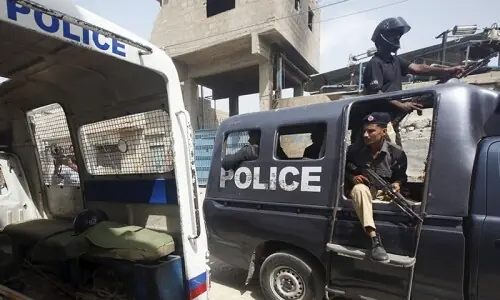
AN unlawful raid conducted within the limits of the Kundai police station, Muzaffargarh district, on the night of Nov 25 by the Sheedani police, Liaquatpur tehsil, Rahimyar Khan district, in which an ASI was shot dead during retaliation by the accused, has exposed the overall security system of Dera Ghazi Khan range and specially that of the districts of Rajanpur and Muzaffargarh.
The Rahimyar Khan police conducted a raid in the limits of Kundai police without getting a permission from the district police officer. The police party raided a house to arrest Zafar, Haseena and Bahadur in a Hudood case. When the police reached near the hideout of the absconders, they opened fire killing ASI Allah Bachaya. A case was registered against Zafar, Haseena and Bahadur on Sept 22.
The incident happened at a place near the Indus river and adjacent to Rajanpur district. The police party could not assess the jurisdiction of Kundai police and brought the body of the police officer to Kot Mithan, Rajanpur district, for the legal process and postmortem. The Kot Mithan police refused to do the legal process because of difference of jurisdiction.
The Kot Mithan police told the raiding party of Rahimyar Khan that the place where the incident took place fell in Muzaffargarh district. Then, the raiding party went to Muzaffargarh district for the postmortem after at least 12 hours of the occurrence. When the mediamen asked about the incident, the police authorities of Rajanpur and Dera Ghazi Khan districts expressed ignorance of it.
It is alarming that without following the legal process and rules, the Rahimyar Khan police raided the house to arrest the absconders. Neither the DIG of Dera Ghazi Khan, nor the district police officer, Muzaffargarh, took action against the unlawful act of the police which intruded in the jurisdiction of another district without permission.
MISTAKES in the nomenclature of schemes proposed by the District Council and Works and Services Department caused delay of over a year in payment to contractors.
According to details, the district council authorities sent draft of schemes to the district coordination officer and the Finance Department for sanction. But due to mistakes in the naming of projects, the contractors could not get the due payment of their completed works.
District planning officer Farid Khan told this correspondent that Rs7.6 million out of Rs30.50 million had been paid to the contractors. He said after settling the issue of wrong nomenclature, they would be able to pay the remaining amount to them.
Due to ineptness of the district council, local audit and Works and Services Department, payments remained pending while no authority was ready to take action against those responsible for the mistakes.
More of Jane Austen’s Prejudices
THE other day, Chacha Chaudhry, or F.E. as we used to call him up at The Pakistan Times, rang to say how worried he was at the state of my health, of which he had come to know through my last column (December 2). I hastened to assure Chacha that it was nothing some rest wouldn’t set right but even 50, my darling Chacha said he would pray for my restoration to full health. Mighty grateful I am to Chacha who can still think of me at 90-plus. I would dearly love to see him make a flawless hundred.
Another person who has given me heart these past few days is Nini, a sister and a friend who lives in Abu Dhabi. When she was here last to see me, she threatened me with dire consequences if I did not recover pretty damn quick. Now, Nini cannot under any circumstances be taken lightly. She put the fear of Moses in my heart and I did my last piece on my sick bed — just to tell her there was nothing wrong with me. Last week, I began reproducing Jane Austen’s History of England by a partial, prejudiced & ignorant historian. Today, I’ll continue with that priceless account of kings, though not of cabbages.
Austen begins this week with Richard III. This is how she goes:
RICHARD THE 3RD: The character of this Prince has been in general very severely treated by Historians, but as he was York, I am rather inclined to suppose him a very respectable Man. It has indeed been confidently asserted that he killed his two nephews and his wife, but it has also been declared that he did not kill his two nephews, which I am inclined to believe true; and if this is the case it may also be affirmed that he did not kill his wife, for if Perkin Warbeck was really the Duke of York, why might not Lambert Simnel be the widow of Richard? Whether innocent or guilty, he did not reign long in peace for Henry Tudor E. of Richmond, as great a villain as ever lived, made a great fuss about getting the Crown & having killed the King at the battle of Bosworth, he succeeded to it.
HENRY THE 7TH: This Monarch soon after his accession married the Princess of Elizabeth of York, by which alliance he plainly proved that he thought his own right inferior to hers, tho’ he pretended to the contrary. By this marriage he had two sons & two daughters, the elder of which was married to the King of Scotland and had the happiness of being grandmother to one of the first Characters in the world. But of her, I shall have occasion to speak more at large in future. The Youngest, Mary, married first the King of France & secondly the D. of Suffolk, by whom she had one daughter, afterwards the Mother of Lady Jane Grey, who tho’ inferior to her lovely Cousin of the Queen of Scots, was yet an amiable young woman and famous for reading Greek while other people were hunting. It was in the reign of Henry the 7th that Perkin Warbeck and Lambert Simnel before mentioned made their appearance, the former of whom was set in stocks, took shelter in Beanlieu Abbey, & was beheaded with the Earl of Warwick, & the latter was taken into the King’s Kitchen. His Majesty died, & was succeeded by his son Henry whose only merit was his not being quite so bad as his daughter Elizabeth.
HENRY THE 8TH: It would be an affront to my Readers were I to suppose that they were not as well acquainted with the particulars of this King’s reign as I am myself. It will therefore be saving them the task of reading again what they have read before, & myself the trouble of writing what I do not perfectly recollect, by giving only a slight sketch of the principal Events, which marked his reign. Among these may be ranked Cardinal Wolsey’s telling the father Abbott of Leicester Abbey that “He was come to lay his bones among them,” the reformation in Religion, & the King’s riding through the streets of London with Anna Bullen. It is however but Justice, & my Duty to declare that this amiable Woman was entirely innocent of the Crimes with which she was accused, of which her Beauty, her Elegance & her Sprightliness were sufficient proofs, not to mention her solemn protestations of Innocence, and the King’s Character; all of which add some confirmation, tho’ perhaps but slight ones when in comparison with those before alleged in her favour. Tho’ I do not profess giving many dates, yet as I think it proper to give some & shall of course make choice of those which it is most necessary for the Reader to know, I think it right to inform him that her letter to the King was dated on the 6th of May. The Crimes & Cruelties of this Prince, were too numerous to be mentioned & nothing can be said in his Vindication, but that is abolishing Religious Houses & leaving them to the ruinous depredations of Time has been of infinite use to the Landscape of England in general, which probably was a principal motive for his doing it, since otherwise why should a Man who was of no Religion himself be at so much trouble to abolish one which had for Ages been established in the Kingdom? His Majesty’s 5th wife was the Duke of Norfolk’s Neice who, tho’ universally acquitted of the crimes for which she was beheaded, has been by many people supposed to have led an abandoned life before her Marriage — of this however I have many doubts, since she was a relation of that noble Duke of Nortfolk who was so warm in the Queen of Scotland’s Cause, & who at last fell victim to it. The King’s last wife contrived to survive him, but with difficulty effected it. He was succeeded by his only son Edward.
EDWARD THE 6TH: As this prince was only nine years old at the time of his Father’s death, he was considered by many people as too young to govern, & the late King happening to be of the same opinion, his mother’s Brother, the Duke of Somerset, was chosen protector of the Realm during his minority. This Man was on the whole of a very amiable Character & is somewhat of a favourite with me, tho’ I would by no means pretend to affirm that he was equal to those first of Men Robert Earl of Essex, Delamerc, or Gilpin. He was beheaded, of which he might with reason have been proud, had he known that such was the death of Mary Queen of Scotland; but as it was impossible that he should be conscious of what had never happened, it does not appear that he felt particularly delighted with the manner of it. After his decease the Duke of Northumberland had the care of the King & the Kingdom, & performed his trust of both so well that the King died & the Kingdom was left to his daughter in law, the Lady Gane Grey, who had been already mentioned as reading Greek. Whether she really understood that language or whether such a Study proceeded only from an excess of Vanity for which I believe she was always rather remarkable, is uncertain. Whatever might be the cause, she preserved that same appearance of knowledge & contempt of what was generally esteemed Pleasure, during the whole of her Life, for she declared herself displeased with being appointed Queen, and while conducting to the Scaffold, wrote a Sentence in Latin & another in Greek on seeing the dead Body of her husband accidentally passing that way.
Some more next week.
All’s well that ends well
IT’S been Eid, Eid and more Eid all this past week. This is not breaking any news. It had to be Eid at the conclusion of the holy month of fasting. This year’s Ramazan was a reminder of last year’s — or of so many past years. Most of the holy month, the city administration had been promising to maintain prices of staple food items not only stable but also reasonable. This is the promise made every time the holy month comes round.
This is also the promise on which no administration has ever been able to deliver. What made a little difference, or should have made that bit of difference, is that now we have an administration very different from some previous ones by virtue of being an elected outfit. There is no doubt that the elected Nazimeen did try their very best. It is only that their very best has just not been good enough to make any difference to the set pattern of our profit-taking culture.
Come Ramazan, prices of eatables take a leap. Indeed the upward movement begins a week or so before the moon for the holy month is sighted. This is sympathetic rise. Then, as we move into the month, prices keep registering jumps by the passing day. The city government did anticipate the inevitable. And they did go about it with good intentions. No doubt about that. But if good intentions were sufficient, we should be living in paradise on our holy earth.
In this behemoth of a city almost all that we eat is imported from upcountry. Karachi and its hinterland produce none of the staple items in our daily diet. For instance, the onion we consume may have come from as far away as Sialkot. Livestock comes from even farther away. Fruit, from still farther away. Quite obviously, it would take some intelligent thinking, followed by some systematic doing if the scarcity and, as a direct consequence, rise in prices is to be tackled effectively.
What the do-gooders in the administration do is to express pious wishes and make pathetic appeals to the bazaar merchants not to raise the prices of food items. No matter how indelicate it might look or feel, the law of supply and demand is inexorable. If the demand would rise, prices would be impossible to arrest and confine to verbally made pleas in the name of the sanctity of the holy month. For the bazaar merchants profit comes first and profit comes last. As far as the hardened trader is concerned, sanctity of fasting is a pious abstraction hard to translate into stable or fair prices.
We may consider ourselves doubly fortunate in Karachi. We live under an elected administration and, by and large, we are served by the Jamaat-i-Islami. One is taking no liberty with truth when noting that the JI enjoys and commands solid support from the bazaar merchants class. Of all the scores of political parties we have milling around us, the JI is reputed to be the closest to the merchant class. If their word does not go well with the bazaar merchants, whose will?
Of the social aberrations and distortions that we live with, one of the most glaring is what we refer to as ‘corruption.’ It hits us in a hundred different and depressing shapes, forms and at different turns of daily life. No leader of the political parties, notably the ‘Islamic’ political parties, has ever had occasion to focus on these and feel that it would be good politics if social weak and dark spots were attended to as a matter of some priority.
The rash of inordinate rise in prices of the daily food items during the holy month of Ramazan is a particularly dismaying feature of life. This blight occurs every year. And every year with unfailing regularity we hear pious sermons addressed to the trading community, whose negative response we ought to take for granted. This annual ritual has another unlovely aspect to it. Towards the middle of the month and thereafter, we witness minions of law making some token arrests in the bazaars. These are usually settled in the style we are quite familiar with. So this annual sport during Ramazan is taken in the stride.
Now may be the occasion for a moment of some serious thought about trading practices and culture. We are uniquely fortunate in being the followers of our Holy Prophet (peace be upon him), who has a consummate trader. Many are the lessons he (PBUH) has for the people who are traders. One very simple maxim is that only that bargain or transaction is correct in which the seller and the buyer share the profit/benefit/joy equally. Is there no way for our MMA maulanas to persuade their followers among the bazaar merchants to show some respect to this principle and also try to follow it? It is from our Holy Prophet (PBUH).
Finally, the holy month comes to an end and we celebrate Eid with the enthusiasm that belongs to Eid alone. Next year we shall have Ramazan like always and it will have the price hike to culminate in Eid festivities.
We shall celebrate it with ‘religious’ fervour and also with worldly gusto. Gone will be the irritation with runaway prices of eatables. Eid is after all Eid and when it comes, why fret about prices: All’s well that ends well.
The sad story of a KESC consumer
KESC’s habit of sending inflated bills to its regular legitimate consumers has long been a known story. Recently one of our readers, Owais Hasin, received one of these and this is what he sent in to the Notebook.
“I was shocked when I got the bill. And my anger soon turned into frustration when I investigated the matter further.
“As I examined the meter readings I thought it was a simple enough mistake in that the meter reader had read ‘9’ instead of ‘4’ and this had added 500 units to my bill. I was foolish enough to think that reporting this error would have been the end of the matter, and that my bill would be corrected.
“I was wrong because as the following events show dealing with any utility service is like asking for trouble.
“I first went to the KESC office at the Awami Markaz since that was nearest to where I live. It turned out to be a large place where one could only pay bills, nothing else. The staff there told me to go to the KESC office near Jason Centre on Sharea Faisal. Here, the office was cramped and crowded, with lots of subscribers waiting to sort out billing complaints. Here I got the schedule of KESC’s current tariff charges, including the many surcharges.
“I realized I had two options. One was to pay the bill and wait for next month’s bill which would be adjusted for the error in the meter reading. The second option was to submit my complaint in writing and wait for a KESC inspector to come to my house and check the reading.
“The tariff goes up as consumption increases, from one slab to a higher slab. If I chose to pay now, according to the inflated bill this would be three times more than my normal rate of consumption. However, in next month’s bill the fact that I paid more because of the incorrect meter reading is not taken into account. The adjustment that is made takes into consideration only the incorrect meter reading and the consumer is not refunded the higher differential and surcharges paid as a result of that higher differential. This, obviously, is quite unfair.
“Hence I chose the second option and submitted a written request to have my meter reading checked. The meter was read the next day when I was not home. I went to ask for the corrected bill three days later, just before the late payment clause was enforced. Instead, I was told that I needed to change my meter. I was also given a long list on which were all the electrical appliances I was permitted to use.
“However, I was not given any answer regarding my request for a corrected bill. I was told that before anything like that could happen my meter would be taken away and tested, and if found defective, it would be changed. I was also told that during this waiting period when my complaint was being verified, the late payment penalty would apply.”
Mr Hasin is angry with the KESC, and understandably so, because he says he went to them to get his bill corrected, not to get a list of appliances that he could or could not use in his home. He believes that this method by the utility to cover up the incompetencies of its staff by blaming consumers is quite common.
In the end, the resident of Mohammad Ali Housing Society writes: “The KESC has ensured that consumers who pay their bills on time should also pay for their [the KESC’s] mismanagement and also for loss in revenue that kunda connections cause. Will the government please look into setting up some kind of consumer protection authority to save us from this institutionalized harassment and fleecing?”
The installation at all major airports in the country of PISCES (Personal Identification Secure Comparison and Evaluation System) has many lawyers up in arms. Through PISCES, immigration counters at the airports have cameras which automatically take photographs of people leaving and entering the country. PISCES has been installed after the events of September 11 and with the help of America’s FBI.
A few travellers, writing their tales in this and other newspapers, have expressed their anger at this infringement on their privacy. They gave several instances of being asked by FIA immigration officers (one correspondent called them “James Bonds”) to move back and position themselves in such a way so that a camera placed at the counter could take their photograph.
Now, in any normal country the imposition of such a surveillance system would at least have drawn some protest from the country’s more libertarian-minded groups, but here even rights organization are silent.
Government officials have often been quoted as saying that PISCES does not in any way compromise on an individual’s privacy. This newspaper carried a story the other day which said that a traveller’s photograph and passport details were saved in PISCES and passed “only to the Intelligence Bureau”. It also quoted the FIA’s regional director in Peshawar, Naveed Malik, as claiming that no pictures were taken, only passengers’ names and passport numbers were “jotted down”.
Then, why the constant direction to people at the FIA immigration counters — which has happened to so many people at Karachi’s airport — telling them to move back slightly and look into the camera?
Reports on a seminar held by the Pakistan Press Foundation on the media’s role to combat violence against women, former Dawn staffer says, failed to dilate upon certain basic issues raised and discussed at the seminar.
For instance, she writes, the president of the Pakistan Women Lawyers’ Association (PAWLA), Rashida Patel — the seminar’s keynote speaker — had said it was regrettable that the media had not sufficiently highlighted the changes recently made in the Family Law Courts Act of 1964, and the implications this law would have on women suffering from domestic violence. Such victims can now lodge their complaints against their husband’s excesses in the family court, where the atmosphere is amenable to women. They need not take the matter to the police and lodge a criminal suit against their husband, a step that most women avoid. Ms Patel had also drawn attention to the wide prevalence and acceptance of domestic violence. Some 70 per cent of the women who approach PAWLA for khula, divorce or compromise, complain about beatings by their husbands. When a few such women have approached the police to file an FIR against their spouses, they find that the police are reluctant, telling them this is a private matter.
Ms Patel pointed out that one reason for the social acceptance of domestic violence in our society is the misinterpretation of a particular Quranic verse. She drew attention to different interpretations of this verse. However, she said, in a male dominated, patriarchal society a particular interpretation by male scholars has been accepted and presented, disregarding other more liberal interpretations. Here she could have referred to the Islamic scholar, Dr Riffat Hasan who mentioned in a lecture, during a visit to Karachi, that the Arabic language is very rich and the explanation of the root word used in this verse runs into 12 pages.
One issue not raised in the seminar is whether specific laws on domestic violence should still be enacted, as called for earlier by several NGOs on women’s rights, or are the changes in the Family Law sufficient to protect the women from domestic violence.
Where the media’s role in discussing violence against women is concerned, the former colleagues writes that the excellent work done by BBC radio in raising this issue several times, and interviewing victims, lawyers and activists was not mentioned. There is a need to call upon Radio Pakistan to follow a similar pattern since radio still has a much wider audience, particularly in the rural areas.
Owais Tohid, a media person, who was not a designated speaker, did well to draw attention to the fact that a code of conduct on how to write about victims of violence and rape, is yet to be developed by the press here.He also said that reporting on rape tends to follow a set pattern, and therefore has little impact on the readers. We need to examine what such a story should contain to make it more effective. What is really required is for persons in the media to take up this issue more seriously as it affects a substantial section of our society.
—By Karachian
email: karachi_notebook@hotmail.com