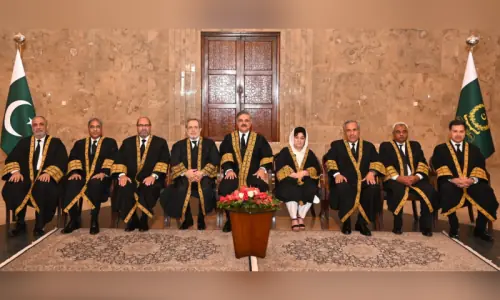
ISLAMABAD, Dec 10: Describing the government’s policy on power tariff and loadshedding as “violative of the constitution”, the Supreme Court on Tuesday ordered that supply to non-paying customers be curtailed and sale of subsidised gas to captive power plants (CPPs) of the industrial sector be stopped.
In a judgment on four identical matters, a three-judge bench led by Chief Justice Iftikhar Muhammad Chaudhry also criticised the National Electric Power Regulatory Authority (Nepra) and Oil and Gas Regulatory Authority (Ogra) for their ineffectiveness and playing in the hands of the government.
The court described the recent tariff hike as ‘exorbitant’ but did not issue an adverse order. It ruled that the government had the power to take away subsidies but it must be exercised in consonance with article 38 that commands the state to act for the welfare of its citizens.
It said provision of electricity was a substantive part of the right to life. “In the wake of loadshedding and high electricity tariffs, it is clear that the government policy in this regard is violative of article 9 of the constitution.”
The court noted that skyrocketing petrol prices despite a steady decrease in the international market was also not in consonance with article 38. “Prices of petrol, diesel, petroleum products, etc are invariably being fixed by Ogra arbitrarily without taking into consideration the rate in the international market. Therefore, in future all necessary steps shall be taken in this behalf to fix the prices strictly in accordance with the prevailing rates in the international market,” the court ordered.
It observed that throughout the proceedings spread over many months, “it was highlighted that Nepra is playing a highly inactive role in fixing power tariff… failed to perform its duties strictly in accordance with laws… It is mandated to make any independent determination of power tariff… however, it was found that the ministry of water and power was, in fact, fixing the said tariff instead of Nepra”.
The court held that it had become clear during the hearing that loadshedding was manageable, subject to dedicated and committed efforts.
The government should concentrate its efforts to minimise suffering of the people but if loadshedding is the only way out, it must be administered without having any distinction between rural and urban as well as domestic, commercial and industrial sectors, it said, calling for a formula for equitable electricity distribution.