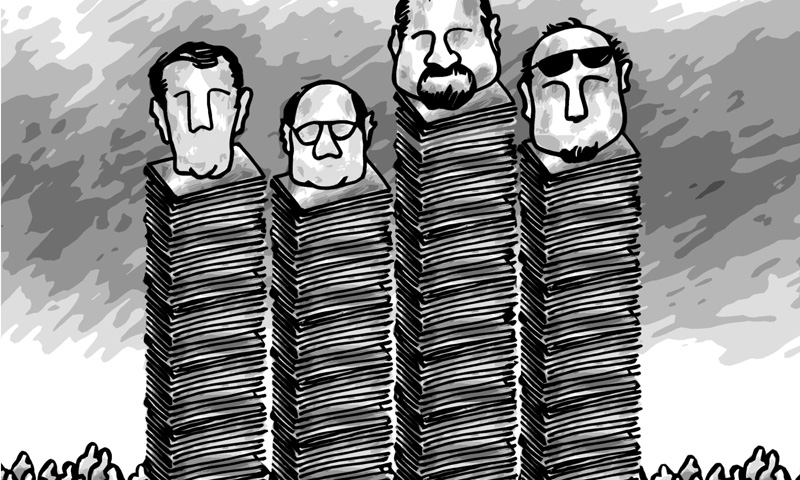
The salaries of the top corporate executive class are rising sharply in a crawling economy, with widening wage differentials and income disparities.
It is intriguing that policymakers and regulators have neither studied nor made any effort so far to address such anomalies that are seen to have triggered the Great Recession of 2007-08, and which are responsible for the current fragile recovery in the West.
When their attention was drawn to the issue, senior officials of the two regulators — Security and Exchange Commission of Pakistan (SECP) and the State Bank Pakistan (SBP) — agreed on the need to look into the matter.
SECP Chairman Tahir Mahmood said he may refer the issue to the legislative framework review committee, headed by former Supreme Court judge Justice (retd) Ajmal Mian, to suggest amendments in the law to curb this practice.
“The existing legal framework does not allow us to penetrate into this area. If need be, we will refer the matter to our legislative review committee to provide us a legal handle on how to tackle the problem,” he said.
In the US, the Dodd-Frank law requires public companies to reveal their CEO-to-ordinary staffer pay ratios. This was designed to deter excessive executive compensation.
The press reports of the proceedings of lawsuits against executives of failed giant banks in the US shattered the myth of the ‘too big to fail’ policy; the so-called best international business practices and innovations. Regulators everywhere are trying to better monitor and regulate companies’ boardroom practices to minimise financial and economic crises.
However, one theory regarding the crisis is that had the excesses been concentrated in the financial services industry only, as opposed to the broader economy, the impact of the implosion would have been largely limited to that sector only. But since giant pension and mutual funds, among other institutions, were all directly or indirectly linked with the toxic financial assets at the root of the crisis, they all ultimately had to pay the price.
In the absence of any data or relevant study, this scribe used anecdotal evidence to uncover what may prove to be the tip of the iceberg.
A pensioner, who retired in the year 2000 as a Grade-II officer in a leading bank after 25 years of service, gets a pension of Rs2,700 ($20) per month. The CEO of the same bank, according to its annual report, drew Rs98 million in a pay/perk package in 2012.
If the CEO’s compensation is assumed to be static at last year’s level, the gentleman takes home a little over Rs8 million ($75,000) a month. A dynamic CEO certainly deserves to earn better than an ordinary lower rank pensioner. The question is: how many times more? It is for the statisticians to work out the CEO-to-worker pay ratio. For this write-up, the contrast of $20 to $75,000 serves.
A reference to the annual reports of six leading listed banks confirmed the existing wage structure trend. In 2012, the CEO of Standard Chartered Bank was paid Rs144 million; UBL Rs98 million; MCB Rs83 million; Faisal Bank Rs72 million; NBP Rs50 million and HBL Rs38 million.
A leading international media company calculated the pay gap by industry, and posted this on its website. It based its findings on the ratio of the CEO’s compensation to average staffer pay for Standard & Poor 500 companies. It found the differential to be the highest in the financial sector, followed by consumer discretionary, consumer staples, industrial, energy, healthcare, communications, technology and materials.
An active market player informed Dawn of an incident at a general body meeting of a bank held earlier this year, where shareholders lost cool and severely criticised the senior executives.
“They protested on learning that the total yearly profit declared by the bank was less than the annual compensation paid to the CEO,” he informed.
“I do not blame the shareholders. How can investors let CEOs rob their companies in broad day light,” an analyst asked when reached for comment on the shareholders’ conduct.
A senior State Bank official, who wished not be named, assured this writer that he would direct the inspection team to gather the information and pursue the matter on the basis of facts gathered. “We will make suitable changes in banking regulations, if necessary, to address the issue of abnormal wage differentials in the sector,” he promised.
A formal, written SBP position on the issue was still awaited till the writing of this article. However, a senior official privately admitted that the banking regulator has not assessed the market from a wage differential perspective.
“We have laws in place for detailed disclosures. If we wish, we can gauge the trend. But we have so far not studied the issue from the angle of wage multiple ratios,” he said.
“Under the current set of laws, the board of directors decides pay packages of senior staff. There are no SBP guidelines and no cap on the value of packages,” he told Dawn.
“But the SBP is assessing the ratio of regular-to-contractual staff at private banks, and it might introduce regulations to deter banks from subletting banking activities beyond a level,” he said.
Several banks were approached for their input, but declined to share comments or information on the issue.
“The excessive salaries of executives at banks are totally unjustified. The State Bank admitted in its last annual report that the commercial banks are also not financing business activities. They are also not doing enough to broaden the deposit base, nor are they lending to the private sector.”
“They are risk averse and go for the easy option of investing in government securities. They charge prohibitively high interest from creditors and give negative returns [lower than the inflation rate] to depositors,” he said.
“Pakistan may be an exception, where the total lending by the banking sector is less than 50 per cent of the value of its total deposits. I see no justification for astonishingly high pay packages for bank executives,” commented Muhammad Sohail, head of Topline Securities.