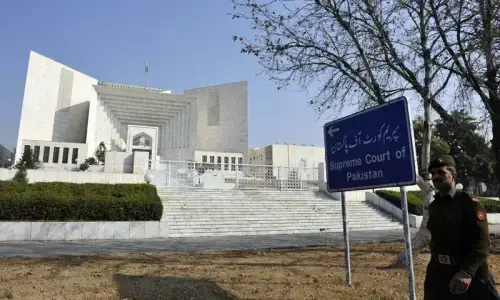
ISLAMABAD: The sharp increase in electricity tariff became a subject of discussion in suo motu proceedings on loadshedding in the Supreme Court on Tuesday.
The court indicated that it would issue an injunctive order if it transpired that the notification of raising tariff for domestic consumers lacked statutory backing.
The injunctive order could mean staying or reversing the government’s decision to raise tariff, said a legal expert.
A three-judge bench headed by Chief Justice Iftikhar Muhammad Chaudhry expressed its desire to review whether the government had the authority to notify the increase in tariff. The court will take up the matter on Wednesday.
Under Section 31 (4) of the National Electric Power Regulatory Authority Act 1997, the government could issue the notification only after a tariff determination by Nepra.
On the court’s instructions, the government through Additional Attorney General Atiq Shah furnished two notifications — one issued on August 5 for increasing tariff for commercial and industrial consumers and the other for domestic consumers issued on Monday.
The court was of the opinion that the second notification had been issued without tariff re-determination by Nepra and regretted that the increase should not have been made in such a manner.
The Managing Director of the Pakistan Electric Power Company, Zargham Eshaq Khan, explained that the Sept 30 notification was a second phase of the already delayed tariff determination by Nepra in April, although it should have been done in September last year. The increase was still less than what Nepra had suggested, he informed the court.
The court regretted that the government was shifting the burden of its inefficiency on ordinary consumers, especially when it still had to recover a staggering amount of Rs441 billion from different consumers, including public and private. “Why don’t you start collecting arrears from tomorrow, instead of passing the burden to the consumers,” the chief justice said, adding that the court was ready to hand down a judicial order in this regard.
The court regretted that international prices of petroleum products were going down, but the government was increasing their prices and passing them on to the consumers.
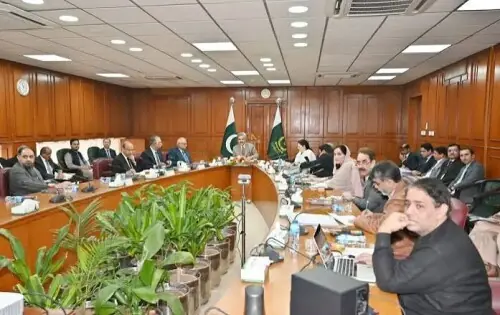
Nepra Chairman Khawaja Naeem said the revenue requirement for generating electricity this year was Rs1.25 trillion, but devaluation of the rupee coupled with inflation, Rs40 billion line losses and pilferage, Rs84bn tariff differential, Rs84bn unrecoverable tariff and Rs45bn mark-up on delayed payments to independent power producers to clear circular debt would reduce the cash flow by Rs437 billion.
“This industry runs on cash flow and shortage of this important commodity give rise to loadshedding and price increase,” he explained.
Mr Naeem presented a list of arrears to be recovered by Wapda from the federal government (Rs3.49bn), Azad Kashmir (Rs24bn), provincial governments (Rs74bn), Fata (Rs20bn), agriculture sector (Rs1.2bn) and the private sector, including domestic consumers, (Rs259bn). Besides, Rs24bn was stuck up because of litigation in different courts, he said, adding that tariff could not be revised in Khyber Pakhtunkhwa for the past three to four years because of a stay order. “Is this the writ of the government when you cannot even recover your arrears,” the court regretted. Under the law, the life of a stay order was only six months.
Mr Naeem said the cost of power production could be reduced by 40 per cent straightaway if the allocation of gas was done judiciously, adding that the cut in prices would reduce the chances of pilferage. He said one of the reasons for circular debt was lack of collection of recoverables. He informed the court that the government was planning to introduce a remote monitoring system which could not be tampered with.
The court also expressed disappointment over the government’s recent energy policy.
Justice Jawwad S. Khawaja, a member of the bench, said the policy might appear to be good on paper, but the moment it was implemented, the apex court would be flooded with petitions seeking resolution of disputes between the centre and the provinces. “My guess is that your policy is not practicable,” he said.