

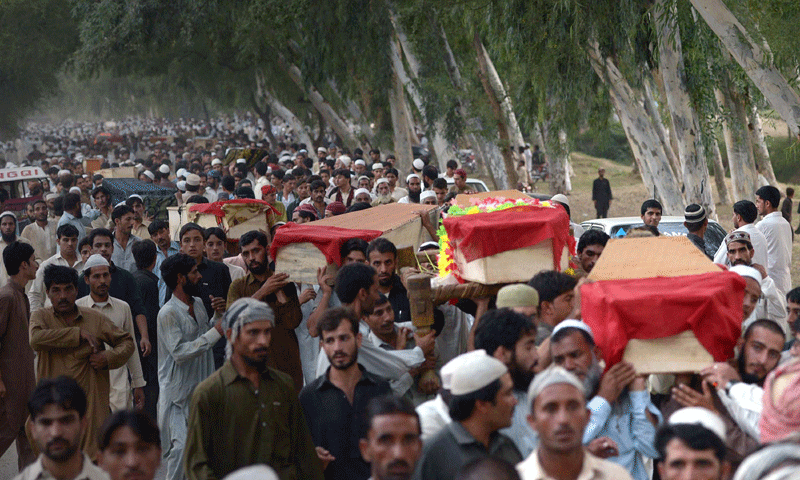
PESHAWAR: Three weeks after the country's main political parties backed the idea of talks with the Pakistani Taliban militants, the plan looks in deep trouble, hit hard by a wave of bloody attacks.
In the space of a week, the northwestern city of Peshawar has suffered three major bombings, killing over 140 people — the vast majority of them civilians.
Hurried denials issued by the main umbrella Tehrik-i-Taliban Pakistan (TTP) group hint at divisions within the organisation and the rise of splinter factions keen to pursue their own agenda rather than follow the central leadership.
Peshawar is no stranger to bloodshed. It lies on the edge of Pakistan's tribal areas and has frequently been hit by bombings and shootings.
However, the brutality of the recent attacks — a suicide bombing on a church service, a bomb on a bus carrying government staff home after work and the latest, a powerful car bomb targeting a busy market on Sunday — has shocked locals.
“The government should publicly hang the killers of innocent people,” said Gul Mohammad, a Peshawar junk shop owner.
“I have a very simple question: why is the government so reluctant to launch an army operation against the Taliban?”
The TTP insists it targets only legitimate military assets in its fight against the Pakistani state and says the recent attacks are a conspiracy to scotch the proposed talks.
But a Taliban commander in the country's northwest admitted the prospect of negotiations had led to division within the organisation, which has pledged allegiance to one-eyed Afghan Taliban chief Mullah Omar as well as to Al Qaeda.
“There are even more differences on several other issues and you know Asmatullah Muawiya has also been sacked by our main leadership,” the commander declared.
Muawiya was the militants' commander in Punjab province, who was cast out by the TTP senior leadership for welcoming the government offer of peace talks.
Hardline groups closer to Al Qaeda, more sectarian and anti-West in outlook than the mainstream TTP, have rejected talks outright.
Factions from Mohmand and Khyber tribal areas and Darra Adam Khel district — all neighbouring Peshawar — are said to be staunchly opposed to the peace talks, and the authorities are probing whether they were behind the recent attacks.
Another militant source said overtures made to certain groups had triggered the Peshawar attacks as others sought to make their influence felt.
“The latest bout of attacks has come because the security establishment is selective in talking to the militants. It wants to talk to some elements while crushing the others,” the source related.
Pressure through violence?
Security officials remain sceptical about the TTP denials, saying the sophisticated nature of the three attacks suggested an experienced, well-equipped group was behind them.
“Though TTP has publicly disowned the latest series of bombings, we are very much convinced that TTP as an organisation is involved,” a senior security official in Peshawar said.
“They want to build pressure on both provincial and central governments before the peace talks.”
A pair of suicide bombers smuggled into a church, a remote-controlled bomb planted on a government staff bus and a 200-kilo car bomb exploding in a busy market in the heart of Peshawar; all this could not be the work of a fledgling group, the official declared.
Rahimullah Yusufzai, a senior analyst and expert on militancy in Pakistan said that while the perpetrators of the past week's atrocities were unclear, the outcome was not.
“If the purpose of these attacks was creating an obstruction in the proposed peace talks then these attacks have achieved that goal,” he said.
“Government is under extreme public pressure due to these recent attacks and losing public support on the proposed peace talks.”
Even with public backing, the two sides' positions look difficult, if not impossible, to reconcile.
On one side the TTP have laid down exacting conditions for taking part in talks — the withdrawal of troops from the tribal areas, the release of their prisoners and a government ceasefire.
On the other, Prime Minister Nawaz Sharif, who was in New York for the United Nations (UN) General Assembly as the attacks unfolded, told the Wall Street Journal that the TTP must recognise the Pakistani constitution and lay down their weapons.































