



 0
0

Can Islamabad become a city of the future?
 IMAGINE an undeveloped locality in the high-security federal capital being transformed into a bustling IT location with special economic or industrial zones in the vicinity creating tens of thousands of new jobs, high rises dotting the landscape, and retailers and hotel property developers queuing up to get a piece of the Islamabad action a la Dubai.
We are, it seems, trying to translate this dream into a possibility. It was reported last week that a task force has been constituted to plan and develop Pakistan’s first Knowledge City in Islamabad, a project which was first announced in June last year by the ministry of education.
The task force, headed by the minister for education, comprises leading officials from HEC, CDA, the ministries of information technology and investment, the Planning Commission, the Federal Directorate of Education and the Islamabad Chamber of Commerce and Industry.
What is a knowledge city?
Unlike traditional knowledge cities like Oxford and Cambridge, the modern concept of knowledge cities has everything to do with economic development. In fact, knowledge city is an increasingly popular urban development strategy focusing on learning, education, entrepreneurship and innovation as the engines for growth.
Many national and regional governments around the world are building the infrastructure to support such innovation zones where young, high-achieving knowledge workers can gather and share ideas, facilitating the development of the next generation of products and services.
Among the developed countries which have designated knowledge city programmes are the US, the UK, Spain, Netherlands, Denmark, Finland, Canada, Australia, New Zealand, Norway, Ireland, Germany, France, Sweden, Denmark, Holland and Japan.
Among the developing countries which have specific knowledge city programmes include India, China, Colombia, Mexico, Panama, Brazil, South Korea, Kuwait, Saudi Arabia, Dubai and Singapore.
Designated knowledge cities are in a league of their own. There are special international symposiums and forums on knowledge cities. For example, the 3rd International Symposium on Knowledge Cities was held in Istanbul in November 2008 and the 2nd Knowledge Cities Summit will be held in Shenzen, China in November 2009.
In 2007, a new international award known as the Most Admired Knowledge City in the World was established in which ten cities are ranked which are successfully engaging in formal and systematic development processes under the flag of knowledge cities. Singapore, Barcelona and Ottawa grabbed the top three positions in the first award announced in 2007. In 2008, Singapore again took top position followed by Bangalore in second place with Manchester and Montreal tied in third position.
Identifying a knowledge city location in Islamabad will not by itself guarantee investment and local development. Besides, there is more to building a knowledge city than the mere establishment of IT parks, universities, biotechnology centres, R&D centres and high-tech science parks. The most admired knowledge cities in the world usually have some or most of the following features.
It has instruments to make knowledge and new communication technologies accessible to all citizens. It has a network of public libraries that is compatible with the best standards in the world. It engages in efforts to nurture its cultural base and develop other social capitals.
It nurtures local enterprises, small and big, and builds up a core of world-class companies with core competencies which can compete in the global economy. It has a knowledge-based plan to develop the city into a vibrant and robust global hub of knowledge-driven industries in manufacturing and traded services with emphasis on technology, innovation and capabilities.
It is a regional hub attracting foreign multinational corporations and local enterprises to use it as a production base for high value added products and providing manufacturing-related services for their subsidiaries in the region.
The city is integrated into the global economy to leverage on international talent, knowledge and technology, by providing an entrepreneurial environment that embraces innovation to generate new business and growth and by grooming world-class local and foreign companies in niche areas.
Can we build and nurture this knowledge city environment in Islamabad? What are the chances of success given our earlier failure to produce anything close to a Bangalore by our twin strategy of promoting IT and tertiary education in the first half of the 2000s?
Progress in building a knowledge city can only be achieved by strong partnerships involving the government, academia and industry that will enable an innovation cluster to develop and sustain the location, besides proactive initiatives to build infrastructure that will make both living and working in the location a fruitful experience.
Hopefully, this will not be another missed opportunity like our previous IT venture.
The grand old man of historiography
 ‘It is not the neutrals or the lukewarm who make history,’ said Adolf Hitler. Well, maybe, and Hitler’s own career is a case in point. But making history may not result in so much bloodshed either: some ‘more’ benign souls, too, can make history. Writing history is no less daunting. It takes a lot of courage, too. And, what to say of a person who makes history while he writes it?
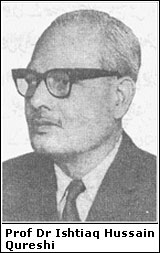
Prof Dr Ishtiaq Hussain Qureshi was one such fellow. He is one of the big names in historiography and he made history, too. His biographical sketch reads like a plot straight out of a traditional story-book where a boy from a small town who once could not afford a decent education later travels the world and becomes a minister and a famous man. Dr Qureshi wrote history, made history and lived history.
Ishtiaq Hussain Qureshi was born on November 20, 1903, in Patyali, a small town near Allahabad, UP. Having passed his matric exams, he wanted to join Aligarh’s Mohammadan Anglo-Oriental College but it was simply beyond his means. The only way he could carry on his education was by joining a government-approved school as a teacher and pursuing his studies as an external candidate. He did just that. However, political turmoil took the country by storm in 1920 when he had passed his intermediate exams and was preparing to earn a BA.
Dr Sahib’s family had suffered much at the hands of the British. His grandfather’s brother was hanged for taking part in the 1857’s war of independence and his grandfather was grilled about his suspected cooperation with his brother. Dr Sahib abhorred the colonialists and, therefore, joined the Non Co-operation Movement and the Khilafat Movement as soon as they were launched. During the movement he helped establish Khilafat committees in the rural areas and gained invaluable experience that shaped his personality and shattered his belief in the notion of Hindu-Muslim unity.
After the movement subsided, he joinied ‘Al-amaan’, a newspaper published from Delhi, and resumed his studies at Delhi’s St Stephen’s College, obtaining a BA and two MA’s --- in history and Persian. Soon he joined his alma mater as a lecturer in history, and a little later proceeded to Cambridge to get a PhD in history. At Cambridge, Prof Dr Whitehead, the renowned scholar known for his strictness, was made Qureshi Sahib’s research supervisor. Qureshi Sahib presented his doctoral dissertation on ‘The administration of the sultanate of Delhi’ and came out with flying colours. On his return to the country, Dr Qureshi was made reader at Delhi University in 1940 and later on was promoted to the posts of professor and dean. During his stay at Cambridge, he had struck an acquaintance with a group of students who earnestly supported Choudhry Rahmat Ali’s idea of Pakistan that he had launched with the publication of his pamphlet ‘Now or Never’ in 1933, thereby coining the word Pakistan, an acronym made up with the initials of different provinces. When a delegation of Cambridge old boys along with Dr Qureshi met the Quaid-i-Azam to discuss political issues, they fully supported the idea of Pakistan. Later, the Muslim League got Dr Qureshi elected a member of the legislative assembly from Bengal.
Dr Sahib’s colleagues and students had a high regard for him but after the creation of Pakistan extremist Hindus laid siege to his residence in Delhi and he could barely move from there and had to take refuge in the Pakistani embassy, leaving his invaluable collection of books behind which was ransacked by the mob. In Pakistan, he first served at the legislative assembly and also worked on the Objectives Resolution Committee; he then joined Punjab University as Professor. In 1948, all of a sudden he was made deputy minister and later minister of state in the Centre and for about five years supervised different ministries including that of education. As minister of education, he was instrumental in the establishment of Liaqat Memorial Library that today houses about 100,000 volumes.
The notable aspect of his personality is that during his entire political career he never quit his scholarly pursuits and kept on researching and writing. Joining Columbia University as a visiting professor in 1955 provided him an opportunity to remain engaged in an array of intellectual and scholarly activities. Here he stayed till 1960 and authored his signature work ‘The Muslim community of the indo-Pakistan sub-continent’, a milestone in the historiography of the sub-continent. In 1960, he was invited to head the then newly-established ‘Central institute of Islamic research’.
 He accepted the offer but in 1961 was made Karachi University’s Vice Chancellor. It was a challenge as the nascent varsity was grappling with a whole lot of problems. Dr Sahib’s vision, experience and relentless work transformed it into one of the country’s best universities. He got new blocks of buildings constructed, new departments and a new faculty opened and sent many university teachers abroad for further research and training. He got the varsity’s central library constructed that today houses over 200,000 volumes.
During his tenure as VC, he penned two very important books, ‘The struggle for Pakistan’ and ‘The administration of Mughal empire’. After his retirement as VC in 1971, Dr Sahib wrote three valuable books, namely ‘Education in Pakistan’, ‘Akber: the founder of Mughal empire’ and ‘Ulema in politics’.
Dr Sahib held many other posts too, such as president, Pakistan Historical Society, and Member, National Commission for Archives and Historical Records. He attended and addressed a large number of national and international seminars. His countless papers on Pakistan’s history and its culture serve as reference for scholars. He did still some more scholarly work during the last phase of his life when in 1979 he was asked to head the then newly-established ‘Muqtadira Qaumi Zaban’, or the National Language Authority’. Here he planned and took the first steps towards making Urdu a language that could replace English as a medium of instruction and as official language of the country, a cause for which he had been fighting throughout his life. Though Urdu has been prepared to assume the mantle of the country’s official language, through the efforts of Muqtadira and other similar institutions of the country, a lack political will by successive governments has been hindering its progress.
Dr Qureshi died on January 22, 1981, in Islamabad and was buried in Karachi’s Gulshan-i-Iqbal graveyard.
Though he himself has now become history, Dr Ishtiaq Hussain Qureshi will live on as a historian and a research scholar.
drraufparekh@yahoo.com



























