Maintaining sanity
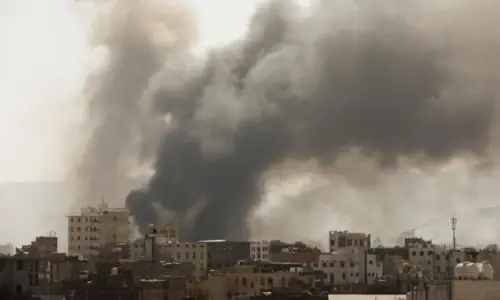
OVER the weekend, the subcontinent had harrowing moments. Indian air force planes violated Pakistan’s airspace. PAF planes went up to challenge them and the intruders went back. With British Prime Minister Gordon Brown present, President Asif Ali Zardari told a press conference on Sunday that the violation by the Indian planes was “technical”. A similar version has been given by the PAF spokesman — a version that sections of the American media did not accept. How come, they said, that two violations should occur at the same time 100 miles from each other? Whether the intrusion was inadvertent or whether hawkish elements in the Indian defence establishment wanted to test Pakistan’s nerve is immaterial; what did indeed take place was the breach of a country’s sovereignty — something that India’s own chief justice does not approve of. Unaware of what was going to happen later in the night, Chief Justice K.G. Balakrishnan told an international conference on human rights in New Delhi on Saturday that there were better and judicial ways of combating terrorism than “arbitrarily breaching another nation’s sovereignty”. Without mentioning Pakistan he said that, in the absence of bilateral extradition treaties, there was “no clear basis for international cooperation” against terrorist attacks. Justice Balakrishnan’s words of wisdom and sanity came in the wake of a statement by Hindu extremist leader Sudershan, who asked India to prepare for a nuclear war. Let us thank heavens that in the midst of such fanatics on both sides and the war hysteria being created by the Indian media and a section of their counterparts here, there are still men who have the courage to censure chauvinism and uphold the cardinal principles which are the basis of human civilisation.
Another Indo-Pakistan war will destabilise South Asia. Which is exactly what the terrorists opposed to the now suspended normalisation process want. The British prime minister asserted what the media — and not just in India — tends to forget: Pakistan was one of the worst victims of terrorism having suffered 50 suicide attacks last year. Mr Brown’s was the second high-profile visit by a western diplomat in recent days, and he echoed the sentiments Condoleezza Rice had expressed during her visit to Islamabad and New Delhi. Both believed that the Mumbai terrorists had links with elements in this country, but both also made it clear that Pakistan had pledged to continue to combat terrorism.
Islamabad has committed 100,000 troops to the operation against the Taliban, and it would be a pity if the hawks in India were allowed to create a situation that would distract Islamabad from its anti-terrorist operations in Fata. Equally, Pakistan would be in a much better position to combat terrorism if some ‘religious’ parties gave up their reticence vis-à-vis acts of terror by the Taliban.
Stock market blues
WITH the removal of the 110-day-old floor on the KSE-100 index failing to cheer investors, the stock market is bound to continue sliding for another few days before shares stabilise at their lowest possible prices. As was anticipated, the KSE-100 index lost 370 points after resumption of normal market operations. There were no buyers despite sell orders at the shares’ lower locks. The Securities and Exchange Commission of Pakistan, the capital markets regulator, placed the floor on the index on Aug 28 at 9,144 points following heavy losses as the “continuous sharp decline in share prices could have implications for the wider financial system”. The index had already slumped nearly 43 per cent from a record high of 15,739 in April as the capital flew from the country amidst fears of a possible sovereign default owing to deteriorating macroeconomic fundamentals.
The SECP action blocked investors and participants of the Continuous Funding System-MK II from exiting the market. J.P. Morgan suspended its operations and MSCI decided to remove Pakistan from its Emerging Markets Index because the floor on the index had effectively prevented trading. Since the removal of the floor without settling the CFS-MK II participants’ positions could result in defaults and pose a risk to the exchanges and the National Clearing Company of Pakistan Ltd, the curbs on normal trading were allowed to stay for too long a period. The government promised a liquidity injection of Rs20bn to support brokers. But it was kept from doing so because of the objections of the International Monetary Fund which had correctly opposed the plan saying that public money should not be used to bail out brokers. So when the SECP issued a directive to lift the floor, some brokers moved the court seeking cancellation of contracts and transactions executed under CFS-MK II.
More legal battles are likely to ensue between different market players in the days to come. The market may stabilise over the next few days, but it is unlikely to recover soon unless investment starts pouring in. The situation may worsen if foreign portfolio investors pull out. The share prices could decline by up to 50 per cent from the floor level and the rupee weakened if that happens. This situation needs urgent action by the authorities. At the same time it is unfair of brokers seeking a bailout from the government, as they did not want to pay tax on their capital gains when the market was rising.
Toxic merchandise
IF agriculture is the backbone of an economy, fertilisers, pesticides and herbicides are meant to keep this backbone hale and hearty. But a lot needs to happen right for these inputs to achieve what they are intended to. From their production, import and distribution to their sale and consumption, manufacturers, traders and farmers need to match perfect supply with perfect timing. With demands for this perfection being very high, the unscrupulous and unethical types sneak in for personal gains at every stage of the process. They can produce imitations of the best-performing chemicals because copyright laws are weak and their implementation even weaker; they can peddle their ware because the government hardly has in place a vigilance and inspection system. They are able to force farmers into buying these products because they are also the sole providers of agricultural credit to buyers and the users of their chemicals. The effects of their merchandise are horrendous: they end up poisoning the soil without improving its productivity besides leaving big holes in the farmers’ pockets and asking for urgent government action.
News reports suggest the Punjab government might have already realised the need to take urgent and drastic measures to remedy the situation. For one, the police have registered scores of cases and arrested hundreds of people for selling fake agricultural inputs; plans are afoot to set up two chemical-testing laboratories — one each in Sahiwal and Dera Ghazi Khan — and the menace of substandard, spurious farm chemicals should completely end by mid-January if Punjab Chief Minister Shahbaz Sharif’s tough-sounding warnings are anything to go by. To be effective, however, these pious intentions need to be backed by concrete measures. The official inspection system needs overhauling to allow farmers a say in it; laws need to change to ensure stricter punishment for the offenders; laboratories need to be set up in every division in the province to ensure on-the-spot checking and verification; and farmers need to get greater access to formal and subsidised bank loans so that moneylenders cannot exploit them. Moving from rhetoric to reality, after all, is an action-packed process.
OTHER VOICES – Sindhi Press
Excessive fares
Ibrat
ON the occasion of Eidul Azha, transporters charged heavy fares from the commuters. Transporters took undue benefit of the situation that saw a large number of families going to celebrate Eid in their native homes. People faced hardship and financial losses. There were also reports of clashes between commuters and transporters.
The administration was missing from the scene and there was no one to implement the law and ensure that the government-fixed fare was adhered to. Rather transporters were given a free hand to fleece the public.
Thrice there was a substantial fall in oil prices, but transport fares were not reduced. Though the price of petrol is Rs60 per litre transport fares remained those of the time when prices were above Rs80 per litre. LPG and diesel prices also declined but transporters continued to charge excessive fares.
There are also reports of the artificial shortage of oil in some towns, created by fuel station owners who chose to close their outlets. They were publicly challenging the writ of the government and were not selling oil at government-fixed prices. It is strange that the owners charge the new rates after they are announced if rates increase, though they have oil stocks purchased at the old low prices. Now that the government has reduced oil prices to give relief to the people, these profiteers are not ready to pass on this relief to the public.
It appears that no one was ready to heed government orders. ...People were left at the mercy of transporters, fuel station owners and shopkeepers as if people were not citizens of this country.
Transporters have become a mafia. If the government is issuing some warning or developing pressure they threaten to go on strike. All this has happened because the government has withdrawn itself from some important sectors. The government had a transport organisation which was providing jobs to the people and maintaining checks and balances to ensure relief to the common man. Unfortunately, this organisation was shut and privatised. Economic power has slipped from the government’s control....
Today when a wave of privatisation is hitting the country, and the privatisation of Pakistan State Oil ... is on the agenda, the government should consider that in the present situation there is market terrorism. Individuals economically become so powerful that they threaten state authority on the basis of their economic power…. The question is would the government like to take cognisance of this publicly committed crime? — (Dec 12)
Selected and translated by Sohail Sangi.
Flawed notions of honour
NICOLAS Chauvin, a soldier in Napoleon’s army, may be dead and gone, but the chauvinist attitude named after him has not only survived, it has also been adopted as a popular pastime to be indulged in by politicians, military men, TV anchors, op-ed writers and religious obscurantists.
Not to be left behind, even supposedly rational scientists like Dr Samar Mubarakmand have joined the jingoistic ranks by calling on the government to show no flexibility in the face of India’s allegations, saying that after all it would take Pakistan only 10 minutes to fire the nuclear missiles.
It may be true that we now have the capability to fire our nuclear missiles in just 10 minutes. Our highest key performance indicator (KPI) for excellence seems to be the speed with which we can annihilate our enemy. Can we also rescue our citizens from a burning building in 10 minutes? Can we come to the rescue of a woman being raped within 10 minutes? Can we recover a child who has fallen into a manhole in 10 minutes? Can we take a sick person to hospital and give him treatment in 10 minutes? Can we stop the burying alive of helpless women in 10 minutes, or can we even register an FIR in 10 minutes? If we can do none of these, and can only annihilate our perceived enemies in 10 minutes, we have a perverted understanding of honour and need to revisit and revise our KPIs.
It is unsafe to have nuclear neighbours like India and Pakistan whose politicians, generals and bureaucrats have an obscurantist mindset, no better than that of feudal villagers who keep family enmities alive because of a conflict over a piece of land or a murder committed many generations ago. We have not been able to grow out of this ancient tribal concept of honour, ego, neechi naak and oonchi pagri. Our honour sleeps peacefully when the chief justice’s daughter’s marks are increased illegally. Our honour is not ruffled when we appoint jirga operators, vani dealers and supporters of women being buried alive as federal ministers. The examples on the other side of the border are no less in intensity or number.
The recent attacks in Mumbai were a great opportunity for Pakistan and India to come together. What if President Zardari had taken off for New Delhi instead of going all the way to Turkey to join neighbour Hamid Karzai for dinner? Why was the Joint Anti Terror Mechanism (JATM), already in place between the two countries, not immediately made to work? Here was a great opportunity for both countries to build mutual trust and clean up their respective backyards.
Pakistan has no business to allow any wanted Indian national to take refuge on its soil. Such persons need to be put on the first available flight to India. How come those imprisoned in India and later exchanged as a result of an aircraft hijacking demand were allowed to roam around as free people in Pakistan? Would Pakistan like India to protect someone who was a prisoner in a Pakistani jail? Such persons should either be sent back or made to stand trial in their own country. If Pakistan were to act in an open manner on these issues, it would also have strong reason to ask India to stop its covert support to militants in Pakistan.
It is time for Pakistan to act like a responsible state and take steps to dismantle the infrastructure operated by non-state militants on its soil. The world looks at all Pakistanis with suspicion, as if no Pakistani can consume his breakfast unless he has fired a few rounds from a rocket launcher. But this perception is not altogether unfounded. The fact is that there is hardly a day which does not see terrorist attacks killing dozens of innocent people in one or the other town or city of Pakistan. Pakistanis feel unsafe in their own country, and are least interested in seeing their neighbours annihilated.
Clearly the same would be the feelings of an average Indian. 60 years of militarisation has made the people of India and Pakistan more unsafe and more vulnerable. If one’s child is killed, it does not matter if the bullet has come from another country or from the barrel of the local terrorist. We have paid a heavy price for our capacity-building to kill others and doing little to protect our own citizens. The oxymoronic ‘arms for peace’ pursuit has made people of both countries poorer in every sense of the term.
From ancient Greece to the present day, notions of honour have had a critical impact on the causes and conduct of wars. It is dangerous for modern nations to cling on to feudal and fake concepts of honour. Ever so often, it pushes us to take refuge in chauvinistic nationalism. We need to revisit and give up this mediaeval sense of honour, even if it calls for serious psychiatric interventions for our leaders. Our honour lies in the well-being of our citizens and in building peace and security for them as well as for our neighbours. Most of all, our honour lies in being honourable people — those who do not tolerate corrupt rulers, PCO judges and militancy in all its forms.
naeemsadiq@gmail.com
When will France rest?
THERE are many things Georges Cellerier likes to do on a Sunday. He likes to potter in his garden and blow away the cobwebs with a little light exercise. He especially likes to spend hours over long lunches with his wife, daughter and granddaughter and “empty his head” of annoyances with a good bottle of red.
There is, however, one thing Cellerier does not like to do on a Sunday: work. The owner of a smart menswear shop in Lyon’s bustling city centre, he is a staunch believer in the worker’s sacred right to a day of rest — a day that for him encapsulates France’s “precious” quality of life. And he is furious with Nicolas Sarkozy for wanting to take it away.
“My Sunday is special to me, one of life’s true pleasures. Everyone needs time to rest and put themselves on standby,” he said from behind his counter. “We do not want to regress.”
As part of his fight to liberalise the economy, President Sarkozy has proposed that all shops in Paris, Marseille, Lyon and Lille, as well as those in other tourist zones, should be allowed to open on Sundays. Of all his labour reforms this project has proved arguably the most unpopular. Entrenched in law as a day off since 1906, “le dimanche” remains a hallowed institution.
“We will not stand for our leisure civilisation being replaced by supermarket civilisation,” declared 120 opposition MPs in Liberation. “What kind of private life or family life can there be without a weekly, collective day of rest, especially at a time when our society is already suffering from a loosening of social ties?”
In confronting one of France’s most cherished traditions, Sarkozy has united figures from both ends of the political spectrum in opposition to his plans. Socialist politicians and union leaders have teamed up with small businesses, church leaders and even members of the president’s own UMP to denounce what they see as a slide towards a liberal, consumerist society that favours big business at the expense of the worker.
Fears of worker exploitation and job losses are the chief concern of critics on the left, who are mistrustful of the government’s assurances that the law will be optional. “Even if we start off on the basis of voluntarism, we must not delude ourselves,” said Gerard Collomb, the socialist mayor of Lyon. “It will be something that becomes the rule.”Staff at big department stores and chains, which are expected to take full advantage of the law change, are among the most worried. “It’s a funny definition of ‘optional’,” said Laura, an assistant at a jewellery counter at Lyon’s branch of Printemps. “They’ve got us exactly where they want us.”
Independent shopkeepers are also apprehensive. Most of them, including Cellerier, could not afford to pay the double salaries and extra running costs.
Others highlight the threat to domestic life. “Sunday is the family day and we have to protect the family — what’s left of it,” said Marie-Colette Stalder, a grandmother of four. “Otherwise why bother having children?”
But the reform has found support in some quarters. Some agree with Sarkozy that, in the middle of a financial slump, any economic boost should be welcomed. Muslim employees hope that working on a Sunday may mean they can take Friday off. Others, particularly young people, are simply keen on having another day to go shopping.
But most remain opposed, repelled by the idea of France’s day of church bells and quiet contemplation being reduced to another opportunity to spend money. “We don’t necessarily want to live like the Americans,” said Cellerier. “My daughter went to New York this year. She said she loved it but she wouldn’t want to live there. It never stops. Awful.”
— The Guardian, London