0
0

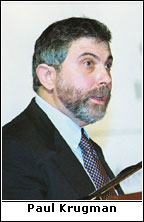 STOCKHOLM, Oct 13: US economist Paul Krugman, a prolific columnist and fierce critic of Washington’s economic policies, won the Nobel Economics Prize on Monday.
Mr Krugman, 55, a Princeton University professor, had formulated a new trade analysis theory which determined the effects of free trade and globalisation, as well as the driving forces behind worldwide urbanisation, the citation by the Nobel jury said.
Speaking to Swedish public television, Mr Krugman said the award “obviously will seriously warp my next few days. I hope that two weeks from now, I’m back to being pretty much the same person I was before. I’m a great believer in continuing to do work. I hope it doesn’t change things too much.”
By awarding a critic of unfettered free-market policies who has focused heavily on globalisation and the developing world, the jury seems to have decided to confront major issues amid the ongoing global financial crisis.
In his New York Times columns, Mr Krugman has stood out as a harsh critic of the Bush administration’s free-market policies.
He also adamantly opposed the initial wording of US Treasury Secretary Henry Paulson’s $700 billion financial sector bailout plan — which he described as “financial Russian roulette”, although he conceded that a rescue was needed.
On Sunday, he wrote admiringly of the British economic rescue scheme. “This combination of clarity and decisiveness hasn’t been matched by any other western government, least of all our own.”
After winning the prize, he told the TT news agency the crisis “has me extremely terrified”.
His theory helps to explain that globalisation tends towards concentration, both in terms of what a manufacturing base makes, and where it is located.—AFP